Short answer
Neon nearly matches Carbon on independent benchmarks in under half the time, but it's only cheaper per token once Carbon's standard pricing starts on Dec 1. No local weights.
- API price
- $3 input · $0.15 cached · $15 output per 1M tokens
- Batch/Flex
- $1.50 / $7.50
- Context
- 1,048,576 tokens (shared), 65,536 output per sync call
- Available
- API (paid), Gemini app and Antigravity for AI Pro/Ultra, Google Cloud enterprise
- Checked
- Nov 19, 2026
Last reviewed: November 19, 2026
Gemini 4 Neon is the mid-tier Gemini 4 model Google released on November 18, 2026. It sits between the fast Hydrogen and the flagship Carbon, costs $3 per million input tokens ($0.15 cached) and $15 per million output tokens on the paid Gemini API, and has a 1-million-token context window (Google). Consumers get it in the Gemini app and Google Antigravity with a Google AI Pro or Ultra plan.
Checked on November 19, 2026, 08:30 UTC. One caveat changes most buying decisions: until November 30, Carbon’s introductory price ($2/$10) makes it cheaper per token than Neon. From December 1, Carbon moves to $4/$20 and Neon becomes the cheaper of the two. Most headline benchmarks come from Google; independent numbers so far come from Artificial Analysis (Intelligence Index and Coding Agent Index) and Vals AI.
This page adds three things a quick AI summary won’t give you: our own monthly cost math before and after December 1, a benchmark table that separates vendor claims from third-party results, and the concrete ways to run Neon from a Mac. The underlying numbers are available as a CSV.
Key takeaways
- Price: $3 in / $15 out / $0.15 cached per 1M tokens – 2× Hydrogen, and 25% below Carbon once Carbon’s standard pricing starts on Dec 1, 2026.
- Through Nov 30, 2026, the same token volume costs 1.5× more on Neon than on Carbon.
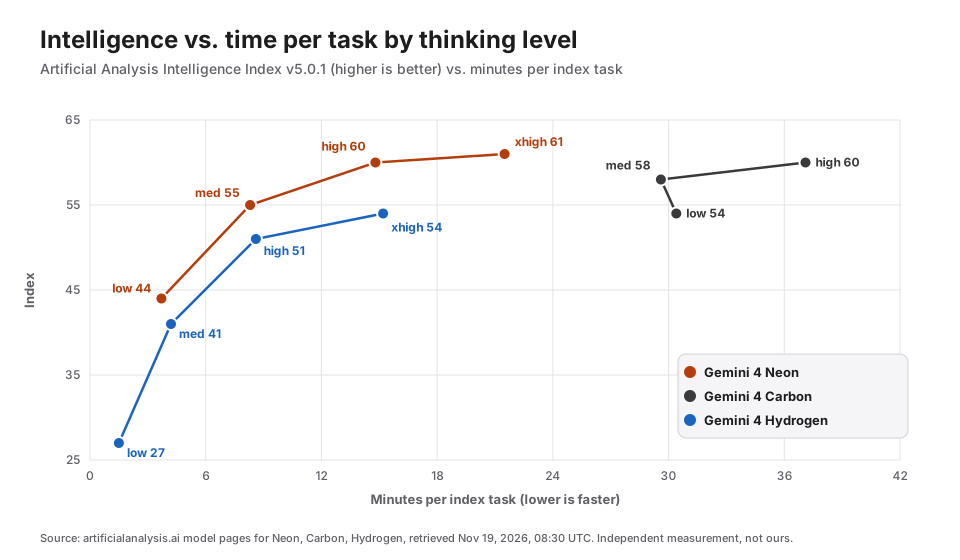
- Independent results: 61 (xhigh) and 60 (high) on the Artificial Analysis Intelligence Index. Carbon (high) also scores 60 but needs 37.1 minutes per task versus Neon’s 14.8, per the same source.
- Vals Index: 70.87%, ranked #2 – 0.44 points behind Claude Fable 5.2 at 41% of its cost per test.
- Coding agents: #1 on the Artificial Analysis Coding Agent Index (58.64 in Antigravity CLI at
xhigh) – just 0.17 ahead of Claude Fable 5.2, but at $6.86 per task versus $15.47.- Replaces Argon and Gemini 3.1 Pro: Neon is now “Deeper analysis” in the Gemini app, and Google names it the upgrade path for both models in the API.
- On a Mac: cloud only, no local weights. Use the Gemini app for Mac (macOS 15+), Antigravity (app on macOS 13+, plus CLI) or the API.
Neon in one table
Table 1: Gemini 4 Neon specifications (as of Nov 19, 2026)
| Item | Value | Source |
|---|---|---|
| Developer | Google DeepMind | Model card |
| Release date | Nov 18, 2026 | Google blog |
| API model ID | gemini-4-neon | AI Studio docs |
| Lineage | adapted from Gemini 4 Carbon; architecture not disclosed | Model card |
| Context window | 1,048,576 tokens, shared by input, thinking and output | AI Studio docs |
| Output per call | 65,536 tokens synchronous; longer only in background mode | AI Studio docs |
| Inputs / output | text, image, audio, video (incl. documents) / text only | Model card |
| Thinking levels | low, medium, high (default), xhigh | AI Studio docs |
| Knowledge cutoff | March 2026 | Model card |
| API price per 1M tokens | $3.00 input · $0.15 cached input · $15.00 output | Google blog |
| Free API tier | no | AI Studio docs |
| Run locally | no – no open weights | Model card |
Where Neon fits in the Gemini 4 lineup
Artificial Analysis counts Neon as Google’s fourth model in seven weeks:
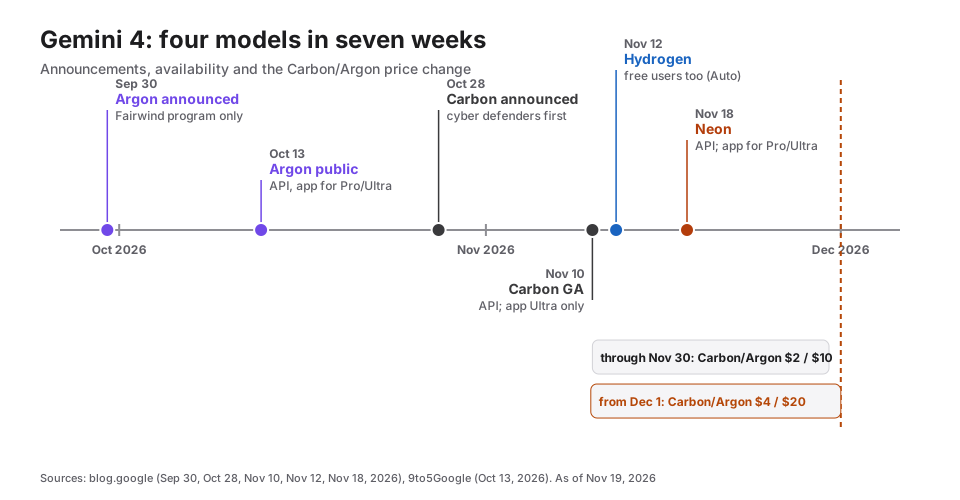
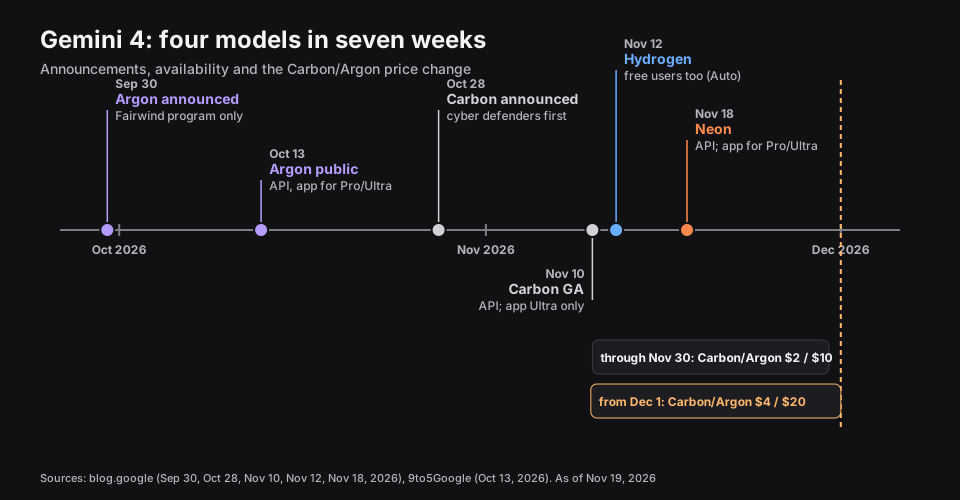
Google’s own framing: Carbon handles “the hardest, long-horizon projects,” Hydrogen handles fast everyday execution, and Neon balances depth and efficiency between them. Google Cloud’s developer guide names Neon the upgrade target for Gemini 3.1 Pro and for general coding and enterprise reasoning on Gemini 4 Argon (Google Cloud). In the Gemini app for AI Pro and Ultra, the picker now reads Auto, Hydrogen (“Everyday help”), Neon (“Deeper analysis”) and Carbon (“Code & complex work”), with Argon and 3.1 Pro gone, per 9to5Google.
The element names do not map to model size or price order, which was the most common complaint in the Hacker News thread on launch day.
Two naming collisions are worth knowing about. Neon, the serverless Postgres company, runs an AI Gateway that resells Gemini models – unrelated to Google’s model. And in May 2026, “Neon” surfaced in the Gemini Mac app’s code as an internal codename for a planned subscription tier, according to Gizchina citing 9to5Google. This article covers only the model gemini-4-neon.
Gemini 4 Neon pricing vs. Hydrogen, Carbon and rivals
Table 2: API list prices per 1M tokens, USD (standard tier, before tax, retrieved Nov 19, 2026)
| Model | Input | Cached input | Output (incl. thinking) | Valid | Source |
|---|---|---|---|---|---|
| Gemini 4 Hydrogen | $1.50 | $0.075 | $7.50 | since Nov 12, 2026 | |
| Gemini 4 Neon | $3.00 | $0.15 | $15.00 | since Nov 18, 2026 | |
| Gemini 4 Carbon (intro) | $2.00 | $0.10 | $10.00 | through Nov 30, 2026 | |
| Gemini 4 Carbon (standard) | $4.00 | $0.20 | $20.00 | from Dec 1, 2026 | |
| Claude Opus 5.5 (reference) | $4.00 | $0.20 | $20.00 | – | Anthropic |
| GPT-6.2 Sol (reference) | $2.00 | $0.10 | $10.00 | – | OpenAI |
All Gemini prices, including cached input, are from Google AI Studio’s pricing page, retrieved Nov 19, 2026. Sales tax may apply on top depending on your state and billing account. Anthropic also bills cache writes, while Gemini 4 uses implicit caching with no write fee – so cross-vendor per-token comparisons say little about cost per finished task.
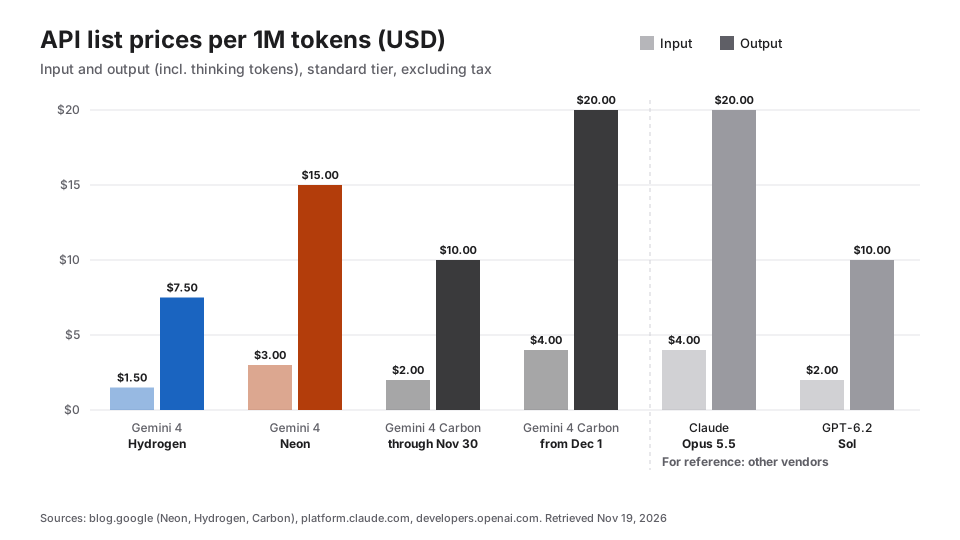
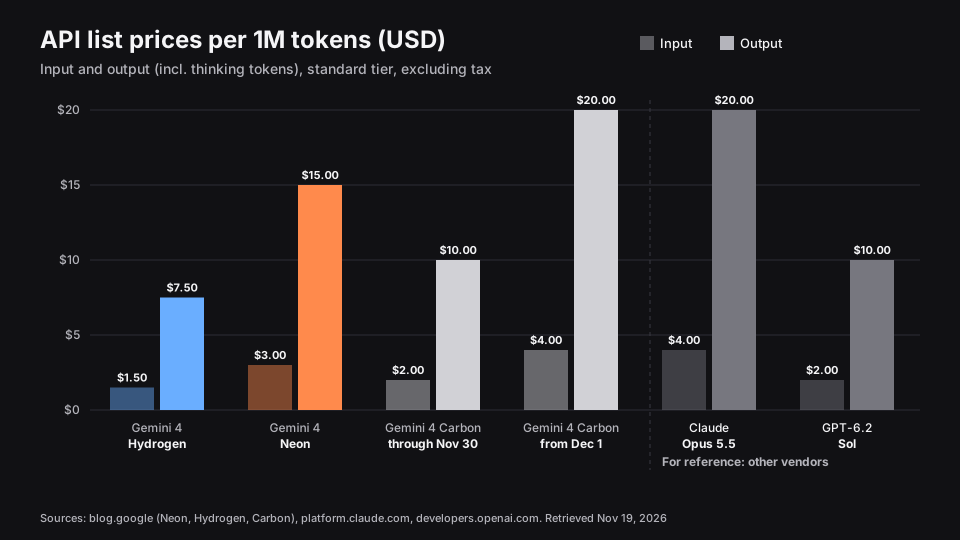
Table 2b: Gemini 4 Neon by processing tier (USD per 1M tokens, Google, retrieved Nov 19, 2026)
| Tier | Input | Cached input | Output incl. thinking |
|---|---|---|---|
| Standard | $3.00 | $0.15 | $15.00 |
| Batch | $1.50 | $0.075 | $7.50 |
| Flex | $1.50 | $0.075 | $7.50 |
| Priority | $5.40 | $0.27 | $27.00 |
Batch and Flex halve the price but aren’t interactive, so a coding agent waiting on replies will realistically run on Standard. Search grounding includes 5,000 free requests a month, shared across Gemini 3 and newer models, then costs $14 per 1,000.
Why the ratio never changes – and what does
Every Gemini 4 model uses the same 1:5 input-to-output price ratio and the same 95% cache discount. That has a useful consequence (our calculation): for an identical token count, Neon always costs 2.0× Hydrogen, 1.5× Carbon through Nov 30 and 0.75× Carbon from Dec 1 – no matter how much is cached or how output-heavy the job is.
So the real difference comes from how many tokens each model burns per task. Artificial Analysis found Neon uses about 15% more output tokens per task than Carbon (OfficeChai, citing Artificial Analysis). On an output-dominated workload that puts Neon at roughly 86% of Carbon’s cost after December 1 and about 173% before it (our calculation: 0.75 × 1.15 and 1.5 × 1.15).
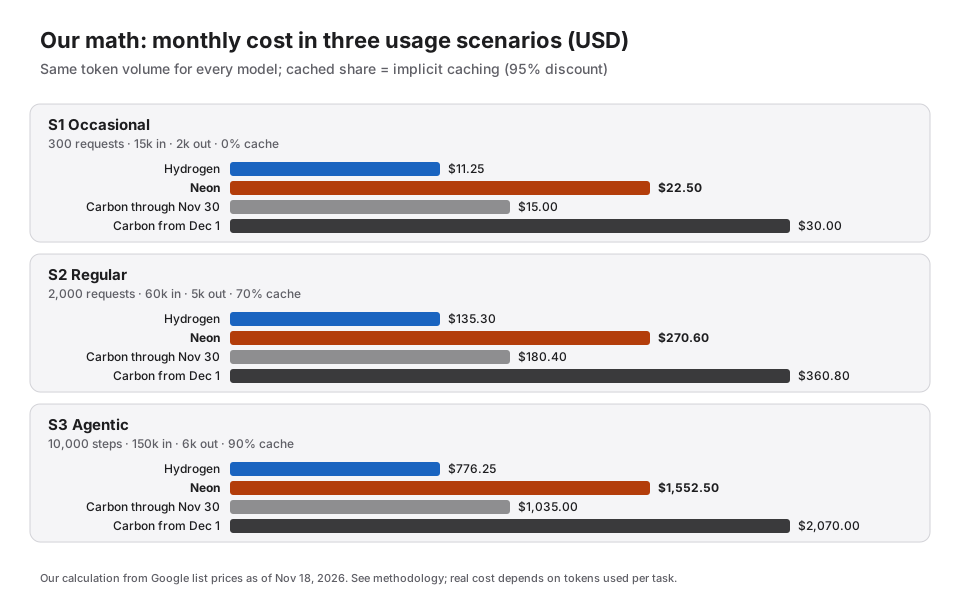
Our cost math: three monthly budgets
These are illustrative calculations, not measurements. They show orders of magnitude for three common usage patterns.
Table 3: Monthly cost in USD for the same token volume (our calculation, prices as of Nov 18, 2026)
| Scenario | Monthly assumptions | Hydrogen | Neon | Carbon through Nov 30 | Carbon from Dec 1 |
|---|---|---|---|---|---|
| S1 Occasional | 300 requests × 15,000 in / 2,000 out, no cache | $11.25 | $22.50 | $15.00 | $30.00 |
| S2 Regular (coding with repo context) | 2,000 × 60,000 in / 5,000 out, 70% cached | $135.30 | $270.60 | $180.40 | $360.80 |
| S3 Agentic (long agent runs) | 10,000 steps × 150,000 in / 6,000 out, 90% cached | $776.25 | $1,552.50 | $1,035.00 | $2,070.00 |
How we calculated
Cost = (uncached input × input price + cached input × cache price + output × output price) ÷ 1,000,000. Worked example, S2 on Neon: 120M input tokens, 84M of them cached → 36 × $3.00 + 84 × $0.15 + 10 × $15.00 = $108.00 + $12.60 + $150.00 = $270.60. Assumptions: output includes thinking tokens; implicit caching only applies to prompts of at least 4,096 tokens and isn’t guaranteed; no grounding fees or tax; Standard tier (Batch/Flex would halve it). Rounded to cents. Expected variance: around ±50% depending on thinking level and task, because
xhighsharply increases output tokens.
Subscription instead of API? Google AI Pro is listed at $19.99/month in the U.S., plus any applicable sales tax (Google), and includes Neon in the Gemini app and Antigravity – with usage limits Google doesn’t express in tokens. If you run agents for hours each day, those limits are likely to bind before your budget does. See our Gemini API cost overview and Gemini plan comparison.
Download: gemini-4-pricing-scenarios.csv – prices, assumptions and results, ready for your own numbers.
Benchmarks: vendor claims vs. independent results
Google launched Neon with a long list of first places. What matters is who measured, on which version, at which setting.
Table 4: Selected Gemini 4 Neon results (as of Nov 19, 2026)
| Benchmark | Neon | Comparison | Measured by | Setting |
|---|---|---|---|---|
| Artificial Analysis Intelligence Index v5.0.1 | 61 xhigh · 60 high · 55 medium · 44 low | Carbon (high) 60 · Hydrogen (xhigh) 54 · Argon 50 | Artificial Analysis | per level |
| Time per index task | 14.8 min (high) · 21.5 min (xhigh) | Carbon (high) 37.1 min (34.2 min on Nov 18) | Artificial Analysis (Neon, Carbon) | – |
| Cost per index task | $6.44 (xhigh) · $3.74 (high) · $1.90 (medium) · $0.75 (low)² | Carbon $7.76 at standard pricing² | Artificial Analysis | list prices |
| Vals Index v2.2 | 70.87%, #2 of 42, $7.41/test | Claude Fable 5.2: 71.31%, $17.94/test; per Google’s table Claude Opus 5.5 70.1%, GPT-6.2 Sol 66.1% | Vals AI | xhigh |
| Legal Research Bench / Tax Agent Bench | 56.25% / 54.89%, both #1 | – | Vals AI | xhigh |
| Terminal-Bench 4.0 | 61.62%, #7 of 69 | – | Vals AI | xhigh |
| Terminal-Bench 4.1 | 65.2% | – | not stated | |
| CursorBench 4.1 | 65.4% | Claude Opus 5.5: 58.1% | Google (via TestingCatalog) | not stated |
| Agent Arena | 1,336, #2, ~4,200 sessions | – | Arena (cited by Google) | – |
| Artificial Analysis Coding Agent Index v2.1 | 58.64, #1 (Antigravity CLI) | Claude Fable 5.2 (xhigh) 58.47 · Claude Opus 5.5 (max) 58.16 · GPT-6.2 Astra (max) 53.47 | Artificial Analysis (read by OrcaRouter) | xhigh |
| Cost per coding-agent task | $6.86 | Claude Opus 5.5 (max) $12.61 · Claude Fable 5.2 (xhigh) $15.47 | Artificial Analysis | xhigh |
| Output speed | ~110 tokens/s | Carbon (high) 55 tokens/s | Artificial Analysis | – |
| GDP.pdf (document tasks) | 33.4% (high) · 28.0% (xhigh) | Carbon (high) 28.4% | Artificial Analysis | per level |
| Zapier AutomationBench | 56.3%, #1 | – | – |
² Per OfficeChai, citing Artificial Analysis. Since Nov 19, Artificial Analysis’s Carbon page explicitly shows $7.76 based on standard pricing ($4/$20). Earlier figures of $5.48 (the same page on Nov 18) and $4.90 (OrcaRouter) appear to use a different price basis; at today’s introductory price, Carbon would cost less per task than Neon at xhigh. The medium and low costs come from Ahmet Balaman’s analysis of Artificial Analysis data.
Our read of the numbers:
highis the setting to start with. Neon at its default level matches Carbon’s index score of 60 while finishing tasks in 60% less time (our calculation from 14.8 vs. 37.1 minutes). Going toxhighadds one point but more than doubles output: 283M vs. 123M tokens across the full index. The tie is a rounded one: unrounded, Neon (high) sits at 59.6 and Carbon (high) at 60.0 (OrcaRouter, from Artificial Analysis data).- More thinking isn’t always better. On GDP.pdf document tasks Neon scores 33.4% at
highbut only 28.0% atxhigh, and Carbon (high) 28.4% (Artificial Analysis). - It’s verbose. Artificial Analysis ranks Neon 93rd of 95 on verbosity. On metered billing, reserve
xhighfor the tasks that need it. - “#3” depends on how you count. Google cites third place on the Intelligence Index; Artificial Analysis’s page lists Neon (xhigh) at #6 of 96 because each thinking variant is ranked separately.
- Vals backs the cost story – nearly Fable 5.2’s score at well under half the cost per test. Keep in mind the Vals Index weights finance at roughly 52% (Vals AI), so it is not a pure coding signal.
- Coding agents: narrowly first, clearly cheaper. Neon leads Claude Fable 5.2 by only 0.17 points on the Coding Agent Index, which publishes no confidence intervals. Per OrcaRouter, 4.2 of its 5.17-point lead over GPT-6.2 Astra comes from one component, SWE-Atlas-QnA. The cost gap is the robust part: $6.86 per task versus $15.47 for Fable 5.2 at
xhigh. - Coding numbers don’t line up neatly. Google’s 65.2% is Terminal-Bench 4.1; Vals’s 61.62% is Terminal-Bench 4.0 with a different harness. CursorBench comes only from Google’s table.
None of these tell you how Neon behaves in your repository, under peak-hour load, or at the edge of your plan’s usage limits.
Developer notes
From Google’s Neon developer guide:
- Thinking level: set
generation_config: {"thinking_level": "high"}in the Interactions API. Valid values:low,medium,high,xhigh. Gemini 3.8 Flash’sminimalnow returns an error. - Drop sampling parameters:
temperature,top_pandtop_kare ignored when in range and rejected with a 400 when out of range. - Long outputs: 65,536 output tokens per synchronous hop. Beyond that you need
background: trueand a highermax_output_tokens– which counts thinking plus answer. - Caching: implicit only, for prompts of 4,096+ tokens.
cachedContents/caches.createare not supported. - Billing: every processed token is billed, including thinking tokens, internal tool system instructions and function declarations. Search grounding is billed per query.
- Timeouts: Google recommends at least 15-minute client timeouts, or background execution.
- Migrating from Carbon or Argon: swap the model ID. Note the default changes: Neon starts at
high; Argon and Gemini 3.8 Flash default tomedium. - Extra from the Google Cloud docs (model page): Microsoft Office and OpenDocument files are accepted as input; computer use, code execution, grounding, URL context and structured output are supported; Live API, tuning and RAG Engine are not. Completed long-decode segments are billed even if a later segment fails.
How to use Gemini 4 Neon on a Mac
Neon is cloud-only, so your Mac’s unified memory doesn’t limit what you can run – the opposite of local models, where RAM caps model size.
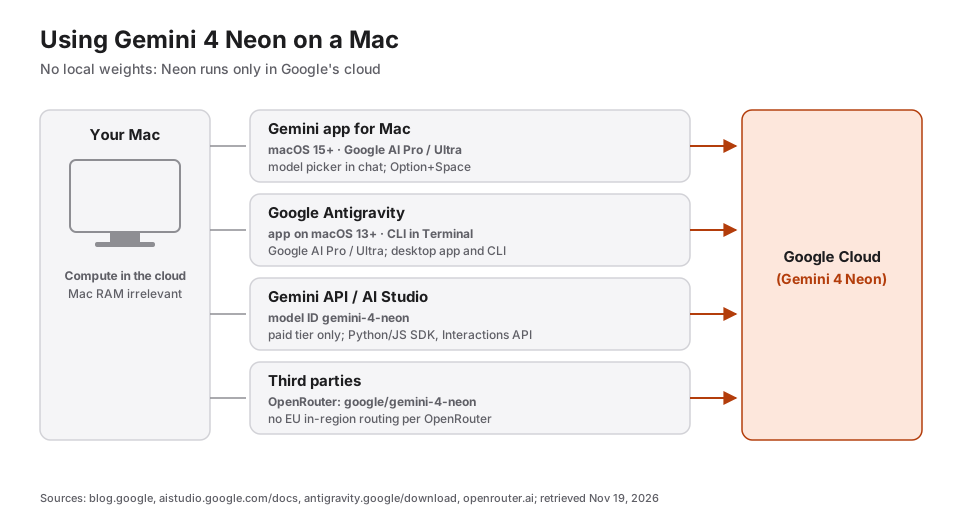
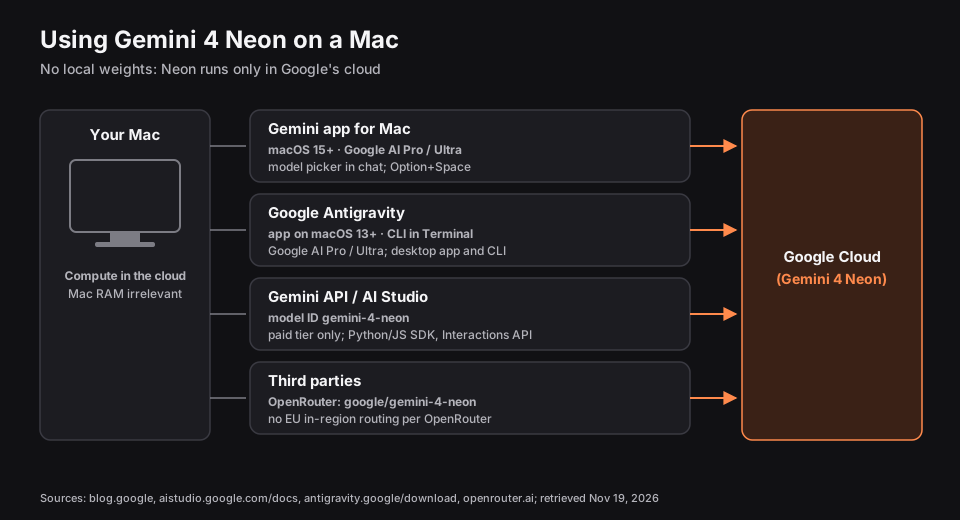
Table 5: Ways to reach Neon from macOS (as of Nov 19, 2026)
| Path | Requirements | Best for | Source |
|---|---|---|---|
| Gemini app for Mac | macOS 15+; Google AI Pro or Ultra; opens with Option + Space | research, documents, everyday work | |
| Google Antigravity app (v2.33.0) | macOS 13+, Apple Silicon or Intel; AI Pro/Ultra; also IDE extensions | agentic coding; Orchestrator lets Neon plan while Hydrogen executes | Antigravity download, Antigravity blog |
| Antigravity CLI (v1.5.11) | curl -fsSL https://antigravity.google/cli/install.sh | bash | terminal workflows | Antigravity download |
| Gemini API / AI Studio | Google Cloud project with billing (paid tier) | your own tools and scripts | AI Studio docs |
| OpenRouter | google/gemini-4-neon, same list prices | multi-vendor setups | OpenRouter |
If your data can’t leave the machine, you need a local model instead: start with setting up Ollama on a Mac mini M4, the best open LLMs of 2026 or LM Studio vs. Ollama.
Data use, region and safety
- Paid tier, no training: Google’s Gemini API terms (effective Mar 23, 2026) say prompts and responses on paid services aren’t used to improve products. They are logged “for a limited period of time” for abuse detection; no exact duration is given there.
- Grounding: with Google Search grounding, Google stores prompts, context and output for 30 days.
- EEA, Switzerland, UK: API clients offered to users there must use paid services – a non-issue for Neon, which has no free tier.
- Data location: On Google’s enterprise platform (Gemini Enterprise Agent Platform, formerly Vertex AI), Neon has been generally available since Nov 18 in
globaland theusandeumulti-regions, with ML processing restricted tousoreuand support for data residency, CMEK and VPC-SC. The catch: Google says access goes to verified enterprise customers “in select regions,” and no single EU region such aseurope-westis listed (Google Cloud). OpenRouter offers no EU in-region routing, and the AI Studio API states no data location. - Safety rating: the model card carries forward Argon’s Frontier Safety Framework results, under which reaching the critical capability level for cyber and biological uplift “cannot be ruled out.” Google’s prompt-injection and refusal figures are vendor-reported.
This is not legal advice.
Hydrogen, Neon or Carbon?
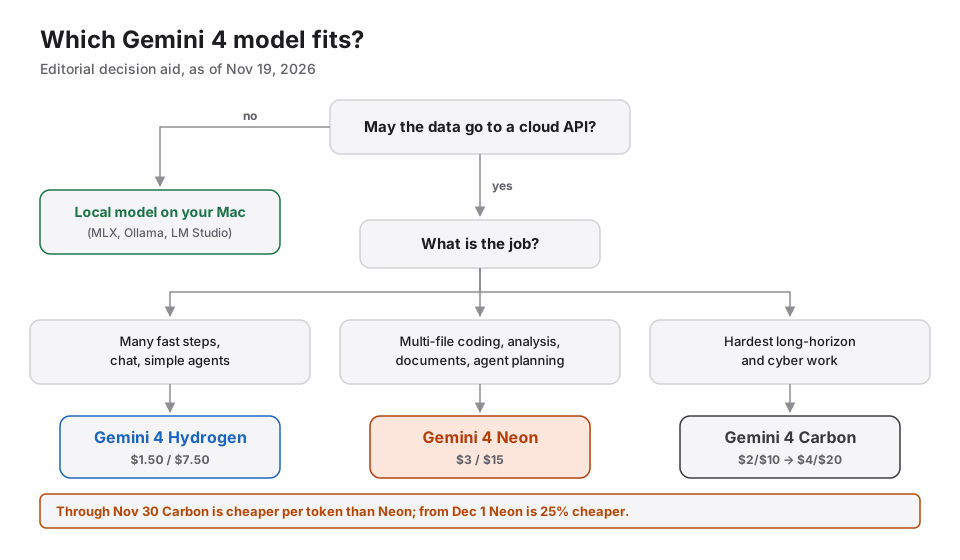
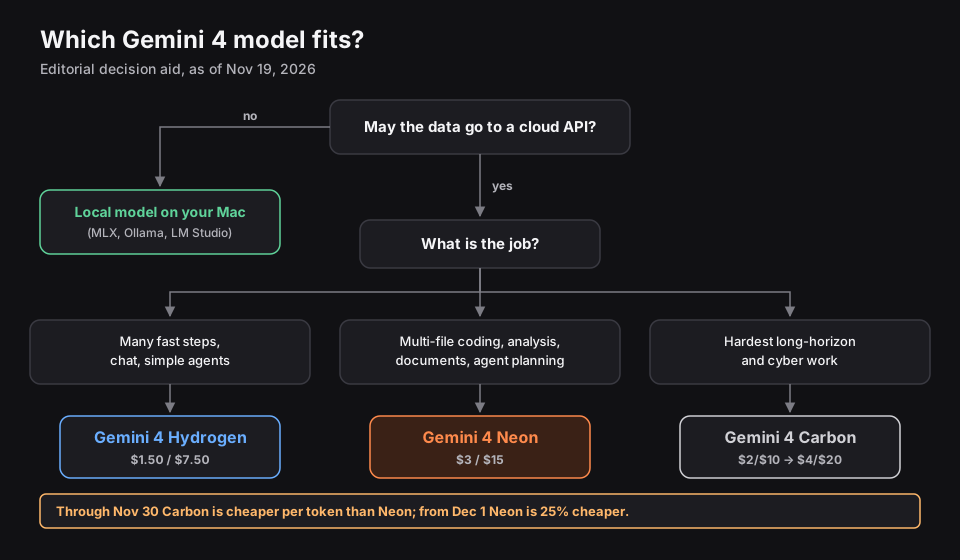
Table 6: Quick decision matrix (our assessment based on the sources above)
| If you… | pick | because |
|---|---|---|
| run lots of short agent steps or chat replies | Hydrogen | half Neon’s price; about 165 tokens/s at high per Artificial Analysis |
| do multi-file coding, document analysis or agent planning | Neon at high | Carbon-level index score in less than half the time per task |
| push heavy volume before Nov 30 | test Carbon | $2/$10 undercuts Neon until then |
| use Carbon today | re-test with Neon after Dec 1 | 25% lower token price |
| run long coding sessions in Antigravity | Orchestrator: Neon + Hydrogen | Neon plans and verifies, Hydrogen handles routine steps at half the price |
| need EU data residency | Neon on Google’s enterprise platform (eu) | the AI Studio API and OpenRouter don’t offer it |
| can’t send data to the cloud | a local model | Neon has no open weights |
Still unconfirmed
- Plan usage limits: Google doesn’t say how many Neon requests AI Pro and Ultra include in the app or Antigravity.
- “32% lower cost per task than Carbon”: Google’s figure for
highdoesn’t state the price basis, and Artificial Analysis has only scored Neon atxhighin coding-agent runs. - Plans page: Google’s subscription page didn’t list Neon on Nov 19 and was inconsistent about which models each plan includes.
Methodology and changelog
How we worked: We have not run Gemini 4 Neon ourselves. Performance figures come from the sources below, with vendor claims labeled. Prices were retrieved from Google, Anthropic and OpenAI on November 19, 2026. Cost scenarios are our own calculations with stated assumptions. We opened and checked 40 sources, 18 of them primary.
Conflicts of interest: None. No affiliate links on this page. More on how we work: AI transparency.
Corrections: Spotted an error? Contact details are on our About page.
Changelog
- Nov 19, 2026: First published (research as of 08:30 UTC, including the Coding Agent Index, the app picker change and EU availability on Google’s enterprise platform).
Related on AI on Mac: Gemini 4 Argon · Gemini 4 Carbon · Gemini 4 Hydrogen · Google Gemini pricing 2026 · GPT-6.2 Astra and Sol · Claude Fable 5.2 on the Mac
Frequently Asked Questions
How much does Gemini 4 Neon cost?
$3 per million input tokens, $0.15 per million cached input tokens and $15 per million output tokens, thinking tokens included (Google, Nov 18, 2026).
Is Gemini 4 Neon cheaper than Gemini 4 Carbon?
Only from December 1, 2026. Through November 30 Carbon costs $2/$10 and is cheaper per token. From December 1 Carbon costs $4/$20, making Neon 25% cheaper per token.
Is Gemini 4 Neon free?
No. It isn't on the free API tier, and Google lists only Google AI Pro and Ultra for the Gemini app and Antigravity.
What is Gemini 4 Neon's context window?
1,048,576 tokens, shared by input, thinking and output, with up to 65,536 output tokens per synchronous call.
Can I run Gemini 4 Neon locally on my Mac?
No. It's available only through Google's services and third-party APIs; your Mac acts as the client.
Which thinking level should I use?
Start with high, the default. Per Artificial Analysis, xhigh adds one index point while using more than twice the output tokens.