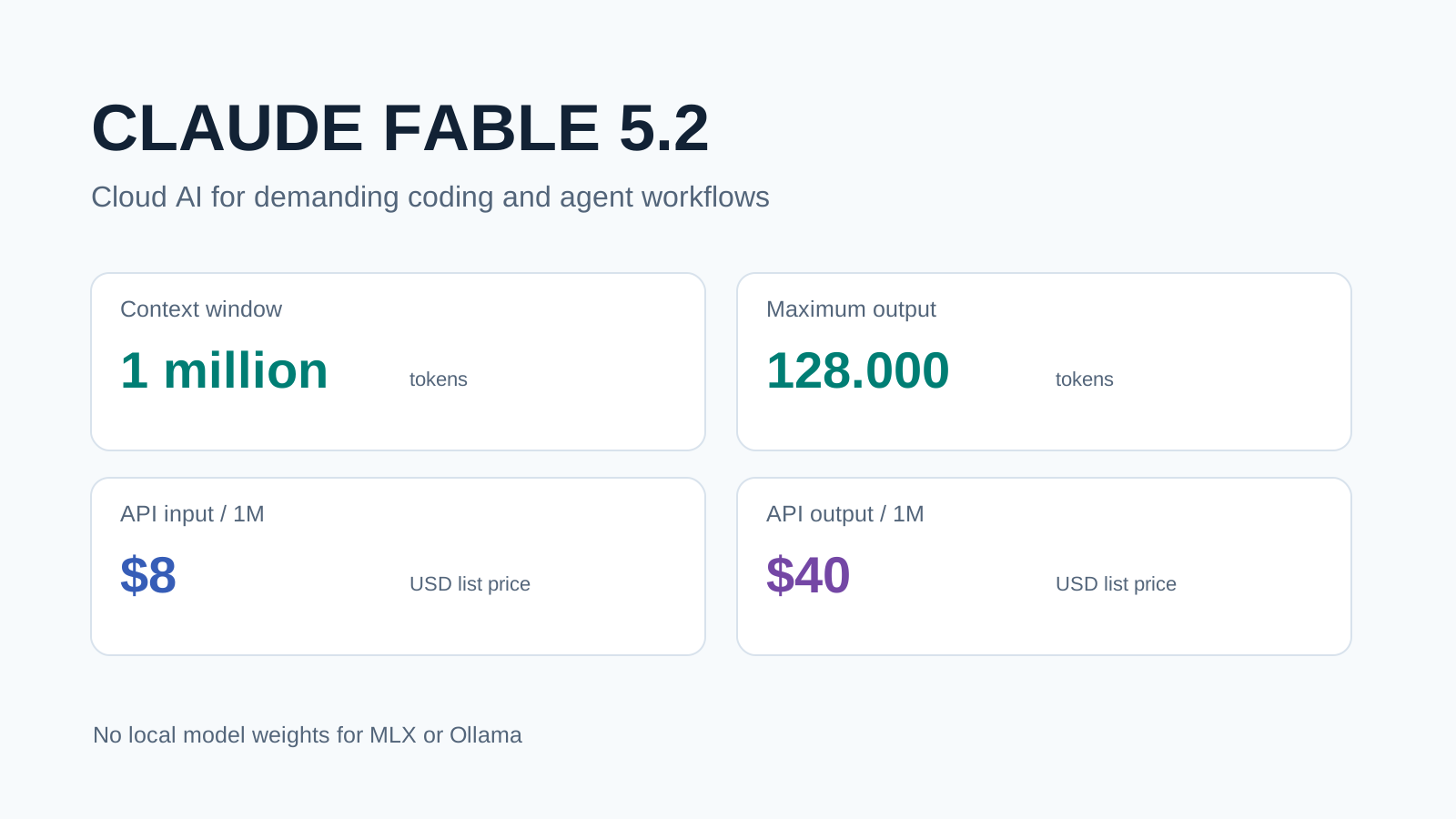
Fact-checked November 11, 2026. Anthropic released Claude Fable 5.2 on November 9, 2026. The model supports a 1-million-token context window, up to 128,000 output tokens, and direct API pricing of $8 per million input tokens and $40 per million output tokens. Compared with Fable 5.1, both rates have fallen by 20%. Compared with Claude Opus 5.5, both remain twice as high. Fable 5.2 is cloud-hosted: there is no downloadable model-weight package to run locally on Apple silicon. 123
Those specifications answer the easy questions. The harder one is whether a model that costs twice as much per token can finish a difficult coding or research task with fewer retries and lower overall spend. This guide separates vendor measurements from independent tests, models three workloads, and examines integration and data-protection issues that matter to Mac-based developer workflows.
Specifications and current pricing
| Feature | Fable 5.2 | Fable 5.1 | Opus 5.5 | Sonnet 5.5 |
|---|---|---|---|---|
| Context window | 1M tokens | 1M tokens | 1M tokens | 1M tokens |
| Maximum output | 128k tokens | 128k tokens | 128k tokens | 128k tokens |
| Input / 1M tokens | $8 | $10 | $4 | $2 |
| Output / 1M tokens | $40 | $50 | $20 | $10 |
| Five-minute cache write / 1M | $10 | $12.50 | $5 | $2.50 |
| Cache read / 1M tokens | $0.20 | $0.25 | $0.20 | $0.20 |
Source: Anthropic model documentation and API pricing, checked November 11, 2026. USD list prices exclude tax and provider-specific markups. Token limits do not imply that consuming the full allowance is practical or guaranteed. 234
Anthropic reports that Fable 5.2 can generate output up to 30% faster than its predecessor. A separate Fast Mode increases output-token throughput by up to 2.5× while doubling the standard price to $16 input / $80 output per million tokens. The boost concerns generation speed rather than promising the same reduction in every end-to-end response time. 15
Performance: where it improves, and where it doesn’t
Anthropic’s launch figures put Fable 5.2 at 49.1% on FrontierCode 2.0 under its stated xhigh configuration, against 32.4% for Fable 5.1 and 45.5% for Opus 5.5. Its FrontierSWE v2 scores were 69.9%, 56.3%, and 62.3%, respectively. These results indicate progress on the manufacturer’s evaluation stack; they are not independent measurements or tests run by this website. 1
Third-party results add important context:
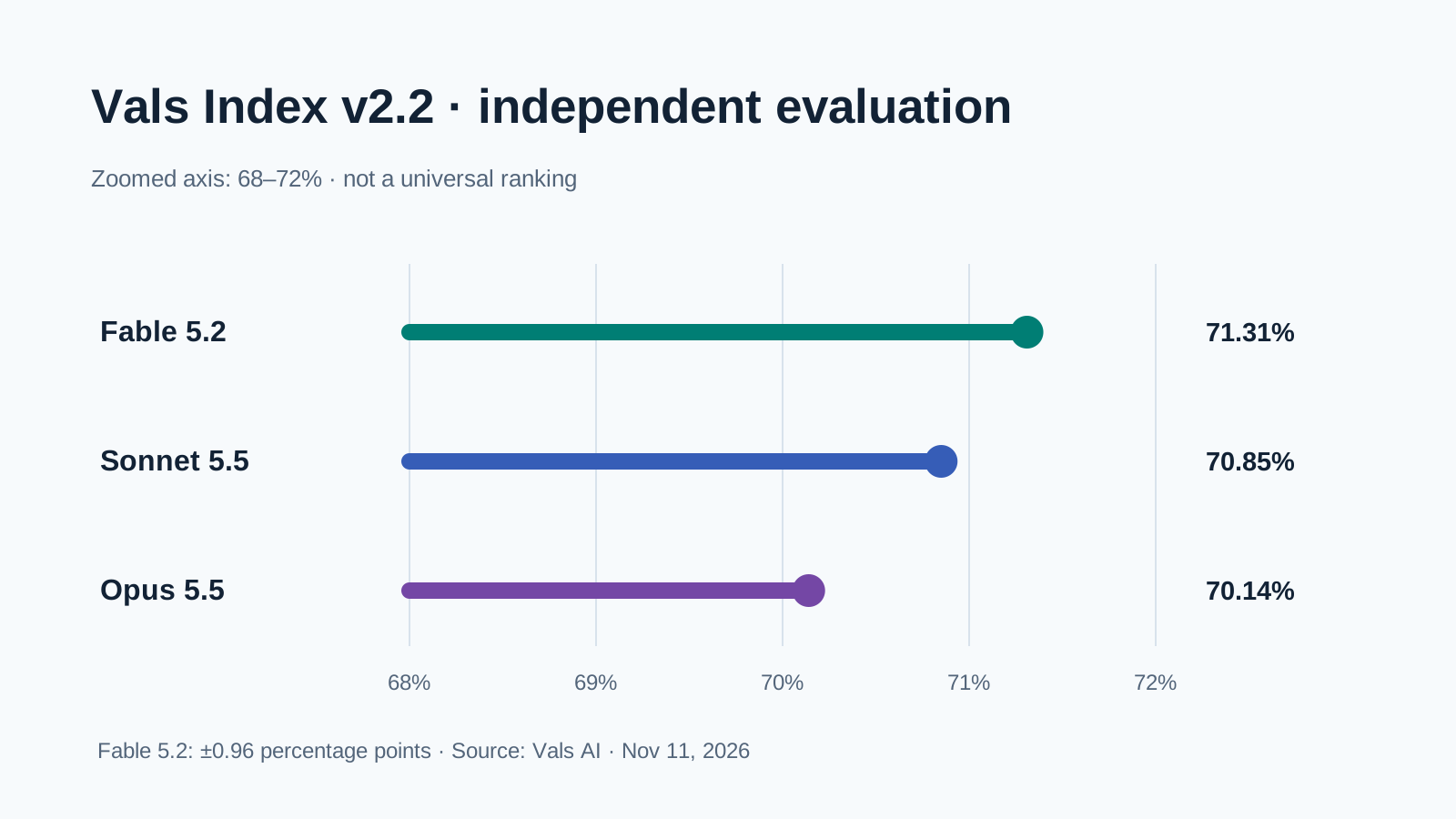
- Vals Index v2.2: Fable 5.2 scored 71.31% ± 0.96 percentage points, compared with 70.85% for Sonnet 5.5 and 70.14% for Opus 5.5. These close overall results should not be presented as unambiguous proof that one system beats another on every workload. Vals also records weaker Fable results on some multimodal software-maintenance tasks. 6
- Artificial Analysis Intelligence Index v5.0.1: A Fable 5.2 result of 65 points used a high-compute configuration; the reported cost per index task was approximately $26.54. This index measures a different task set and does not share Vals’ percentage scale. 7
- Plotly DataAnalyticsBench: Fable 5.2 answered 43 of 43 tasks correctly in the company’s published run, but two other tested GPT-6 variants reached the same score. The Fable run cost $35.74 on that setup. Its narrow evaluation design limits how far these results can be generalized. 8
A single leaderboard position cannot replace a controlled trial against your own repository, bug reports, code review standards, security requirements and test suite. For a software agent, the meaningful endpoint is a verified solution, not a plausible patch or the number of lines produced.
Three API budgets, calculated
For uncached usage, the formula is straightforward:
USD cost = (input tokens / 1,000,000 × input rate) + (output tokens / 1,000,000 × output rate)
| Example workload | Input / Output | Fable 5.2 | Opus 5.5 | Sonnet 5.5 |
|---|---|---|---|---|
| One substantial task | 100k / 10k | $1.20 | $0.60 | $0.30 |
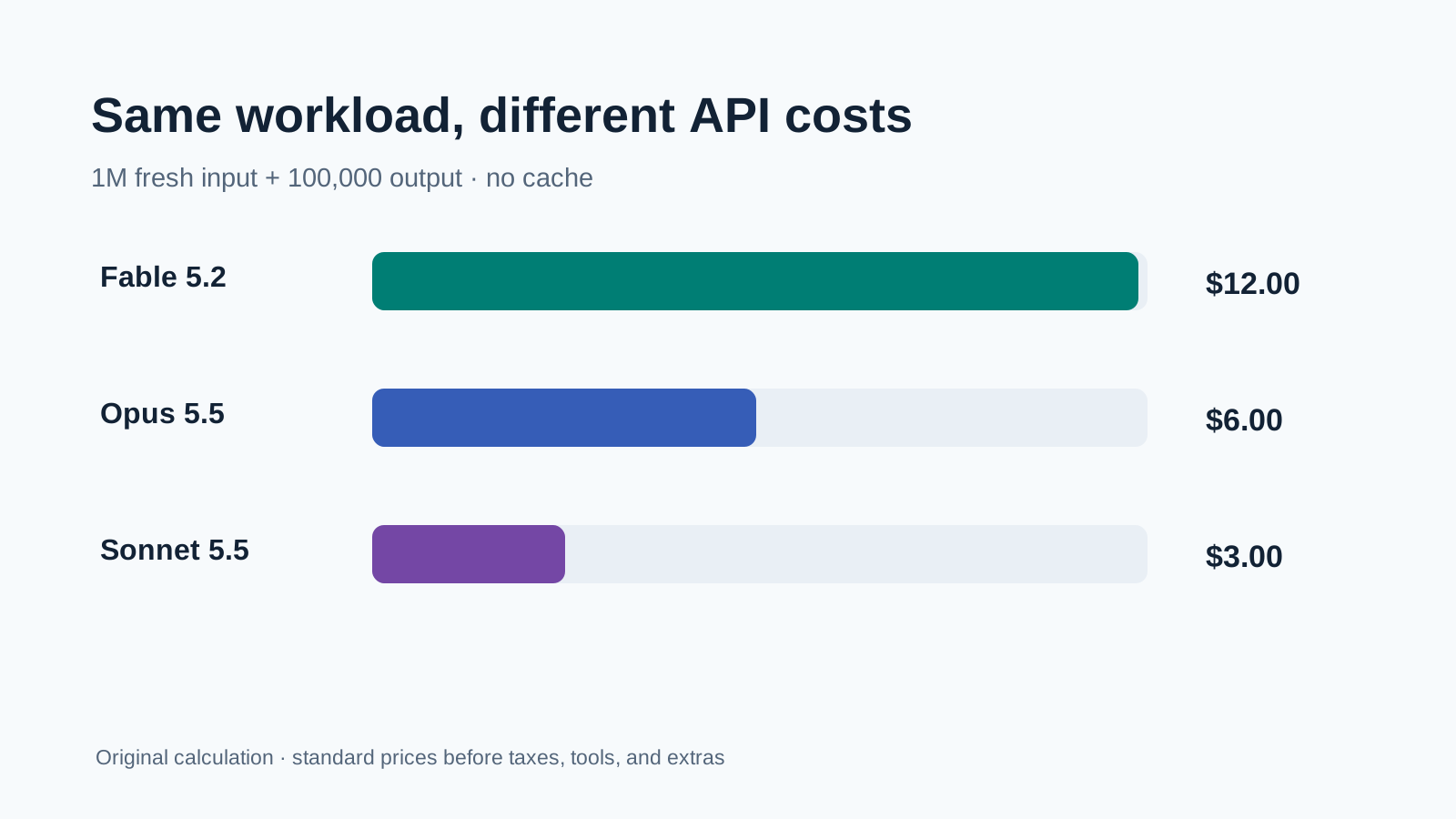
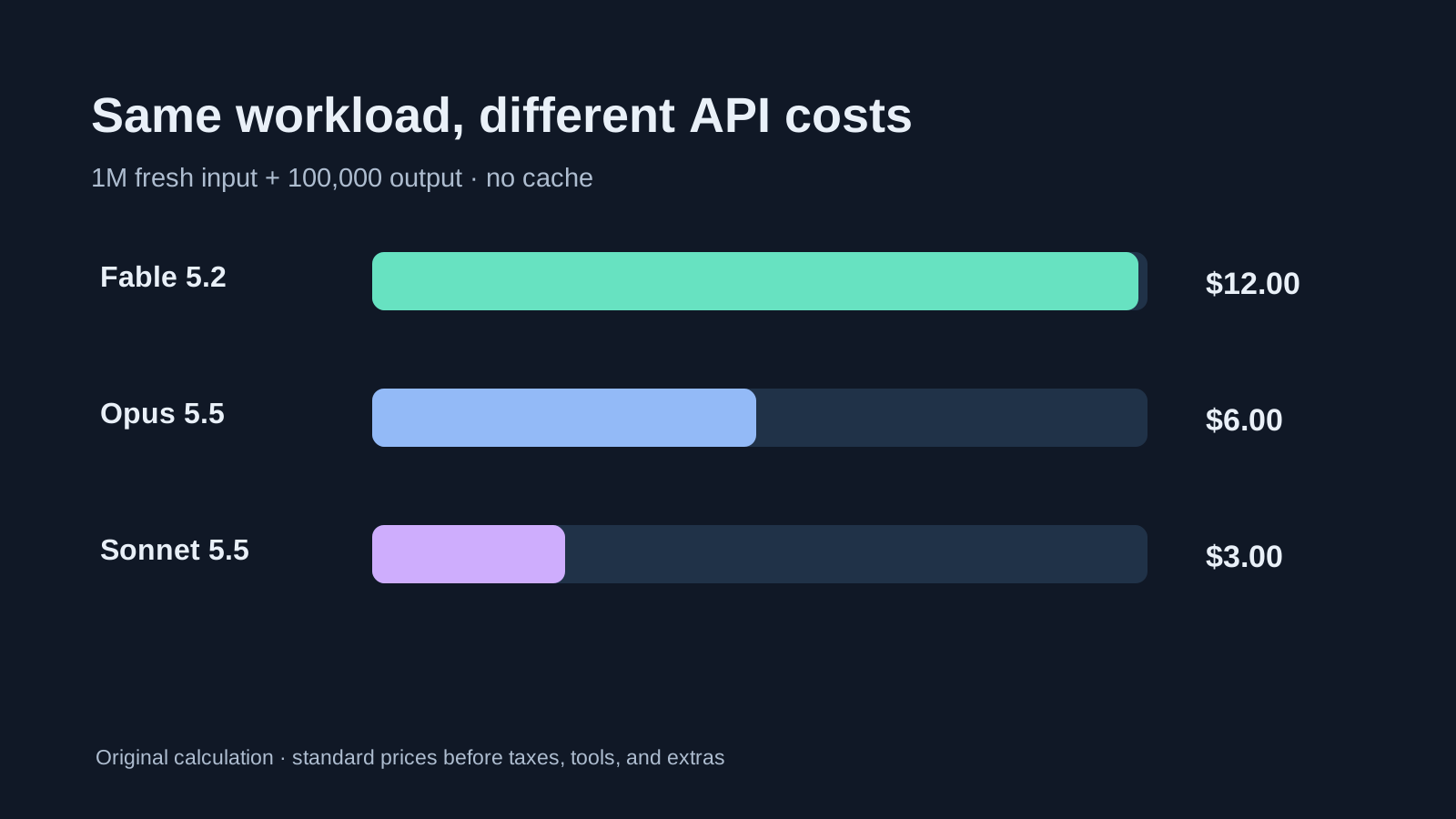
| Agent session | 1M / 100k | $12.00 | $6.00 | $3.00 |
| Heavy monthly workload | 10M / 1M | $120.00 | $60.00 | $30.00 |
Original arithmetic using published API prices as of November 11, 2026. These are illustrative token counts, not measured usage patterns. No cache writes, tool calls, taxes, provider markup or request retries are included. 4
Caching changes the marginal cost. For Fable 5.2, reading an eligible cached million tokens costs $0.20, whereas freshly supplied input costs $8. Writes are not free: the five-minute cache write price is $10 per million. To illustrate: an API task consuming 1M input tokens, 90% of which are charged as cache reads, and generating 100k output tokens costs $4.98, excluding cache population. With the same hit rate, Opus 5.5 costs $2.58. The calculations assume the stated cache hits actually occur and omit write charges on purpose. 4
An expensive model can still be the cheaper problem solver. Vals reports an overall Fable index-run cost near $17.94, lower than its approximately $24.77 for Opus 5.5 in that harness. The comparison should not be generalized into a claim that Fable has cheaper API tokens; it plainly does not. Agent orchestration, thinking tokens, attempts, tooling and success criteria alter total cost. 6
An evaluation that makes sense for a real codebase
Choose 10 to 20 representative tasks—easy bug fixes, complex cross-file defects, test-driven refactors, and at least a few failure-prone cases. Run the same task definition and tool access with Fable 5.2 and Opus 5.5. Record successful test passes, human review outcome, wall-clock time, input/output/cache tokens and cost. Repeat ambiguous cases. Compare the median cost per accepted task, not just cost per response.
Using Fable 5.2 from a Mac
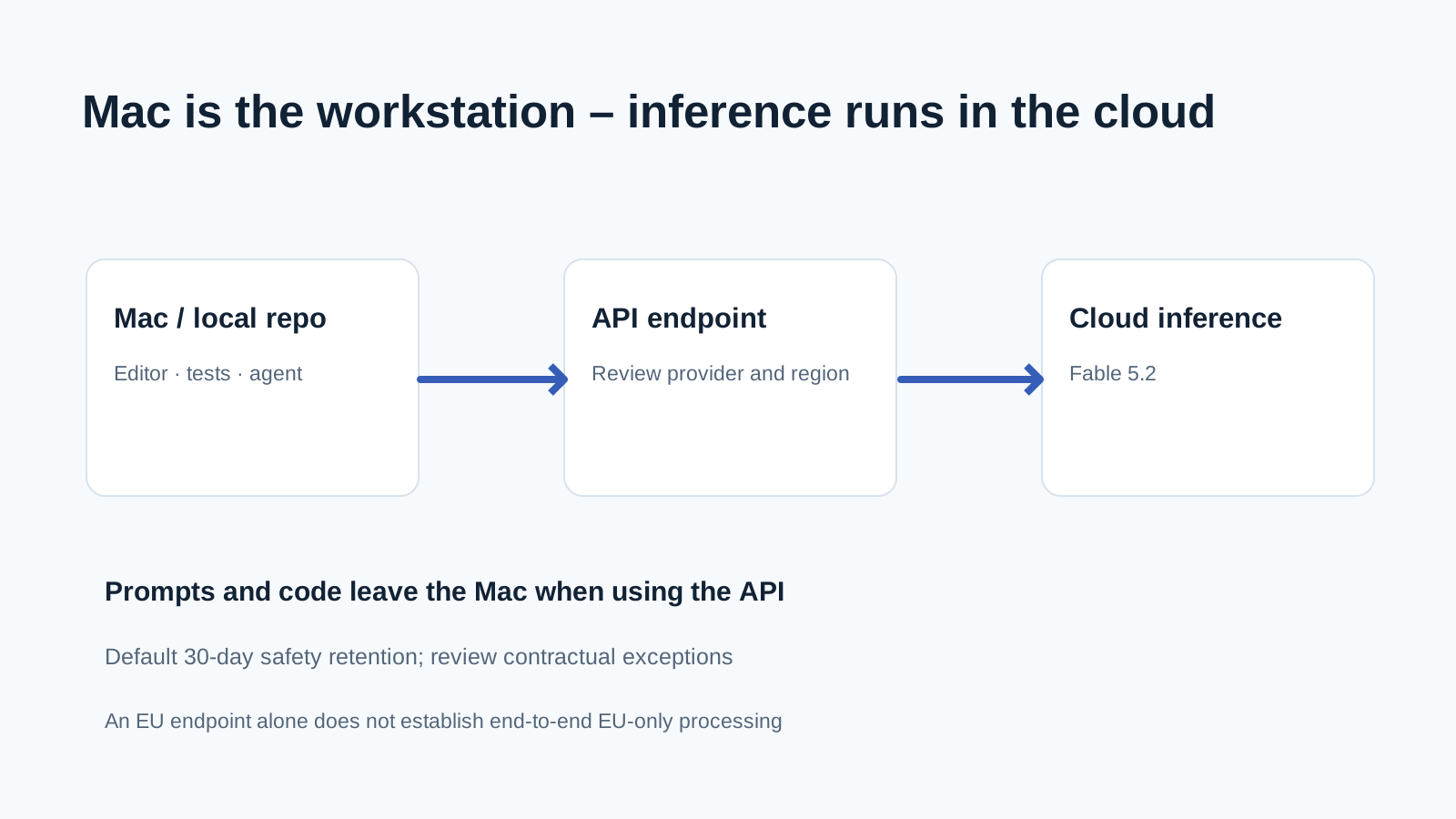
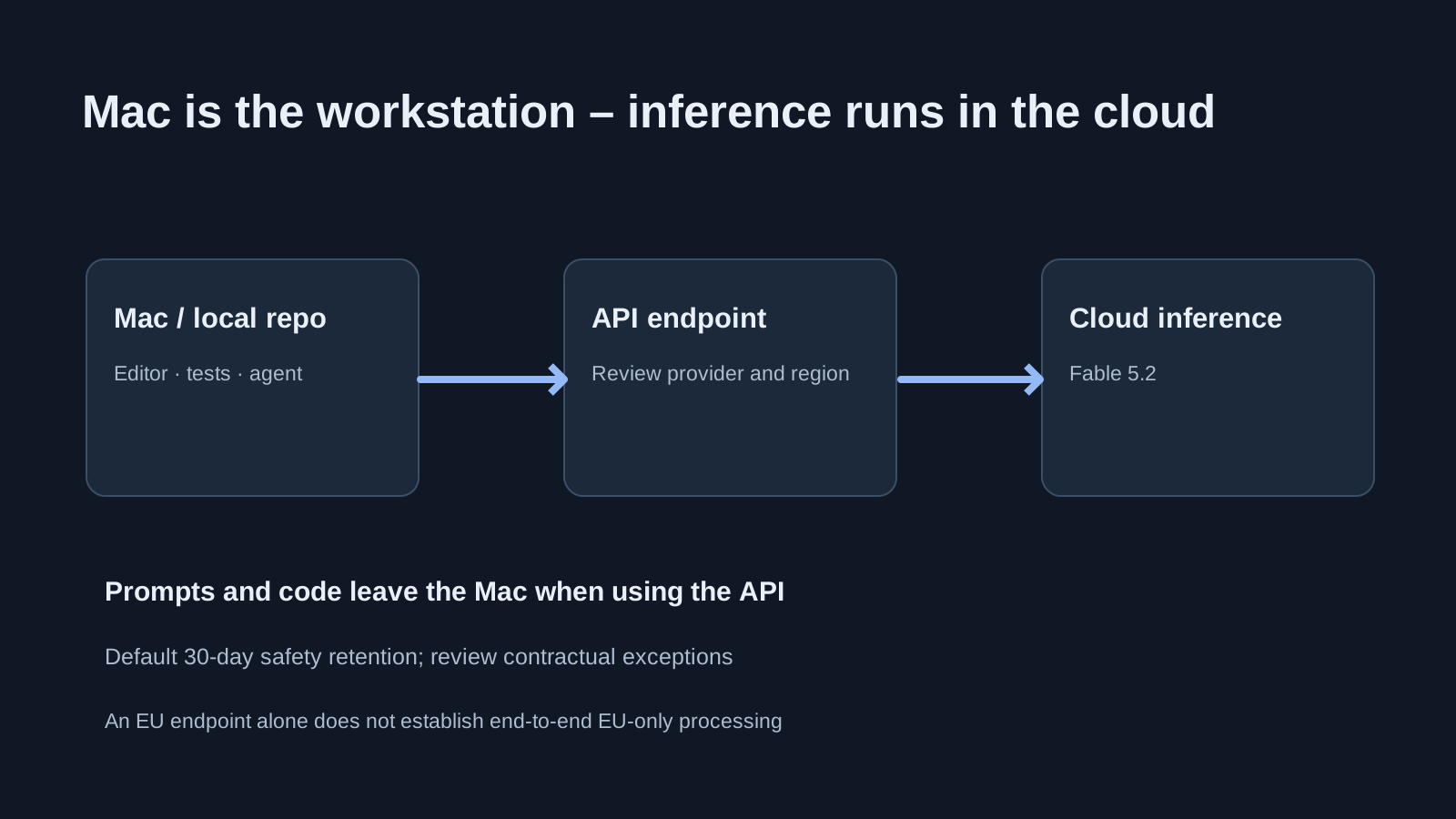
Because the model weights are not available for local execution, M-series Macs do not need a particular amount of unified memory to host Fable. A Mac mini or MacBook can run the development environment, local tests and agent software, but inference takes place on a remote provider. Ollama and MLX cannot run proprietary Fable 5.2 model weights locally. This distinction matters for privacy, offline use and the recurring cost of automation. 2
The model name depends on where the request is sent:
| Access route | Identifier |
|---|---|
| Anthropic Messages API | claude-fable-5-2 |
| OpenRouter | anthropic/claude-fable-5.2 |
| Amazon Bedrock | Provider-specific Bedrock model identifier or inference profile; verify region and prefix in AWS |
| Google Cloud | Provider-specific model name and location; verify the current regional endpoint |
Sources: Anthropic, OpenRouter, AWS, Google Cloud. Do not interchange identifiers across providers. 291011
An illustrative request using the currently documented Anthropic Python SDK interface looks like this:
import os
import anthropic

client = anthropic.Anthropic(api_key=os.environ["ANTHROPIC_API_KEY"])
response = client.messages.create(
    model="claude-fable-5-2",
    max_tokens=4096,
    output_config={"effort": "high"},
    messages=[{"role": "user", "content": "Identify the likely root cause of this failing unit test and suggest a reproducible fix."}],
)
for block in response.content:
    if block.type == "text":
        print(block.text)
This is an integration example, not a live-tested request. Install an SDK version supporting output_config, load the API key securely and handle exceptions, token accounting and rate limits in production. 12
Migration hazards in agent frameworks
Fable 5.2 uses adaptive thinking and requires an effort setting between low and max if you want to change its default high; it cannot simply be switched off. Older harnesses may break on previously accepted tool_choice settings or on changed thinking history. In particular, modifying preserved thinking blocks can produce HTTP 400 errors because the API expects their content and order to remain consistent. The migration guidance also documents changes to computer-use tool versions and to advisor–executor model pairing. 31314
A safe upgrade starts in a test environment. Keep tool definitions stable, retain conversation history exactly as the API requires, exercise your agent’s retries and checkpoints, and make rollback to a known-working model trivial. Anthropic’s documentation is the compatibility source of record; a router accepting a model name does not prove that your existing agent workflow is compatible.
Privacy: EU endpoints are not equivalent to zero retention
Anthropic’s covered-model rules require a 30-day safety-retention window for Fable 5.2 by default, unless an applicable exception is expressly authorized. The rule matters when code repositories, sensitive documents or customer data are included in prompts. 1516
Google documents Fable 5.2 availability through an eu multi-region on its partner-model platform. That does not by itself establish that every processor, safety-review workflow and retention obligation meets a particular organization’s GDPR, confidentiality and data-residency requirements. Separately, OpenRouter’s model page did not show EU in-region routing for this model on November 11, 2026. These statements concern different access routes, so they are not contradictory. 91017
For regulated development workflows, review the actual agreement and subprocessors, retention settings and exceptions, selected cloud region, logging, data transfer terms and any additional router. If those requirements cannot be met, choose a different hosted offering or a genuinely local open-weight model rather than assuming that an EU-labeled endpoint resolves all data-protection questions.
Claude subscriptions and the launch promotion
From November 9 to November 16, 2026, Anthropic is running a time-limited Fable 5.2 launch offer. Eligible Pro subscribers can use Fable up to a defined share of their existing weekly limit under the published promotion; Max and Ultra plans may receive one to three additional Fable-limit resets depending on subscription tenure and other eligibility conditions. The precise timing, scope and qualifying terms are in the linked official notice. This is a short-lived promotional policy, not a permanent baseline entitlement. 1819
For recurring workloads that require a scheduler, reproducible cost attribution or custom tooling, account subscription limits and API billing should be compared separately. An interactive chat subscription is not automatically an unlimited API allowance.
Should you choose it?
Use Fable 5.2 as a selective escalation model for problems where you can demonstrate a higher verified completion rate or fewer expensive iterations. Start a routine coding workflow with Opus 5.5 or Sonnet 5.5 when cost predictability matters. For sensitive or offline-only workflows, reject cloud inference if the relevant data-processing arrangement does not meet the requirements. These are recommendations based on the pricing and integration evidence, not claims of a hands-on Mac benchmark. 14615
A useful next step is to build a small, versioned benchmark sheet: same prompts, same repo state, same tool permissions, identical acceptance tests, and a record of costs and failed attempts. That is a far stronger decision aid than a headline model ranking.
Sources and methodology
This article was compiled from Anthropic’s announcement, API reference and pricing, independent performance reporting by Vals AI and Artificial Analysis, application-specific Plotly results, and provider documentation. Prices and access rules were checked on November 11, 2026; no first-party model benchmark was conducted. Provider availability and launch promotions may change. The full dated source audit, calculation notes and publication checklist are in the accompanying editorial dossier.
Footnotes
-
https://www.anthropic.com/claude-fable-and-mythos-5-2 ↩ ↩2 ↩3 ↩4
-
https://platform.claude.com/docs/en/models/fable-5-2/overview ↩ ↩2 ↩3 ↩4
-
https://platform.claude.com/docs/en/models/fable-5-2/whats-new-fable-5-2 ↩ ↩2 ↩3
-
https://platform.claude.com/docs/en/about-claude/pricing ↩ ↩2 ↩3 ↩4
-
https://platform.claude.com/docs/en/build-with-claude/fast-mode ↩
-
https://www.vals.ai/models/anthropic_claude-fable-5-2 ↩ ↩2 ↩3
-
https://plotly.com/blog/claude-fable-5-2-plotly-data-analytics-bench/ ↩
-
https://openrouter.ai/anthropic/claude-fable-5.2-20261109 ↩ ↩2
-
https://docs.cloud.google.com/gemini-enterprise-agent-platform/models/partner-models/claude/fable-5-2 ↩ ↩2
-
https://aws.amazon.com/blogs/machine-learning/introducing-claude-fable-5-2-on-aws/ ↩
-
https://platform.claude.com/docs/en/build-with-claude/effort ↩
-
https://platform.claude.com/docs/en/models/fable-5-2/migration-guide ↩
-
https://platform.claude.com/docs/en/build-with-claude/preserved-thinking ↩
-
https://platform.claude.com/docs/en/manage-claude/api-and-data-retention ↩ ↩2
-
https://support.claude.com/en/articles/15425695-covered-models ↩
-
https://platform.claude.com/docs/en/manage-claude/data-residency ↩
-
https://support.claude.com/en/articles/17506494-claude-fable-5-2-launch-offers ↩
-
https://support.claude.com/en/articles/15424964-claude-fable-models-on-your-plan ↩