Verified November 11, 2026. Google publicly released Gemini 4 Carbon on November 10, following its October 28 announcement and a more restricted cybersecurity rollout. Carbon is Google’s higher-reasoning sibling to Gemini 4 Argon: it is intended for difficult coding, multi-step investigations, agent coordination, security analysis and scientific research. But the most consequential facts for developers are less glamorous: the introductory API rate expires November 30, long output requires special continuation, and Carbon does not run locally on Apple Silicon. 12
This guide checks the API documentation against independent agent evaluations and calculates three monthly spending scenarios. It is based on external sources, not a hands-on performance test.
What is actually available?
| Item | Confirmed specification |
|---|---|
| Public API model ID | gemini-4-carbon |
| OpenRouter model ID | google/gemini-4-carbon |
| General availability date | November 10, 2026 |
| Context budget | 1,048,576 tokens shared by input, thinking and output |
| Normal maximum output | 65,536 tokens |
| Long-decode capacity | Up to the shared 1M-token budget over continuation hops |
| Inputs | Text, images, audio, video, PDFs |
| Outputs | Text |
| Thinking controls | low, medium, high (default: medium) |
| Cached input | Implicit caching only; explicit cache creation is unsupported |
| Tool capabilities | Function calling, computer use, code execution, search grounding, JSON-structured output |
| Deployment | Managed API and Google applications; no publicly downloadable model weights |
The shared context limit matters: this is not a promise of one million input tokens plus one million output tokens. A very large prompt consumes budget that cannot simultaneously be used for thinking or generated text. Google’s standard synchronous output limit is 65,536 tokens; its Long Decode feature chains generation steps to permit longer output. 234
Carbon vs. Argon: the right division of labor
Google’s positioning is unusually explicit. Argon is recommended for most advanced software engineering and knowledge work. Carbon is designed for the outliers: difficult root-cause investigations, substantial architecture changes, multi-step debugging and open-ended research in which longer reasoning and verification loops pay off. According to its model card, Carbon is based on Argon. 12
That distinction matters for agent frameworks. Treating Carbon as the default for every autocomplete, lightweight search or issue triage task can be expensive even when the advertised token rate matches Argon’s promotional price. Higher reasoning effort and repeated attempts create more billable tokens. A task router can instead assign routine work to a smaller or faster model and reserve Carbon for architecture, escalation and independent verification. This recommendation is an engineering inference, not a measured universal optimum. For historical context, see our Gemini 4 Argon fact check; its earlier rollout information needs updating after the broader release.
Independent benchmarks, without the marketing shortcut
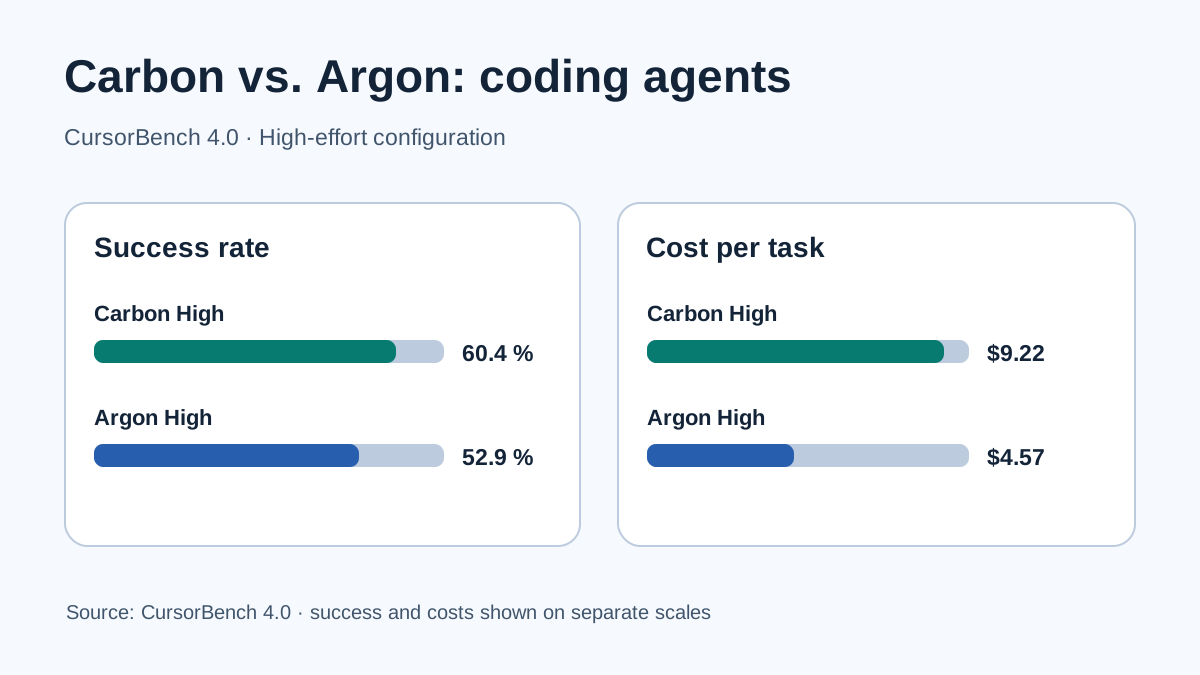
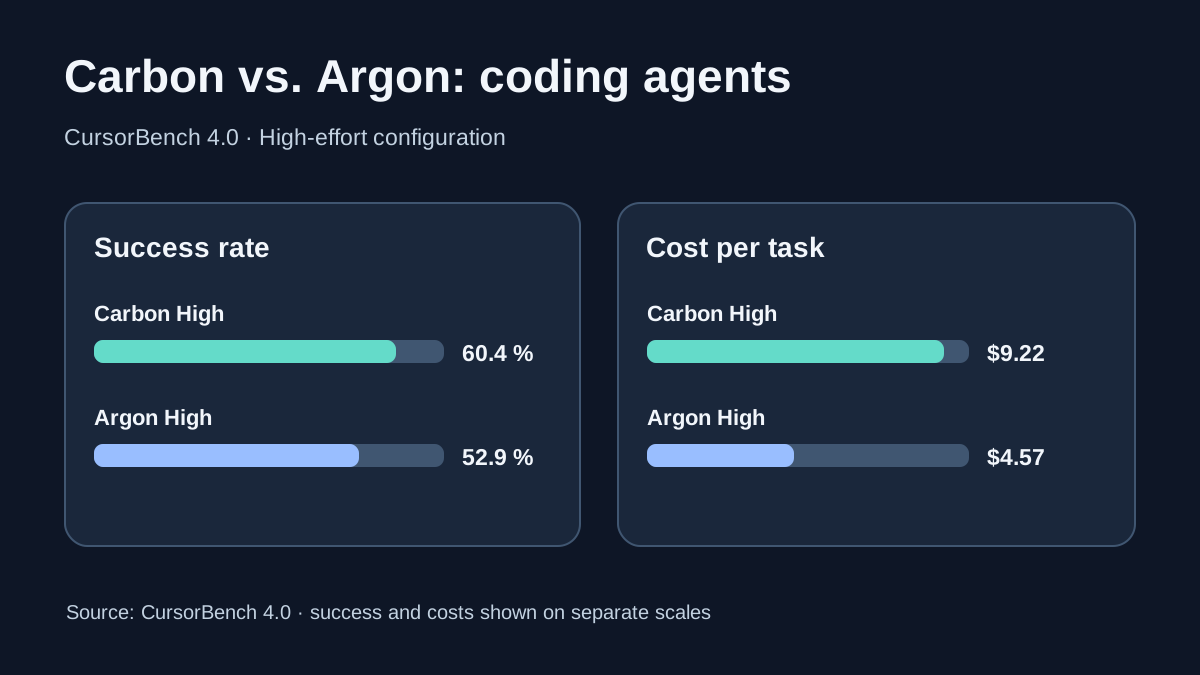
The most useful comparisons are evaluations that run complete tasks rather than grade isolated answers. Two benchmark providers publish scores and task-level costs for Carbon and Argon.
| Evaluator | Carbon High | Argon High | Interpretation |
|---|---|---|---|
| CursorBench 4.0 | 60.4% success; $9.22/task | 52.9%; $4.57/task | Better task success for Carbon, roughly twice the measured cost per task |
| Zapier AutomationBench | 53.88%; $2.12/task | 51.29%; $1.70/task | More modest improvement on cross-app business tasks |
| DeepMind: Terminal-Bench 4.0 (AA) | 65.2% | 57.1% | Reported agentic terminal performance; use the disclosed testing context |
| DeepMind: GraphWalks 256K–1M F1 | 96.2% | 84.2% | Stronger retrieval in a controlled long-context traversal task |
CursorBench uses ambiguous multi-file tasks based on actual Cursor sessions. Its cost is calculated from model token usage and published prices, and the maintainers caution that small score gaps may not be statistically meaningful. Zapier’s benchmark deliberately scores the final state of a simulated business environment, not an agent’s claim that it completed the task. Both are valuable; neither predicts outcomes for every repository or company. 562
Artificial Analysis currently lists Carbon High at an Intelligence Index of 60, whereas Google’s November 10 model card reproduces a score of 59 for its earlier evaluation snapshot. These are source-and-date-specific numbers; do not combine or average them. Artificial Analysis also characterizes Carbon as comparatively slow and verbose per test task, making real workflow latency worth measuring separately from raw accuracy. 72
Google reports strong cyber results including 88.2% on SEC-bench Pro and 71.0% on CWE-bench. However, the model card explicitly limits the reported cyber evaluation configuration to access through the Fairwind program. It would be inaccurate to assume that every standard public API call carries the same specialized research access or behavior. 28
The November price is temporary
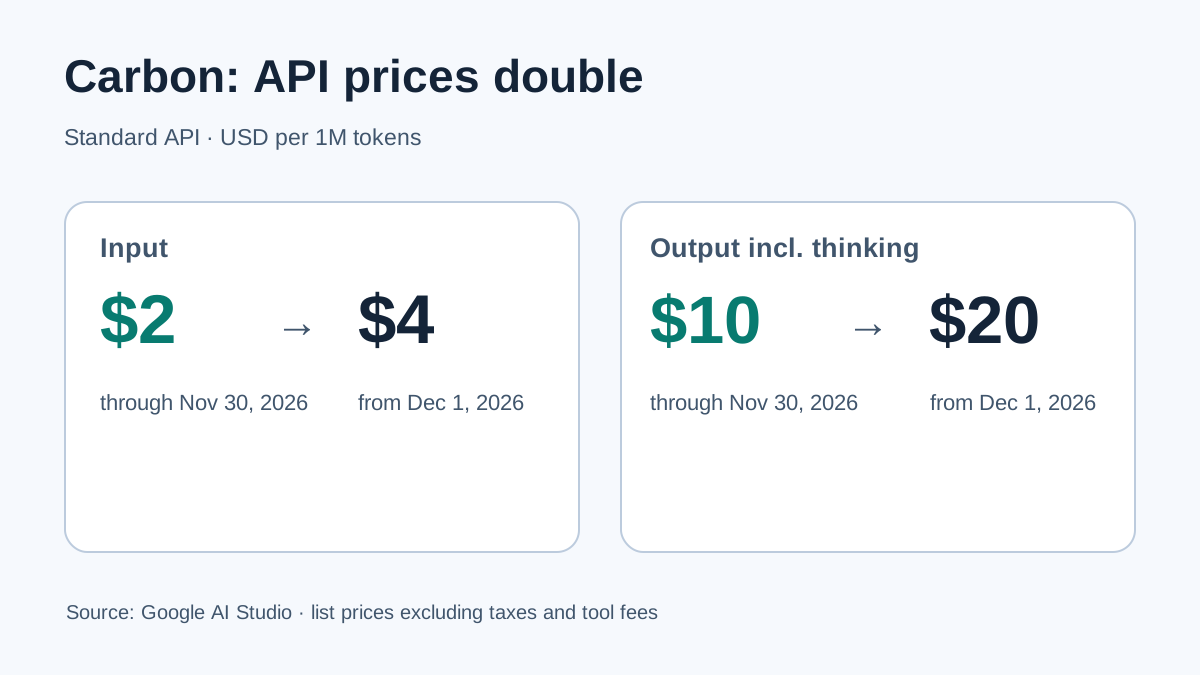
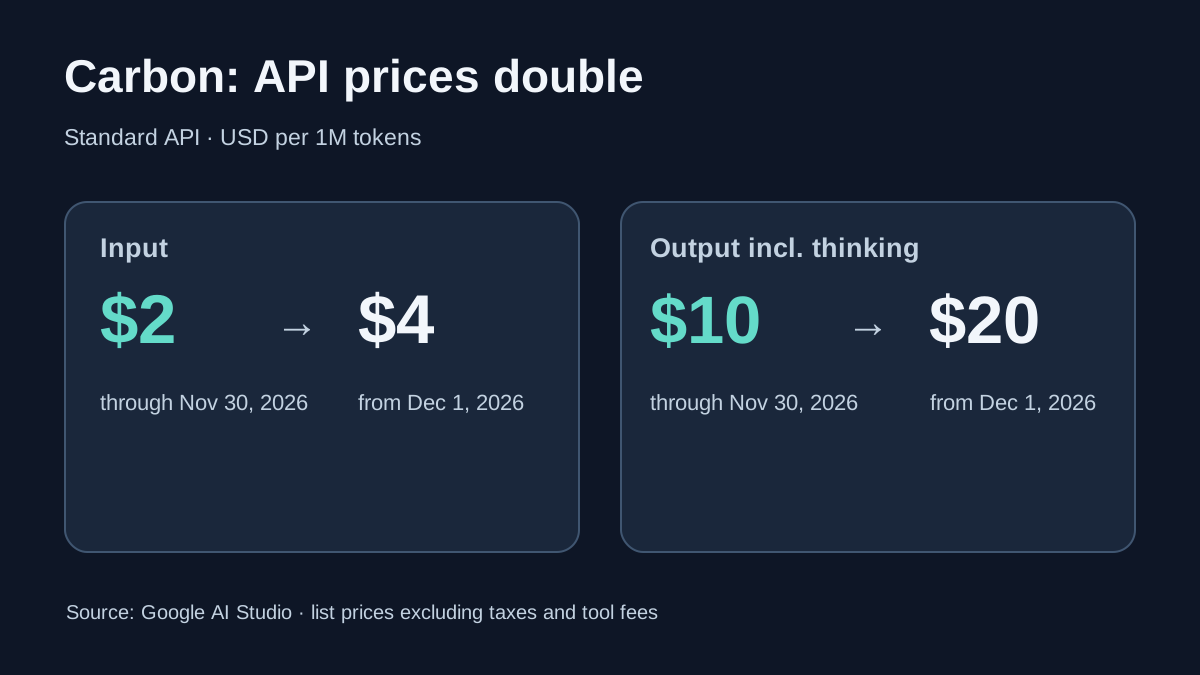
Google AI Studio’s public pricing page is the primary source for billing. From November 10 through November 30, 2026, Carbon costs $2 per million input tokens and $10 per million output tokens on standard inference. On December 1, those prices become $4 and $20 respectively. Output pricing includes thinking tokens; the free API tier does not offer Carbon. Implicit cache reads are priced at $0.10 per million tokens during the promotion and $0.20 after it. 9
Google also lists discounted Batch and Flex modes at $1 input / $5 output per million promotional tokens, compared with $2 / $10 after December 1. Priority inference has higher rates. These are distinct execution modes with eligibility and API constraints, not alternative promises of identical latency and throughput. The Batch API documentation describes non-real-time processing and a separate API surface. 910
Three cost scenarios (independent calculations)
The estimates below assume hypothetical monthly volumes, standard inference, successful cache hits at the stated proportions, and no taxes, routing markups or tool fees.
Formula: uncached input millions × input rate + cached input millions × cache-read rate + output millions × output rate.
| Monthly workload | Input / output | Assumed cached input | Through Nov 30 | Starting Dec 1 |
|---|---|---|---|---|
| Light experimentation | 1M / 0.2M | 0% | $4.00 | $8.00 |
| Active application | 10M / 2M | 50% | $30.50 | $61.00 |
| Heavy agent platform | 100M / 20M | 80% | $248.00 | $496.00 |
The heavy scenario should not be mistaken for a typical monthly bill. Its purpose is to show the sensitivity to output and cache assumptions. When an agent sends a large repository or tool history repeatedly without actual cache hits, the uncached portion can dominate its spending. The cache feature is automatic and not guaranteed; Google’s documentation says its minimum eligible prefix is 4,096 tokens for Gemini 4 models, with additional rules affecting some short follow-up turns. 11
A critical metric is cost per verifiably completed task. The cheapest model per token may still cost more when it needs repeated attempts, while a high-quality model can overspend if its long reasoning loops do not improve completion rates.
API integration: a minimal verified request
Google’s current developer guidance uses the Interactions API. With the official Python SDK installed and a valid GEMINI_API_KEY in your environment, the first request is straightforward: 1213
from google import genai

client = genai.Client()
result = client.interactions.create(
    model="gemini-4-carbon",
    input="Review these migration requirements for contradictions: ...",
)
print(result.output_text)
This example is adapted from Google’s documented SDK pattern and does not imply that a live API call was executed for this article. Paid billing must be enabled. For production, add retries for rate limits, tool permissions, timeout handling, logging controls, a cost ceiling and automated checks for the final artifact. Long-running operations can use background execution and query the same interaction after the initial request disconnects. 1314
Long Decode does not eliminate runtime constraints
Google’s Long Decode feature enables multiple sequential continuation hops. An application does not simply request one enormous conventional HTTP response: foreground streaming or server-side background execution coordinates the steps. That distinction affects timeouts, progress reporting, retry logic, observability and billing. Request budgets should cover the shared input/thinking/output window, not just visible final text. 4
Google Antigravity /swarm
Carbon arrived alongside a preview of /swarm in Google Antigravity. The feature organizes specialized agents across isolated Git worktrees, shares their status on a common board, and assigns verifiers to challenge diffs and run tests. Google’s own guidance suggests using Carbon for hard coordination, security auditing and architecture while pairing it with lighter workers for routine file editing. 15
This is an orchestration feature, not a property of every Carbon API deployment. Teams integrating Carbon in their own code need to build or adopt their own concurrency, repository isolation, execution policies and verification infrastructure. Multiple concurrent workers can consume model quota substantially faster than one assistant. This feature is separate from Google’s enterprise Gemini Agent at Work announcement.
Mac use: powerful cloud client, not local inference
An M-series Mac can host the IDE, a Python or JavaScript application, a project index and supporting tools that invoke Gemini 4 Carbon remotely. That is useful, but it is not local AI. Google’s published distribution channels are managed services, and it has not released Carbon model weights for MLX, Ollama or llama.cpp. No amount of Unified Memory changes that distribution restriction. 2
If offline access, complete on-device processing or predictable low marginal inference cost are hard requirements, compare open-weight models on the actual Mac. If the central requirement is difficult reasoning across large codebases, a cloud Carbon call may be worth benchmarking. Keep the comparisons fair: local model benchmarks on AI on Mac measure the named local models, not Carbon itself. See the locally measured MLX model results for an on-device reference point.
European routing: technically possible, legally more nuanced
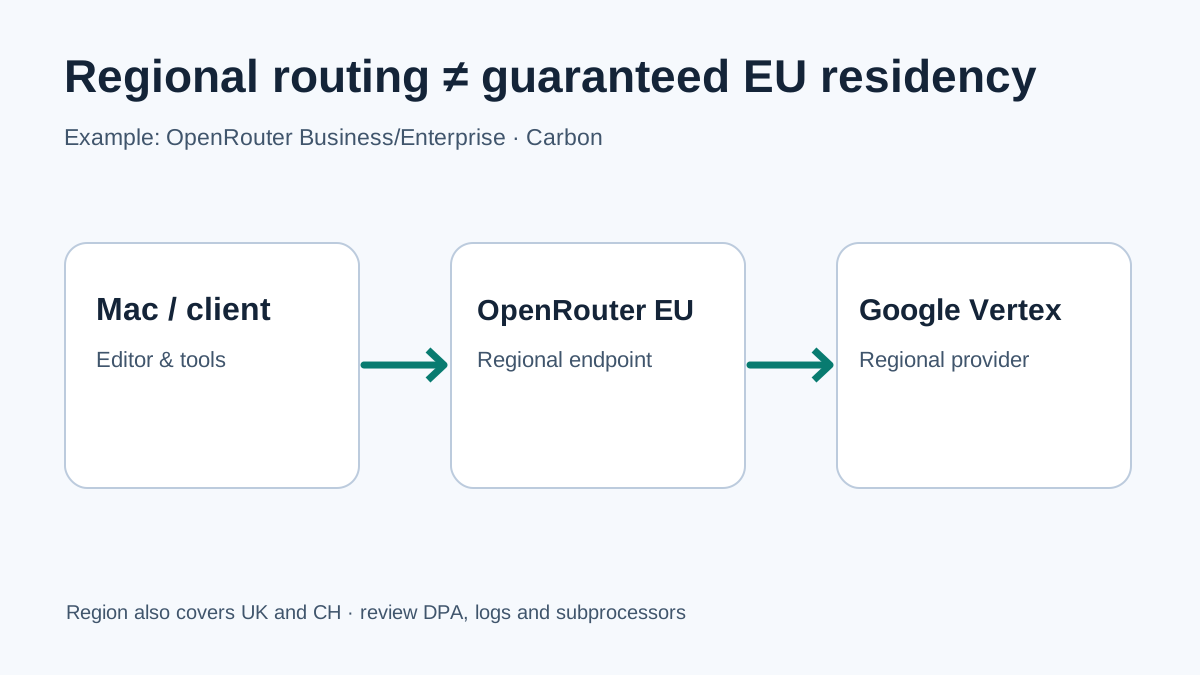
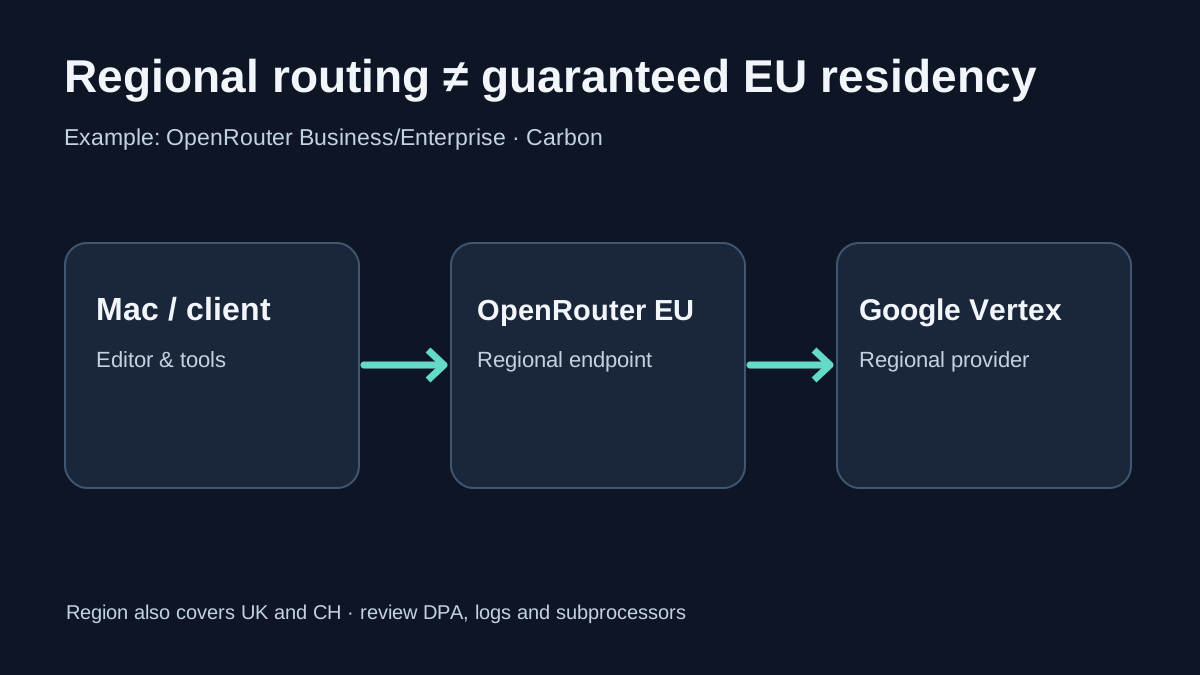
Germany is among the supported Gemini API countries. Google’s API terms distinguish paid from unpaid services and say prompts and responses from eligible paid services are not used to improve Google’s products. That does not amount to an unconditional promise that all service data remains exclusively in Germany or the EU; the terms also describe potential storage and security logging in other regions. 1617
OpenRouter separately documents an EU in-region route for Carbon through a regional Google Vertex provider. The displayed regional price on November 11 is $2.20 input / $11 output per million tokens, and the documented base URL is https://eu.openrouter.ai/api/v1. A Business or Enterprise plan is required. OpenRouter’s geographic definition includes the EU/EEA, the UK and Switzerland, so it must not be misrepresented as strict EU-only processing. Its fail-closed routing behavior can be useful but is not a substitute for contractual and privacy review. 1819
Before processing sensitive data, review the applicable service terms, data-processing agreements, subprocessor lists, telemetry and regional deployment settings. A product being accessible from Europe is not proof of compliance for a specific organization or dataset.
A scientific footnote worth watching
Google also described Carbon-assisted work on retrieving remote protein homologs from large sequence archives. Across seven low-homolog protein families from the CASP17 blind test set, it reported an average 40-fold increase in homologs retrieved in a multi-agent setup. This is a claim about upstream sequence discovery, not a demonstration that Carbon replaces AlphaFold 3 or independently validates structure predictions. Google says broader benchmarking is still underway. 1
Researchers should require sequence provenance, reproducible query definitions, controlled database versions and independent biological evaluation before incorporating such workflows into a research pipeline.
A practical adoption test
Do not migrate a full coding workflow based only on a public leaderboard. Select 20 representative project tasks, including long migrations, simple bug fixes and ambiguous issues. Run Carbon and Argon under identical tool permissions and test suites. Repeat each task multiple times; log objective success, introduced regressions, human review time, latency, cache hit rate, thinking/output tokens and total cost. Decide whether Carbon’s additional success rate offsets its operational cost for the specific category of tasks you need it to handle.
For many developers, the best arrangement will be a default fast model with escalation to Carbon when verification fails or complexity warrants it. A Mac can be the development workstation; Carbon remains the remote inference service.
Questions developers ask
Does Carbon have a free API tier? No. The Google AI Studio pricing page marks the free tier unavailable for this model. 9
Can it output one million tokens? Through Long Decode continuation within the shared context budget, not one ordinary synchronous response. 4
Is explicit prompt caching available? No. Gemini 4 Carbon uses implicit context caching only. 11
Is Carbon automatically cheaper than Argon? No. A shared advertised token price does not imply similar thinking-token spend, runtime or cost per completed task. 56
Can an Apple Silicon Mac load the model weights? No official Carbon weights are available for local installation. 2
Does EU in-region routing mean EU-only processing? Not necessarily. The provider’s region definition covers the EU/EEA plus the UK and Switzerland; legal compliance requires separate review. 1819
Method and sources
This article was fact-checked on November 11, 2026 using official model and API documentation, independent benchmarks and provider routing information. No original Carbon inference results are claimed. The cost table uses openly stated inputs and prices and excludes taxes and tool charges. A complete evidence matrix and expanded source register are included in the accompanying editorial package.