Updated September 30, 2026 — after Google’s official Gemini 4 Argon announcement
Google has now published a detailed first-party announcement for Gemini 4 Argon, substantially changing what can be stated as confirmed. Argon has a maximum output limit of 1 million tokens, launches at an introductory API price of $2 per million input tokens and $10 per million output tokens, and now has multiple Google-published benchmark results. It is still not generally available: the first rollout is to trusted cyber defenders through Google’s Fairwind Program. [G1][G2]
The key correction to pre-launch reporting is straightforward: 256k output and $2.25/$11.25 are not the official Argon specifications. Google instead confirms 1M output and $2/$10 introductory pricing. The rumored 2-million-token context window, however, is still not explicitly confirmed in Google’s announcement. [G1][L1][L2]
The short version
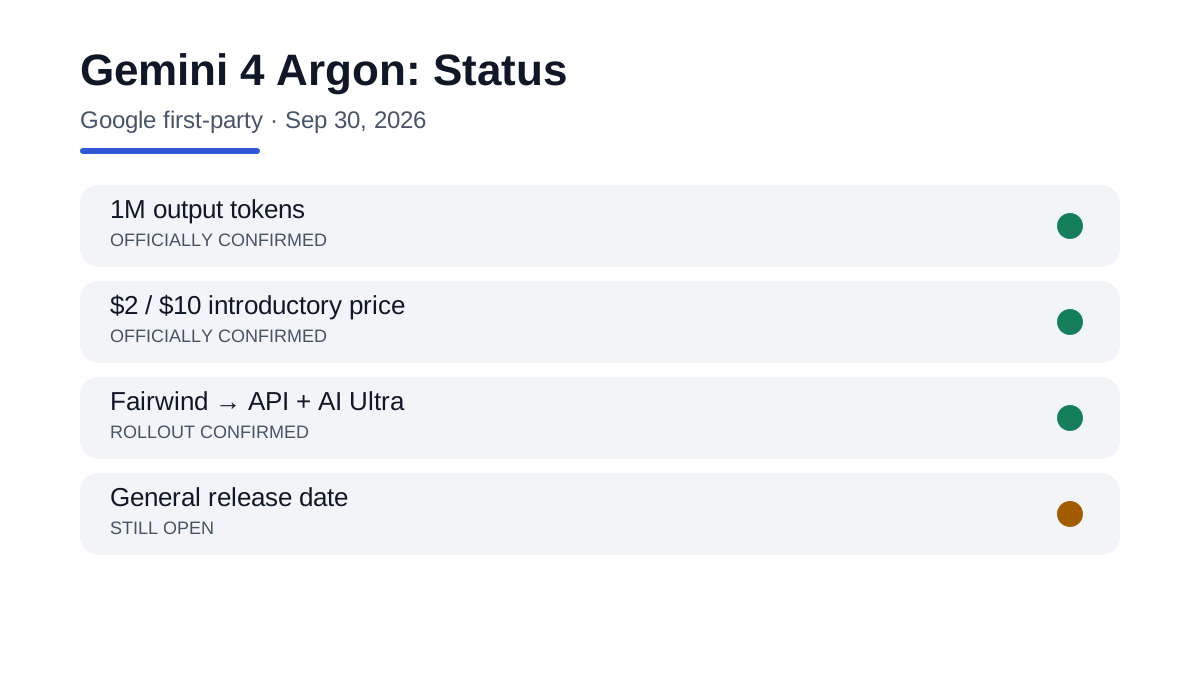
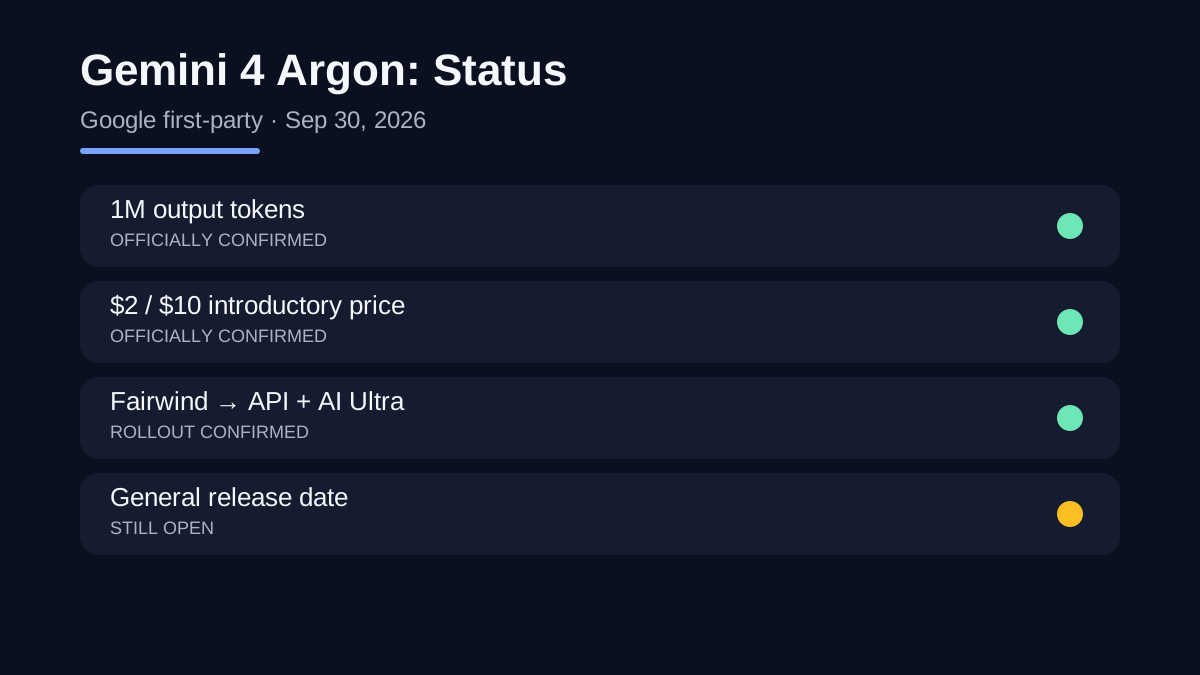
| Question | Official status on Sep. 30, 2026 |
|---|---|
| Is Gemini 4 Argon official? | Yes. Google introduced Argon as its new Gemini 4 frontier model. [G1] |
| Is it publicly available? | Not generally. Trusted cyber defenders get the first access through Fairwind. [G1][G2] |
| Maximum output? | 1,000,000 tokens. Google explicitly says Argon expands output from the previous 64K limit to 1M. [G1] |
| Context window / input limit? | Not explicitly disclosed. The earlier 2M context claim remains unconfirmed. [G1][L1] |
| Introductory price? | $2 / 1M input, $10 / 1M output. Cached input is 95% off, or effectively $0.10 / 1M at the intro rate. [G1] |
| Price after the introductory period? | $4 / 1M input, $20 / 1M output. Google’s footnote states the post-intro rate. [G1] |
| Public API model ID? | Google’s launch post does not yet provide a generally available public model ID. [G1] |
| Who gets access next? | Google says broader rollout will start with paid API customers and Google AI Ultra subscribers. No date is given. [G1] |
What Google DeepMind officially says about Gemini 4 Argon
Google’s first-party post, “Gemini 4 Argon: our next era of frontier intelligence,” is authored by Koray Kavukcuoglu, SVP at Google DeepMind and Google’s Chief AI Architect. Google positions Argon for complex, long-horizon workflows across real-world software engineering, enterprise knowledge work such as legal and finance, cybersecurity defense, and creative writing. [G1]
Google explicitly describes the launch as phased. Argon is first reaching trusted cyber defenders through Fairwind while Google participates in the U.S. government’s voluntary pre-release model-access process. The company says it will expand to developers, enterprises and consumers as soon as possible after gathering feedback and iterating on safeguards. [G1][G2]
1 million output tokens: the biggest confirmed spec change
The headline technical specification is Argon’s 1-million-token output limit. Google says this is a major expansion from the previous 64K output ceiling, giving the model enough room to reason and generate hundreds of thousands of tokens in a single trajectory. [G1]
That distinction matters: 1M output is confirmed; a 2M input/context window is not. Google’s announcement does not specify Argon’s maximum input context size. [G1][L1]
Official pricing: $2/$10 at launch, then $4/$20
Google has also published Argon’s pricing:
| Token type | Introductory price | After introductory period |
|---|---|---|
| Input | $2 / 1M tokens | $4 / 1M tokens |
| Cached input | $0.10 / 1M tokens at the intro rate | depends on the then-current input rate |
| Output | $10 / 1M tokens | $20 / 1M tokens |
The cached-input figure follows directly from Google’s stated 95% discount versus normal input tokens. This supersedes the leaked $2.25/$11.25 figure. [G1][L2]
Google’s official Argon benchmark results
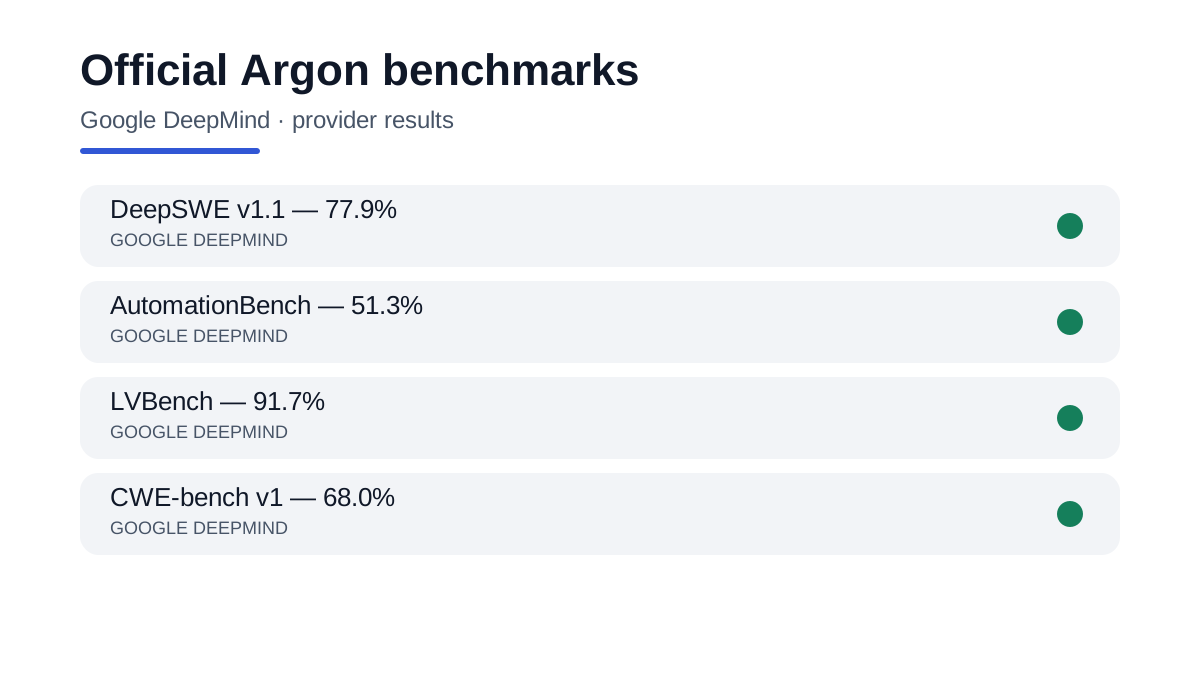
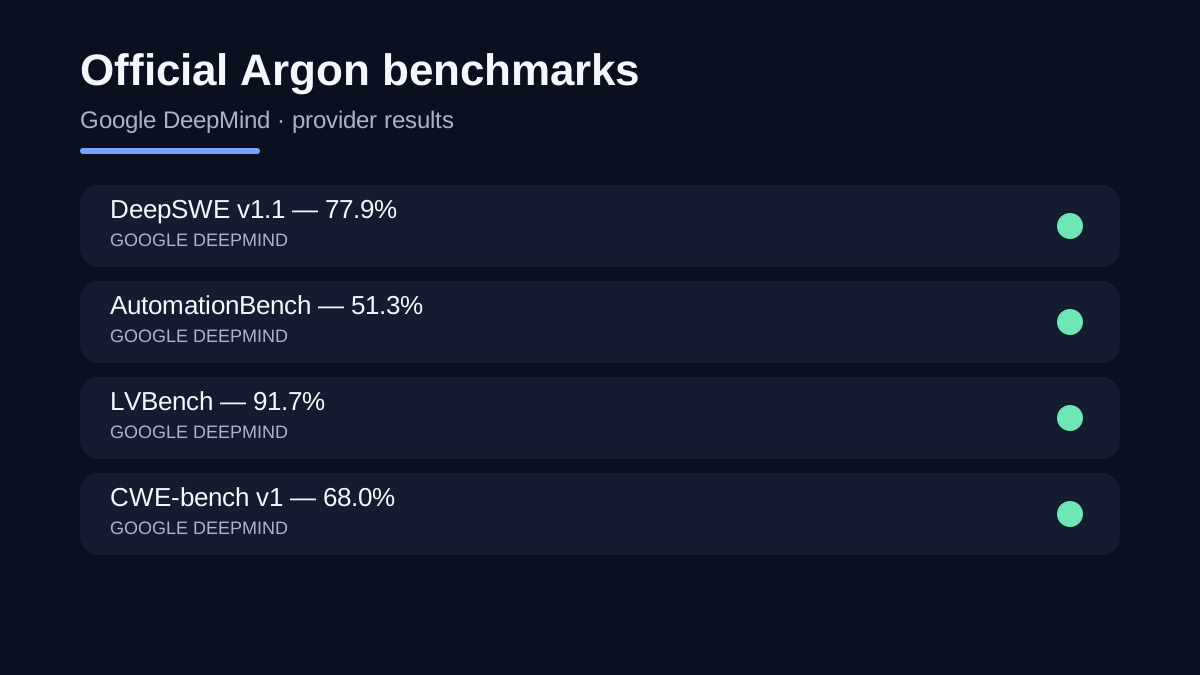
Google DeepMind has now also published a dedicated Gemini 4 Argon model page with a substantially larger first-party performance table. These are provider-reported results rather than independent reproductions, but they are now directly documented by Google rather than inferred from leaks. [G3][G4]
| Benchmark | Gemini 4 Argon | GPT-6 Astra | Claude Opus 5.5 |
|---|---|---|---|
| Vals Index | 68.9% | 63.1% | 67.0% |
| AutomationBench | 51.3% | 41.4% | 42.5% |
| Vals Finance Agent v2 | 65.4% | 53.5% | 58.6% |
| Harvey’s Legal Agent Benchmark | 19.6% | 5.4% | 3.8% |
| DeepSWE v1.1 | 77.9% | 74.1% | 74.2% |
| FrontierSWE v2 | 55.0% | 65.5% | 62.3% |
| Vibe Code Bench | 91.9% | 89.6% | 90.3% |
| Terminal-bench 4.0 | 57.4% | 58.2% | 66.4% |
| PostTrainBench | 45.3% | 44.3% | 49.3% |
| Terminal-Bench Science 0.1 | 57.6% | 68.1% | 63.3% |
| LABBench 2 | 88.8% | 85.4% | 73.1% |
| RiemannBench | 76.0% | 72.0% | 69.6% |
| GraphWalks up to 128k | 99.7% | 98.7% | 90.6% |
| GraphWalks 256k–1M | 84.2% | 71.8% | 66.8% |
| Agent’s Last Exam | 39.5% | 34.2% | 38.2% |
| OSWorld 2.0, offline subset | 69.2% | 72.6% | — |
| Chartography | 71.6% | 71.0% | 66.3% |
| LVBench | 91.7% | 87.5% | 83.7% |
| CWE-bench v1 | 68.0% | 68.0% | 67.0% |
The DeepMind table also adds an important long-context datapoint: Google evaluates Argon on GraphWalks from 256k to 1M context and reports 84.2% F1. That demonstrates operation in that range, but it is not the same thing as an explicit statement that 1M is the API model’s maximum input limit. The earlier 2M-context leak therefore remains unconfirmed. [G3][L1]
The launch also resolves a major leak discrepancy: the pre-release table claimed 88.7% on DeepSWE v1.1, while Google’s official figure is 77.9%. [G3][L2]
Leak vs. official: what changed?
| Pre-launch claim | Official status now |
|---|---|
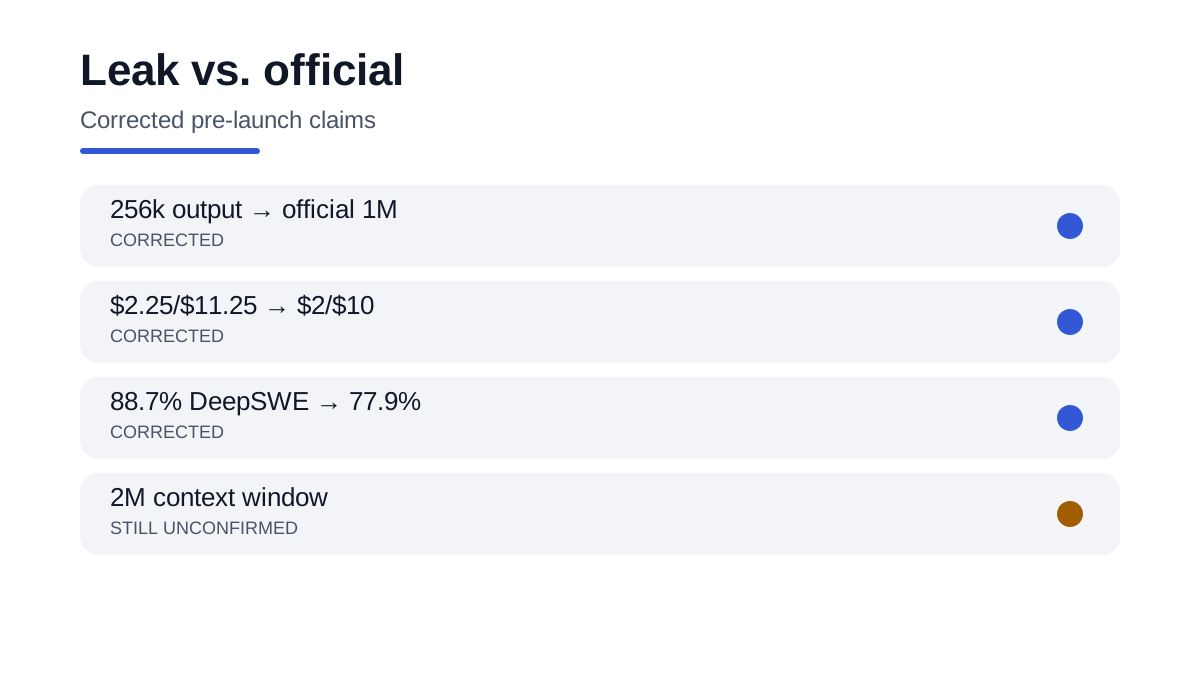
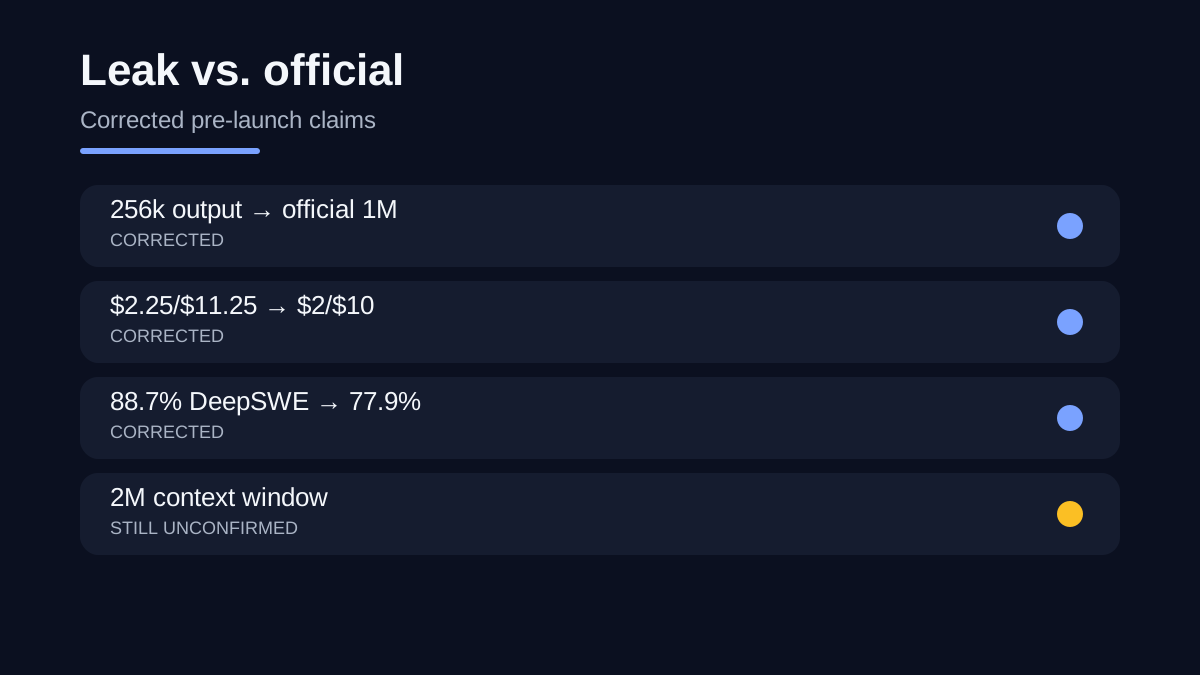
| 256k output tokens | Superseded: Google confirms 1M output tokens. [G1][L1] |
| $2.25 input / $11.25 output | Superseded: official intro price is $2/$10, then $4/$20. [G1][L2] |
| 88.7% DeepSWE v1.1 | Google’s launch result is 77.9%. [G1][L2] |
| 2M context window | Still unconfirmed. Google does not state a maximum input context in the announcement. [G1][L1] |
| Broad October / “in weeks” launch | Not confirmed. Google says “as soon as possible” and identifies paid API + AI Ultra as the first broader groups. [G1] |
What Argon is already doing inside Google
Google gives unusually specific examples of internal Argon deployments. These are vendor-reported internal results, not independently reproduced benchmarks. [G1]
- Quantum algorithmic optimization: In one example, Google says Argon beat a published baseline by 40% when optimizing qubit×gate resources.
- Data-center memory: Argon agents reportedly freed more than 300 TiB of memory after rollout, with Google estimating 500 TiB to 1 PiB in total potential savings.
- C/C++ → Rust migration: Google says Argon is being used on migrations ranging from libraries such as re2 and libgav1 to 800K+ lines in Fuchsia’s Zircon kernel.
- libgav1: Argon agents replaced 32K lines of SIMD code in an existing Rust port. Google says the resulting memory-safe decoder runs 2.7× faster than that Rust port while producing identical video output.
These examples are useful evidence of intended workloads, but they should stay clearly labeled as Google-internal results. [G1]
Cybersecurity: Fairwind gets Argon first
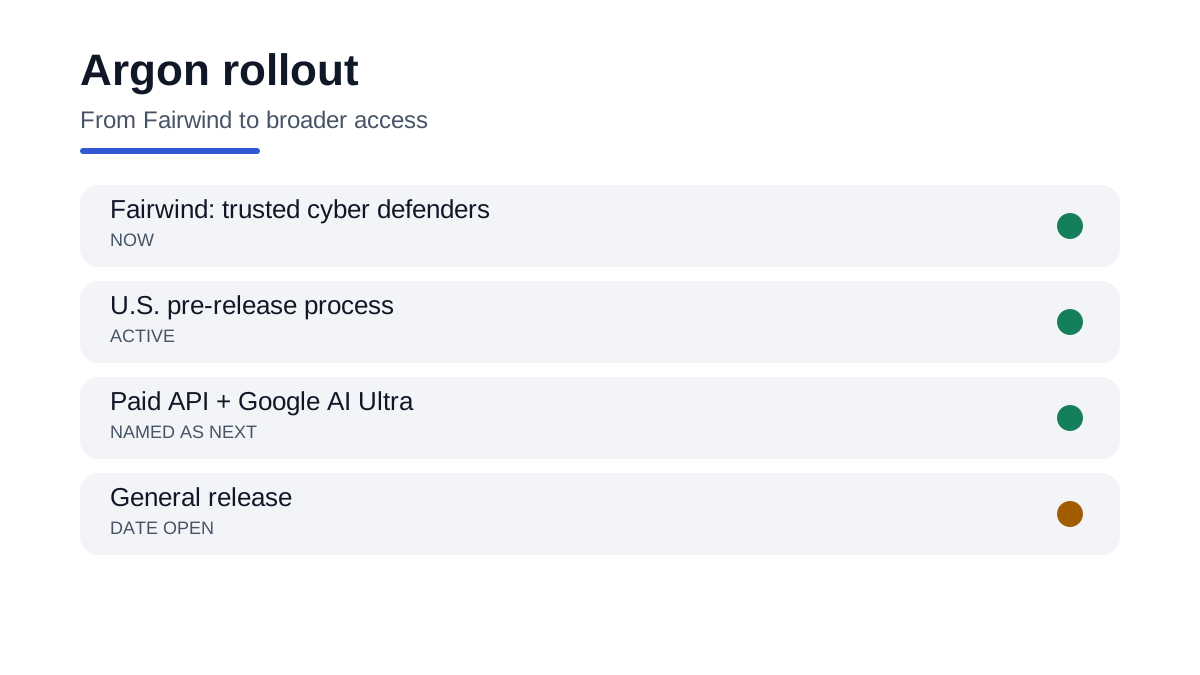
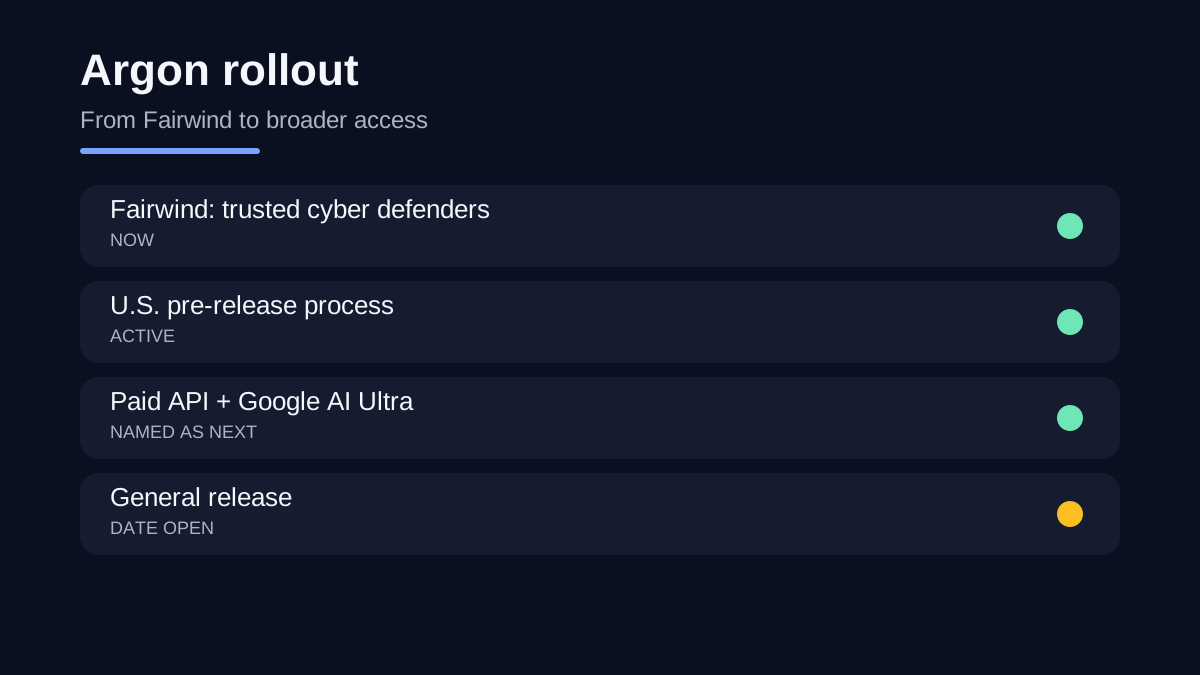
Argon is initially a cybersecurity-first rollout. Google says the model can autonomously find, validate and patch critical software vulnerabilities. For trusted defenders and Google’s internal teams, the company says it will provide Argon without cyber guardrails so those users can employ its full defensive capabilities. [G1][G2]
Google also names Wiz as an early Fairwind user through Scan for Good. In one early deployment, Google says Argon found a critical vulnerability that exposed sensitive personal information in healthcare software used by hospitals around the world — a risk that previous frontier models had missed. [G1]
On Google’s internal vulnerability benchmark, Argon reportedly found exposures across 20 programming languages. On Wiz’s internal black-box penetration-testing benchmark, Google says Argon outperforms Gemini 3.8 Flash Cyber on attack-surface discovery, vulnerability identification and proof-of-concept evidence. These remain provider/partner-reported results. [G1]
Frontier safeguards before broad availability
Google highlights four safety areas before broad release: preventing misuse including cyber and CBRN attacks, improving resistance to indirect prompt injection, monitoring for possible misalignment, and hardening isolated sandbox environments for high-risk training and evaluation. [G1]
Notably, Google says it is deploying mitigations that monitor Argon’s chain-of-thought and actions and can stop execution when necessary. The company says related monitoring systems were also used during training runs. [G1]
When will regular users get Gemini 4 Argon?
There is still no exact public release date. Google says it intends to make Argon available to developers, enterprises and consumers as soon as possible after the controlled testing phase. The first groups named for broader access are paid API customers and Google AI Ultra subscribers. [G1]
Specific October dates or “two-week” launch claims therefore remain speculation until Google publishes a date.
What remains unknown
Despite the much more detailed launch post, several pieces are still missing for a complete technical assessment:
- the maximum input/context window — the 2M claim is still unconfirmed,
- a generally available API model ID and exact AI Studio/Vertex availability,
- a full model/system card with evaluation details,
- independently reproduced Argon benchmark runs under matched harnesses,
- public rate limits, caching rules and regional availability for the wider API launch.
Bottom line: official specs correct the leaks, the 2M context claim stays open
Gemini 4 Argon is now far better documented than it was only hours earlier. Google confirms a 1-million-token output limit, $2/$10 introductory input/output pricing, a 95% cached-input discount, specific benchmark results including 77.9% on DeepSWE v1.1, and an initially controlled Fairwind rollout. After the introductory period, pricing rises to $4/$20. [G1]
That means several major leak claims must be corrected: 256k output is obsolete, $2.25/$11.25 is not the official price, and 88.7% DeepSWE is not Google’s published result. The 2M context claim remains unresolved, because Google has not disclosed Argon’s maximum input context in the launch post. [G1][L1][L2]
Sources
- [G1] Google / Google DeepMind: Gemini 4 Argon: our next era of frontier intelligence, Sep. 30, 2026 — https://blog.google/innovation-and-ai/models-and-research/gemini-models/gemini-4-argon/
- [G2] Google DeepMind: Fairwind Program — https://deepmind.google/fairwind-program/
- [G3] Google DeepMind: Gemini 4 Argon — model page and official performance table — https://deepmind.google/models/gemini/
- [G4] Google DeepMind: Gemini 4 Argon evaluation methodology — https://deepmind.google/models/evals-methodology/gemini-4-argon
- [L1] TestingCatalog: Pre-launch report on internal Argon checkpoints and 2M/256k claims — https://www.testingcatalog.com/gemini-4-pro-frontend-ui-taste-leak/
- [L2] Dealroom News: Pre-launch leaked Gemini 4 Pro/Argon benchmark and pricing claims — https://dealroom.co/news/157364-leaked-gemini-4-pro-benchmarks-top-gpt-6-astra-and-claude-opus-5-5/