Google released Gemini 4 Hydrogen on November 12, 2026. At $1.50 per million uncached input tokens and $7.50 per million output tokens, including reasoning, the new model targets the execution-heavy part of software development: reading repositories, implementing changes, calling tools and checking results. It offers a unified 1,048,576-token budget. It is a hosted model, not a downloadable Apple Silicon model. Announcement · Developer API pricing · Cloud specs
Research snapshot: November 12, 2026. This is a documentation and benchmark analysis, not a hands-on inference review.
The numbers developers need
| Specification | Hydrogen |
|---|---|
| Google API model | gemini-4-hydrogen |
| OpenRouter model | google/gemini-4-hydrogen |
| Launch status | Generally available, Nov 12, 2026 |
| Shared context budget | 1,048,576 tokens |
| Single foreground output segment | 65,536 tokens |
| Thinking settings | low, medium, high (default), xhigh |
| Input | Text, images, audio, video, documents |
| Output | Text |
| Knowledge cutoff | March 2026 (Cloud documentation) |
| Weights | Private |
Sources: Model card, Cloud model reference, OpenRouter, Vals AI.
The model card describes Hydrogen as adapted from Carbon. Google has not disclosed its parameter count in these sources. Developers can access it through the Gemini API and AI Studio; Google also announced its rollout to Search, enterprise products and the Gemini app. Free Gemini app users receive Hydrogen through automatic selection when appropriate, rather than guaranteed manual selection. Paid AI Pro and Ultra users can access it in Antigravity. Developer launch · Search rollout
Budgeting for Hydrogen: why the output line matters
| Developer API tier | Input | Cached input | Output incl. reasoning |
|---|---|---|---|
| Standard | $1.50 | $0.075 | $7.50 |
| Batch | $0.75 | $0.0375 | $3.75 |
| Flex | $0.75 | $0.0375 | $3.75 |
| Priority | $2.70 | $0.135 | $13.50 |
All prices are USD per million tokens, checked November 12, 2026, excluding potentially applicable U.S. state or local sales tax, extra provider charges and paid tools. Batch/Flex processing conditions differ from Standard. Google lists a limited free tier; check your project’s actual quota. Pricing · Rate limits
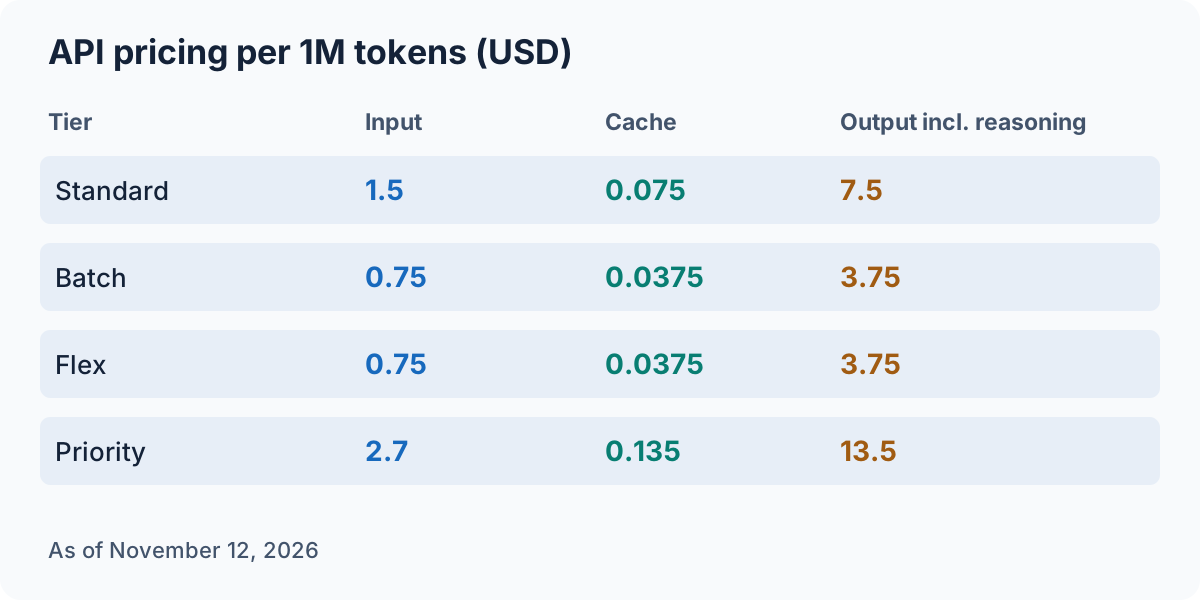
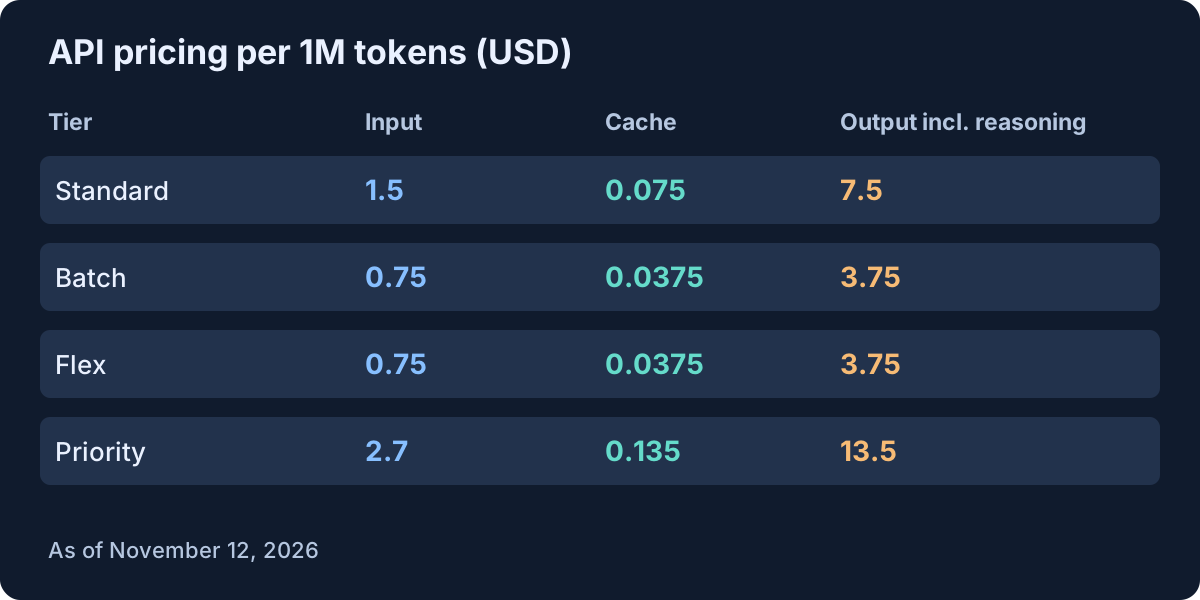
A typical agent pays for repeated inputs as well as code, tool calls and reasoning output. With I million total input tokens, H million input tokens actually served from cache and O million billed output tokens, the Standard estimate is:
USD = 1.50 × (I − H) + 0.075 × H + 7.50 × O.
| Illustrative monthly workload | Input (M) | Cache hits (M) | Output (M) | No cache | With cache |
|---|---|---|---|---|---|
| Occasional | 1 | 0.5 | 0.2 | $3.00 | $2.29 |
| Regular coding | 10 | 8 | 2 | $30.00 | $18.60 |
| Heavy agents | 100 | 90 | 10 | $225.00 | $96.75 |
Calculated examples, rounded to cents. These are hypothetical workloads, not observed monthly usage. If a task generates more thinking tokens or requires retries, the output bill increases. Batch/Flex halves token rates for the same mix, not necessarily total operational cost.
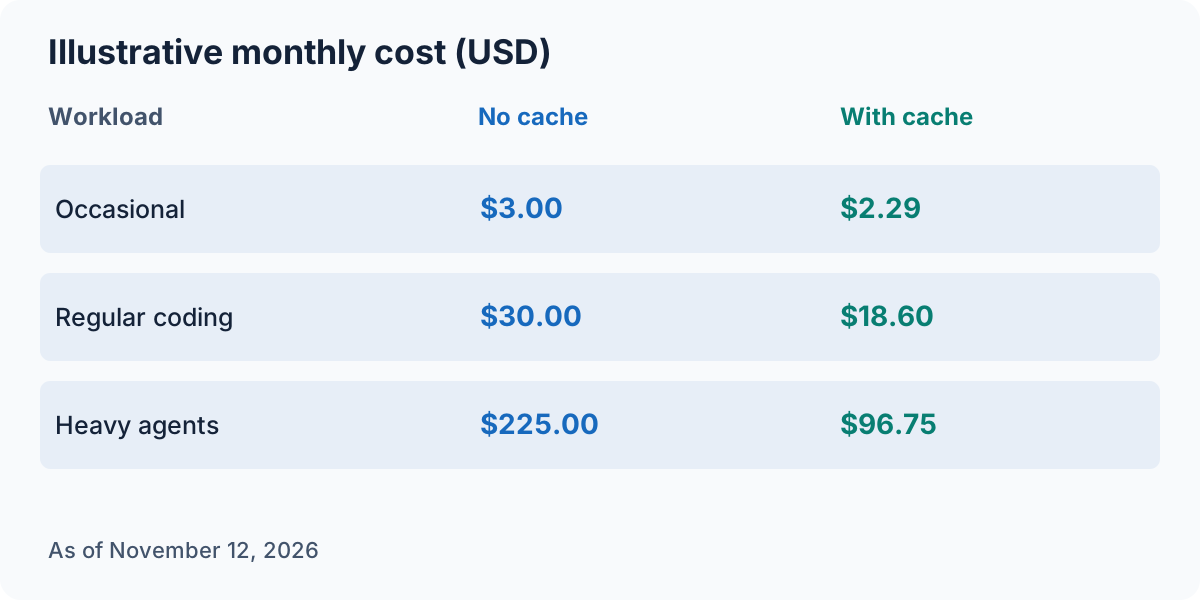
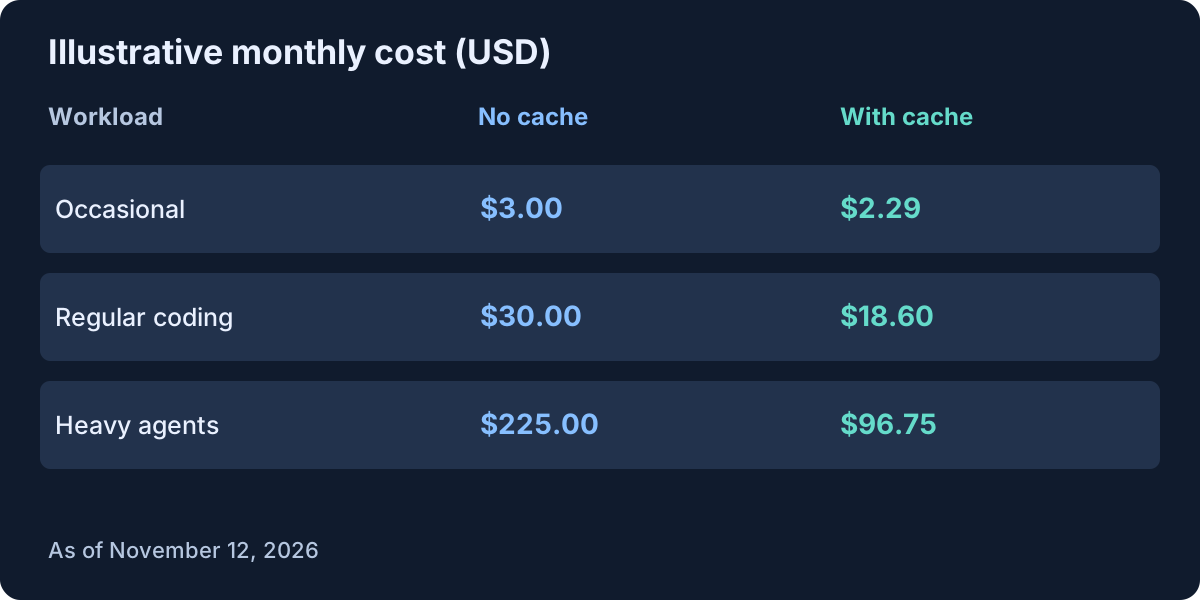
Google’s cache discount is 95% on eligible input, not on the entire bill. Keep stable prefixes near the beginning of requests and measure cache hits in usage metadata. Hydrogen supports implicit caching with a 4,096-token minimum; explicit cache objects are unsupported. Google also documents special multi-turn rules for short prompt extensions. Cache behavior
If an agent uses Google Search grounding, Google’s paid Standard pricing includes 5,000 searches per month shared with other Gemini 3 and newer models, then $14 per thousand searches. One prompt can trigger multiple searches. Grounding · Pricing
Carbon and Argon: compare against the right date
| Standard Developer API | November 12 input/output | Announced December 1 input/output |
|---|---|---|
| Hydrogen | $1.50 / $7.50 | No change announced |
| Argon | $2 / $10 | $4 / $20 |
| Carbon | $2 / $10 | $4 / $20 |
USD per million tokens, according to Google’s pricing page. At equal uncached token volumes, Hydrogen is 25% cheaper today. If the announced Carbon and Argon increases take effect and Hydrogen stays unchanged, the difference becomes 62.5%. This is not an apples-to-apples cost-per-task result: a model requiring additional retries may erase its nominal savings. See our Carbon and Argon analyses for their respective launch details.
Benchmark evidence: a strong worker, not a universal winner
| Google model-card benchmark | Hydrogen | Claude Sonnet 5.5 | GPT-6.1 Terra |
|---|---|---|---|
| SWE-sweep | 13.5% | 3.1% | 5.8% |
| Terminal-Bench 4.1, cheating-adjusted | 57.0% | 63.9% | — |
| Agents’ Last Exam v1.1 | 71.6% | 60.4% | 69.8% |
| OSWorld-2.1 offline subset | 77.6% | 83.9% | 74.2% |
| HLE-Diamond | 58.8% | 53.3% | 47.3% |
Source: Google’s November 2026 model card. Vendor evaluation, not our own measurements. A missing value is not zero; benchmarks test different skills.
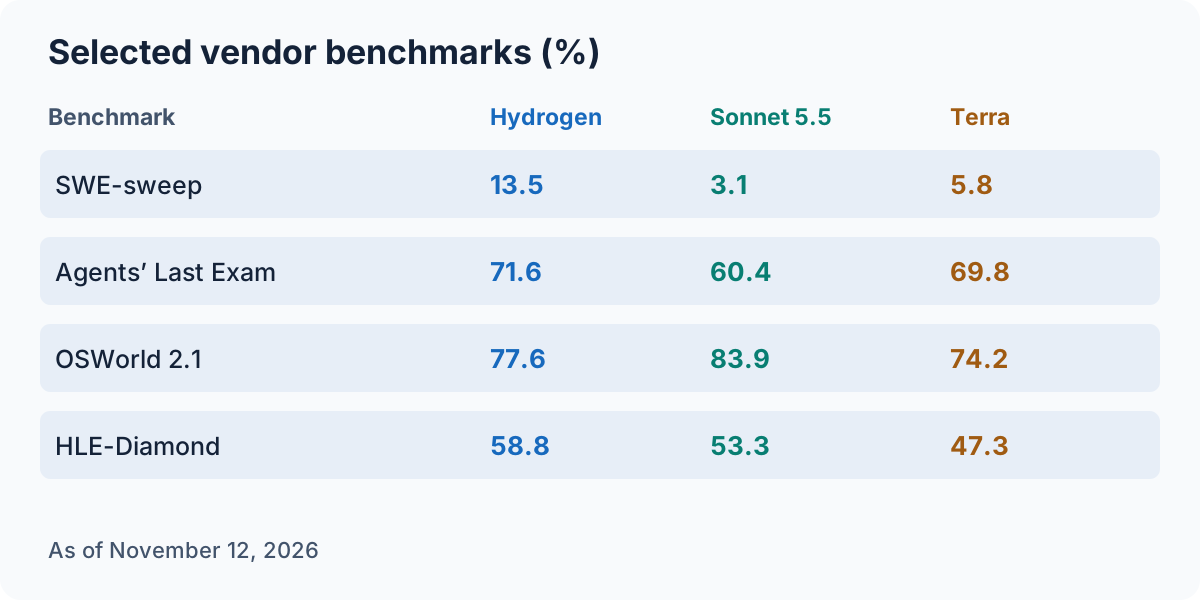
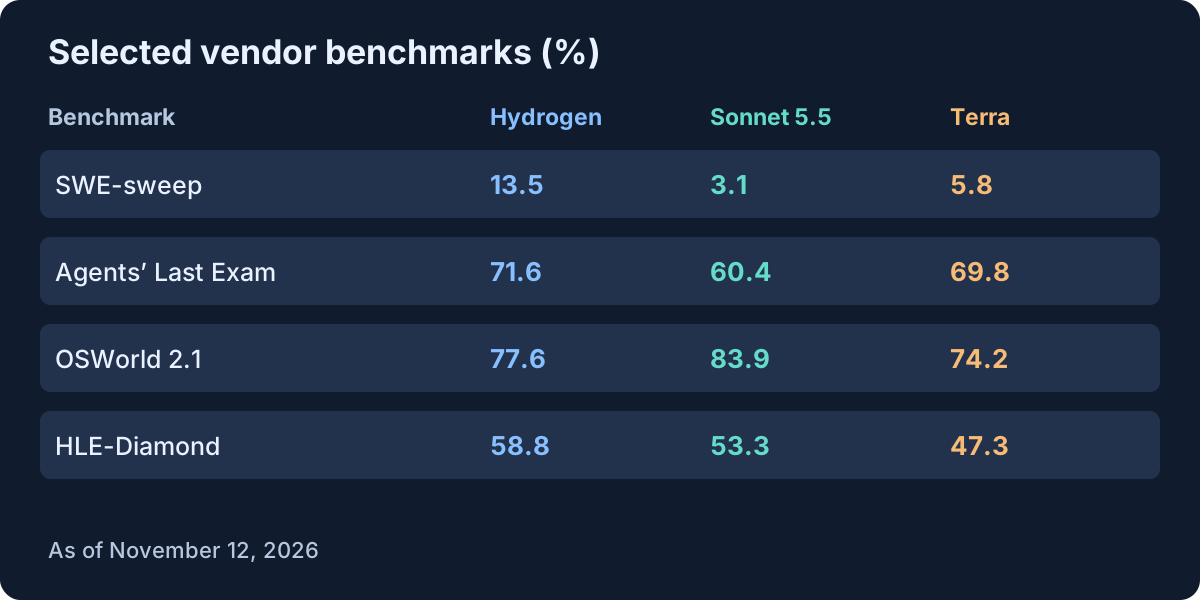
Independent Vals AI results at xhigh are more mixed: Hydrogen scored 68.49% on the Vals Index (sixth out of 37) and 54.04% on Terminal-Bench 4.0 (11th of 64). The latter is a different benchmark version from Google’s 4.1 result. Google reports Artificial Analysis scores of 51 at high and 54 at xhigh, versus 50 for Argon; Ridge provides a secondary listing of the 54 score. The direct AA model page was not accessible during this research. Vals AI · Google announcement · Ridge
One context window, not two
A 1,048,576-token budget has to accommodate incoming context and generated content together, including reasoning and function calls. For example, 800,000 input tokens leave at most 248,576 tokens for everything else. A foreground segment generates at most 65,536 output tokens; longer generations require supported continuation mechanisms. Google specifies v1beta1 for long decodes on Agent Platform. Cloud specifications · Migration guide
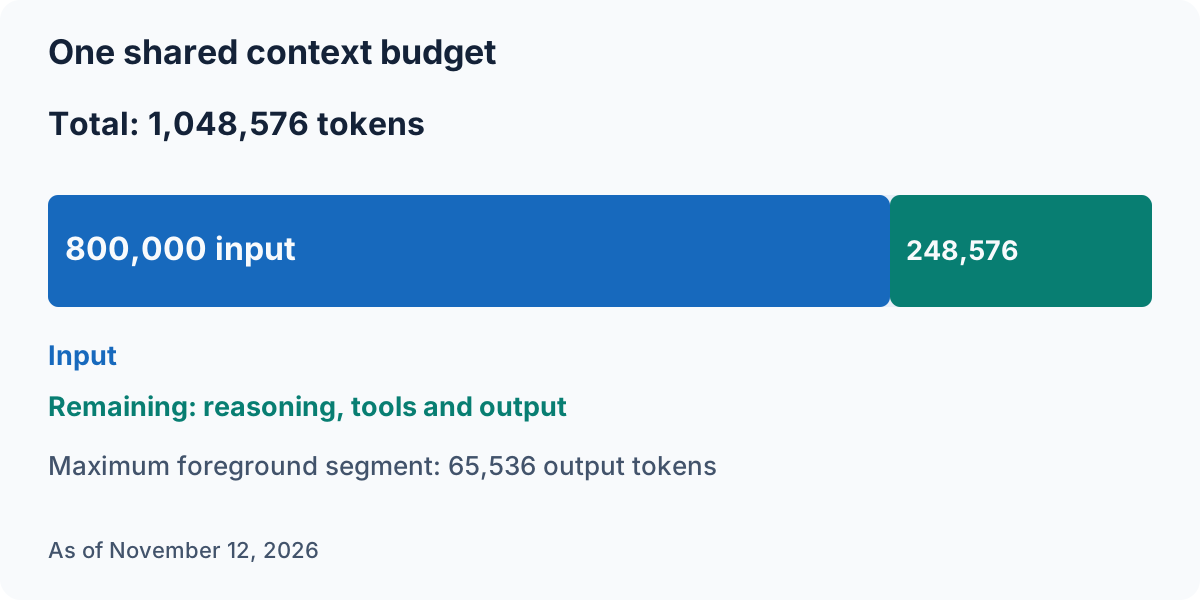
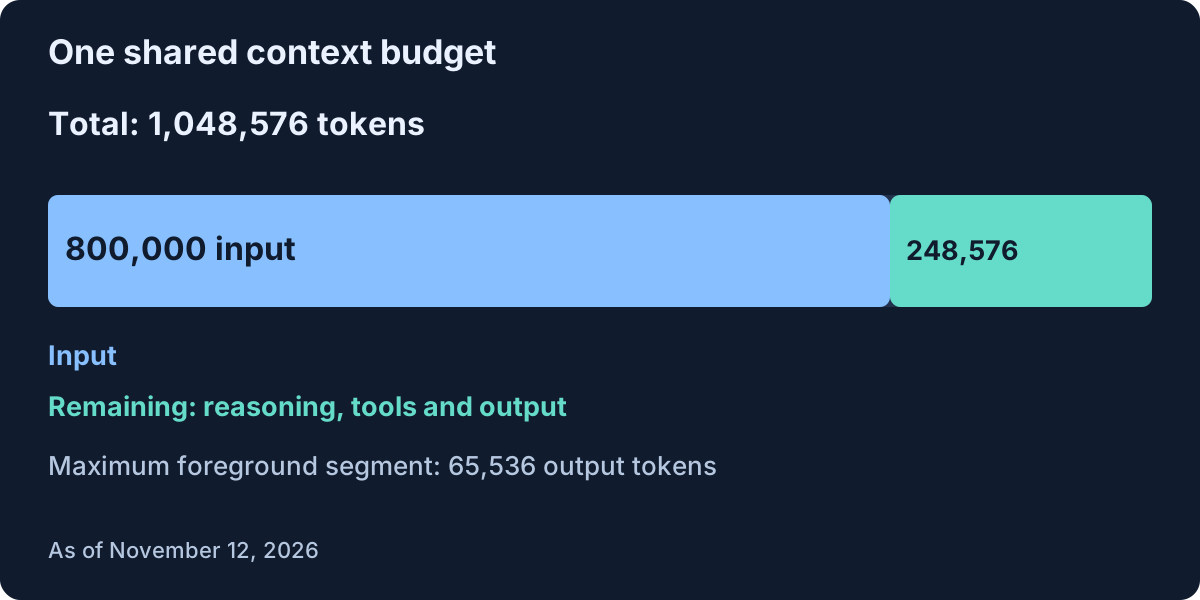
When migrating a Flash-based harness, explicitly configure thinking, remove unsupported thinking_budget and MINIMAL, retain thought signatures across tool turns, and leave compaction headroom. Sampling settings are fixed in the documented Cloud implementation. Hydrogen is a short-term GA release with at least 45 days’ retirement notice; maintain a fallback model rather than hard-coding it indefinitely. Developer guide · Lifecycle
Using Hydrogen from an Apple Silicon Mac
The API client runs on macOS; Google’s servers execute inference. No public Hydrogen weights are available, so installing Ollama or MLX cannot turn it into a local model. Local tests, linters, Git and private local models can still complement a remote agent. See the MacBook Pro AI development guide for hardware considerations.
For a minimal Python API call, create a virtual environment and install the SDK:
python3 -m venv .venv
source .venv/bin/activate
pip install -U google-genai
export GEMINI_API_KEY='YOUR_API_KEY'
from google import genai
client = genai.Client()
result = client.interactions.create(
model="gemini-4-hydrogen",
input="Outline tests for a function that normalizes file paths."
)
print(result.output_text)This example follows Google’s text generation docs; it has not been executed with a live key. An OpenAI-compatible client can instead use the OpenRouter model ID and its configured provider, but check how your client exposes reasoning and continuation.
U.S. data handling and regional routing
For U.S. deployments, Google Cloud lists a US multi-region ML processing option in addition to global and EU options. Confirm the actual processing scope and billing provider for your project; a U.S. endpoint alone is not evidence of U.S.-only handling. The opened OpenRouter listing showed European in-region access via Vertex at $1.65/$8.25 per million input/output tokens on Business or Enterprise, using https://eu.openrouter.ai/api/v1. An earlier search preview disagreed with the live listing, so check before relying on this availability. OpenRouter’s European boundary includes the UK and Switzerland. Google Cloud · OpenRouter · Regional routing
Separate regional inference from contract terms, logging, retention and processing of source code. Google distinguishes paid and unpaid services, and applies paid-service data-use terms even to free usage in the EEA, Switzerland and the UK. The terms also allow limited security logging and transient storage in other countries. API clients offered to users in those regions must use Paid Services. Review the actual API terms before transmitting confidential files. An available region or a paid plan alone does not establish compliance.
A practical agent routing policy
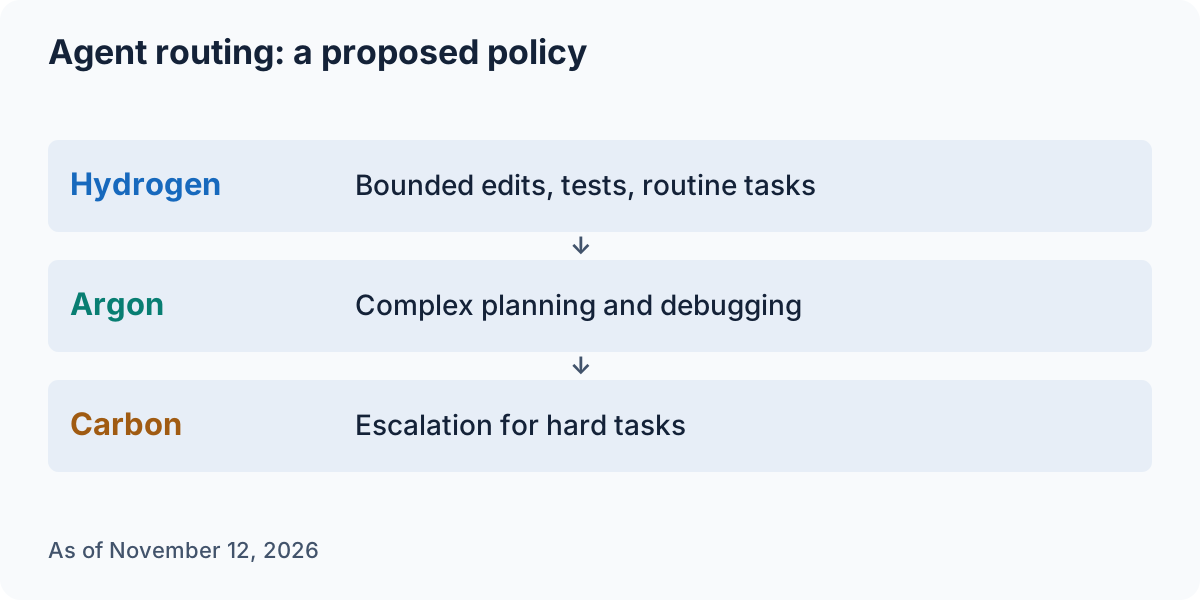
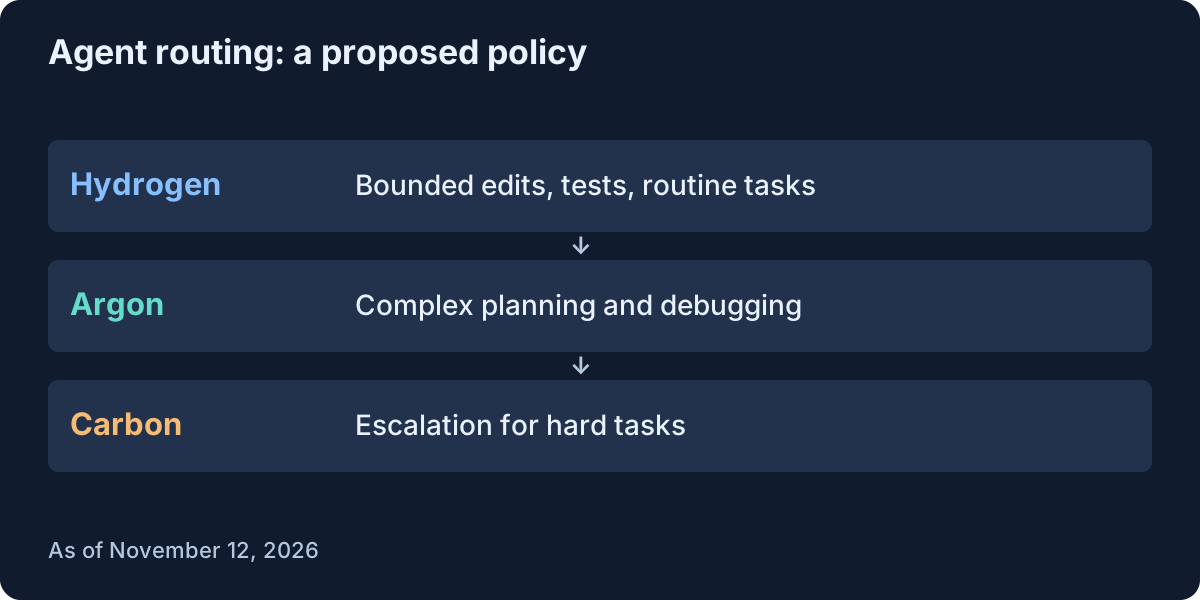
Use Hydrogen as a candidate for bounded edits and repetitive verification. Escalate harder architecture or debugging tasks to Argon or Carbon after failures or ambiguity. Google reports its Antigravity Orchestrator consumed 24% less quota and finished 19% faster on Terminal-Bench 4.0 while approaching Carbon’s success rate. That is a vendor result in a particular harness, not a transferable guarantee. Launch announcement
For a real selection test, run ten representative tickets using the same commit, tools, test suite and acceptance criteria. Record model, thinking level, total billed tokens, cache hits, wall time, retries and accepted patches. Compare cost per accepted ticket, not cost per million tokens alone. This is a proposed test, not a completed benchmark.
Transparency
Sources and review basis
These primary and reference sources form the basis of the technical assessment. Vendor claims and external benchmarks are identified as such in the article.
- blog.google gemini-models / introducing-gemini-4-hydrogen
- aistudio.google.com docs / pricing
- docs.cloud.google.com gemini / 4-hydrogen
- deepmind.google model-cards / gemini-4-hydrogen
- openrouter.ai google / gemini-4-hydrogen
- vals.ai models / google_gemini-4-hydrogen
- blog.google developers-tools / build-with-gemini-4-hydrogen
- blog.google search / gemini-4-hydrogen-search-upgrade
- aistudio.google.com docs / pricing
- aistudio.google.com docs / rate-limits
- aistudio.google.com docs / caching
- aistudio.google.com docs / google-search
- ridgebench.com models / gemini-4-hydrogen
- docs.cloud.google.com guides / gemini-4-hydrogen
- docs.cloud.google.com models / model-versions
- aistudio.google.com docs / text-generation
- openrouter.ai features / in-region-routing
- aistudio.google.com docs / terms