Google released Gemini Decision 1 on November 11, 2026. Its purpose is to make bounded decisions rather than write answers: classify a request, select a tool, or grade a document. It supports multimodal input and costs $0.10 per million input tokens, with no billed output tokens. Google launch · Pricing
Verified November 13, 2026. This analysis is based on public documentation and calculated cost scenarios, not our own model performance measurements.
Specifications and availability
| Item | Gemini Decision 1 |
|---|---|
| Native ID | gemini-decision-1 |
| Gateway ID | google/gemini-decision-1 |
| Context | 262,144 tokens including questions |
| Inputs | Text, images, audio, video, PDF |
| Output | Typed decisions and probabilities |
| Questions | 1–1,000 per request |
| Choice options / rubric levels | 2–255 |
| Input price | $0.10 / million tokens |
| Output tokens | 0 |
| Context caching / Batch API | Not supported |
| Downloadable weights | No public release confirmed |
Sources: Google Decisions API, OpenRouter. The question count is subject to the total context limit.
A dedicated decision layer
An agent often needs to branch before it generates an answer. A general-purpose LLM can emit a JSON category, but generating and parsing text is unnecessary for many bounded classification tasks. The Decisions API evaluates the options directly and returns structured results.
| Question type | Result | Example |
|---|---|---|
noul | Probability of yes | Does the request require code? |
choice | Chosen option and probability distribution | Which handler should run? |
score | Expected score on an ordered rubric | How complex is this task? |
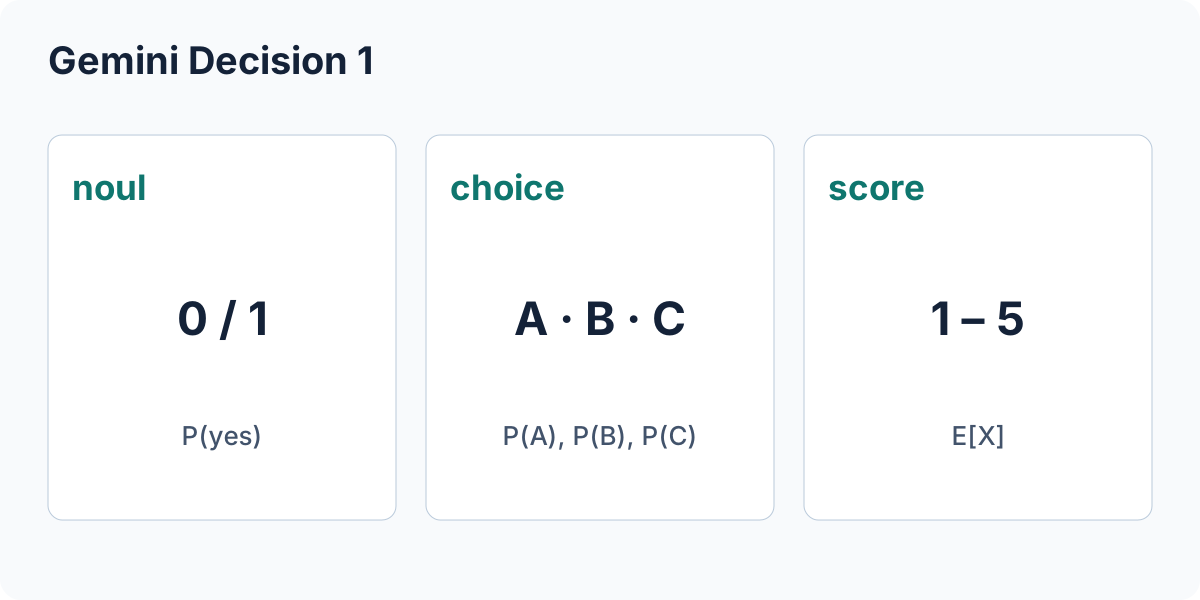
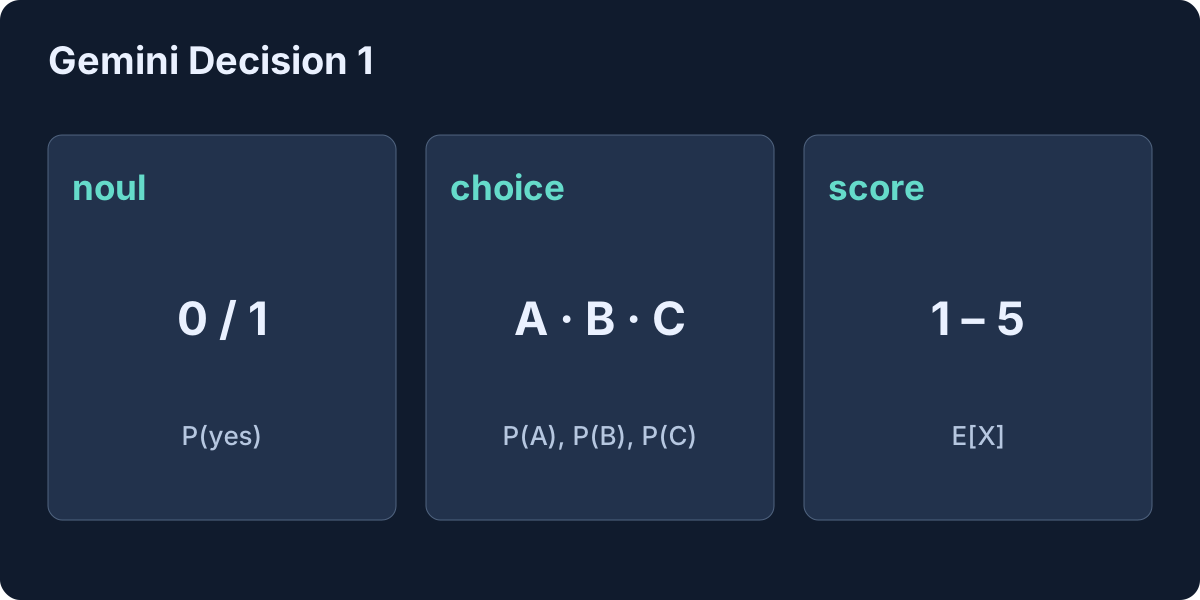
A probability of yes near zero can indicate a strong negative prediction rather than uncertainty. Confidence provides a separate signal for escalation. Questions operate on the same input independently, so they cannot inspect one another’s answers. A sequential decision workflow requires application-side orchestration. API guide
Pricing: how much do requests cost?
The direct Gemini Developer API charges $0.10 per million input tokens on its standard paid tier. Google offers a free tier within its usage limits; neither context caching nor Batch API is supported for this model.
Assuming 2,000 billable input tokens per request:
| Monthly requests | Input tokens | Model cost (USD) |
|---|---|---|
| 1,000 | 2 million | 0.20 |
| 10,000 | 20 million | 2.00 |
| 100,000 | 200 million | 20.00 |
| 1,000,000 | 2 billion | 200.00 |
The estimates use requests × tokens × $0.10 / 1,000,000. They exclude taxes, gateway charges, retries and subsequent inference. See Google pricing.
Shared input changes the economics
Suppose a document contains 10,000 tokens and must be evaluated against 20 independent questions containing 100 tokens each. Separate requests consume 202,000 tokens and cost $0.0202. A combined request consumes an estimated 12,000 tokens and costs $0.0012.
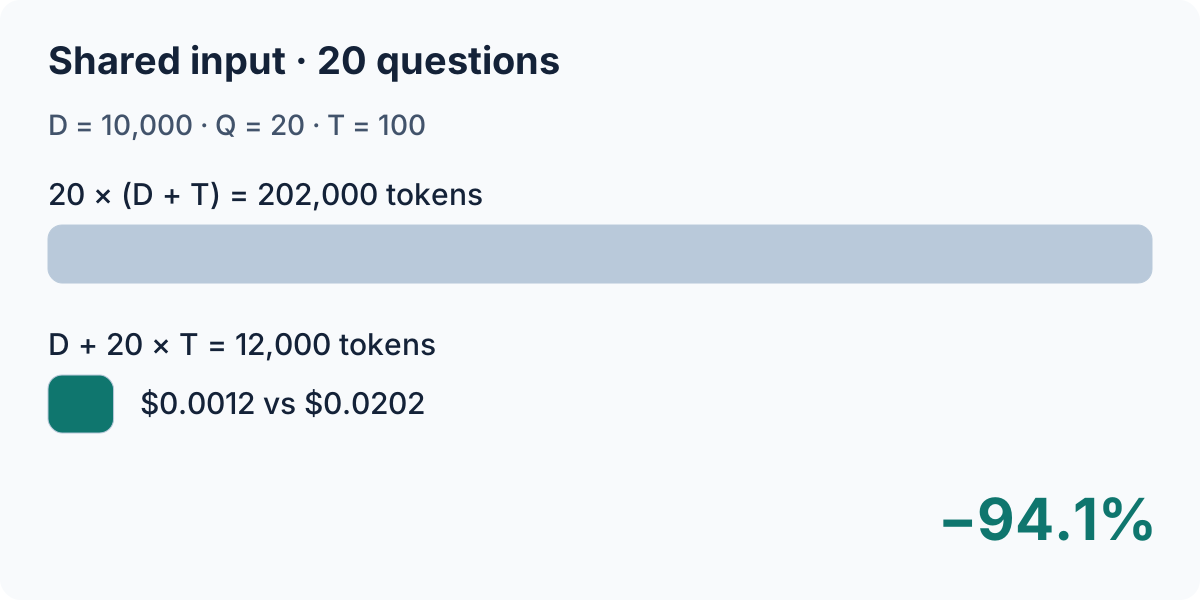
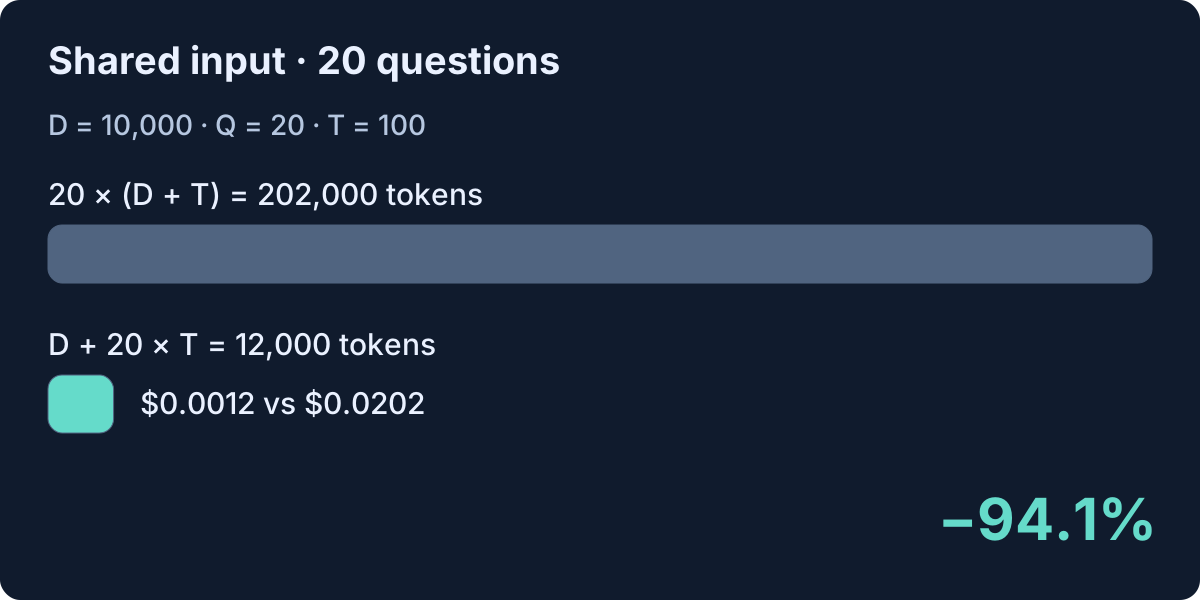
The saving is approximately 94.1%. This is not a measured bill: actual formatting adds overhead, and all questions must fit the context window. Unlike cross-request caching, the benefit comes from reusing the shared input within a single call.
For N documents of D tokens, Q questions and T tokens per question, the combined cost in dollars is N × (D + Q × T) × 0.10 / 1,000,000. Separate requests cost N × Q × (D + T) × 0.10 / 1,000,000.
Agent routing on Apple Silicon
A developer assistant might use a local model for simple questions, a cloud coding model for implementation and a larger reasoning model for difficult investigations. Gemini Decision 1 can classify requests at the entry point, while the application owns the execution policy.
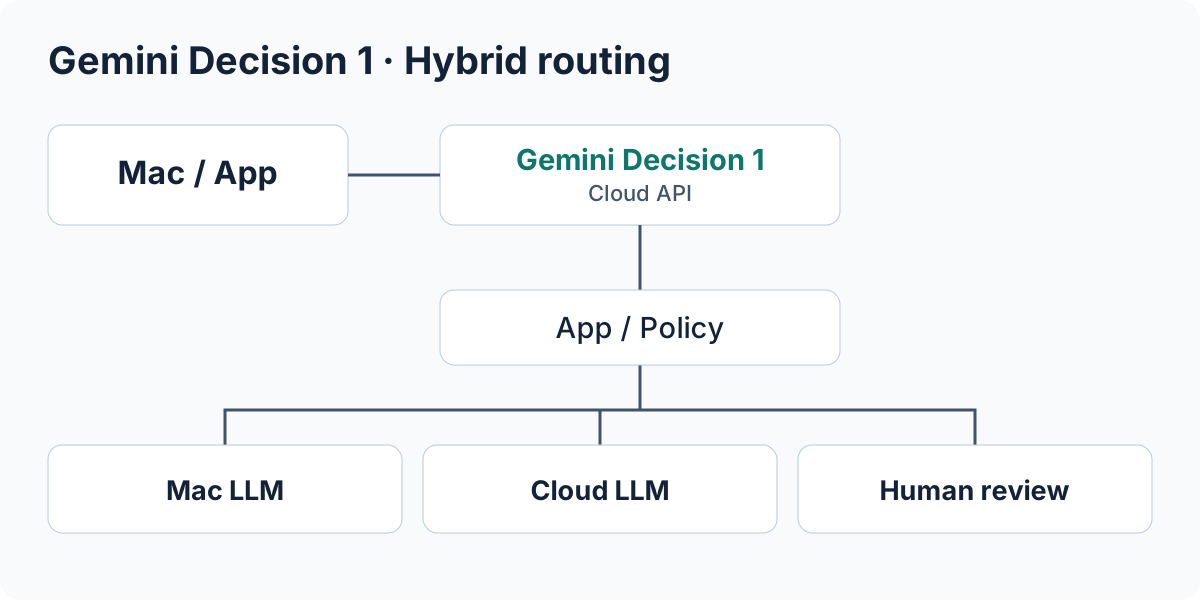
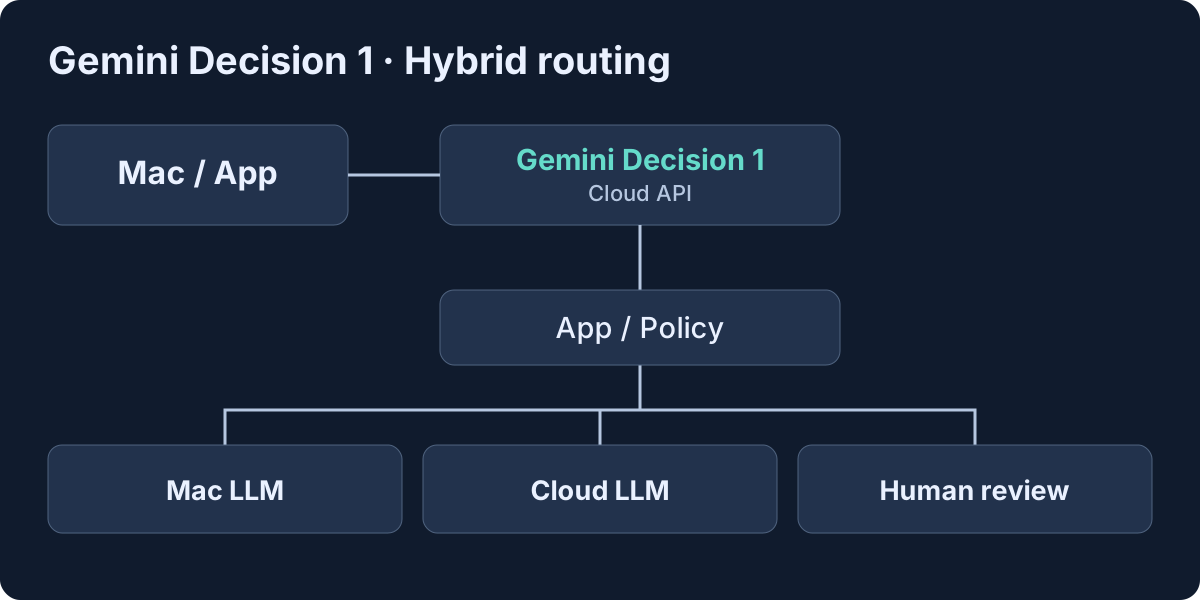
Low-confidence decisions should enter a review or fallback path. Do not treat classifier outputs as authorization for high-impact tool calls: access control must remain independent.
The following Python example uses the documented Google GenAI SDK interface (version 3.2 or later). Install with python3 -m pip install -U google-genai and set GEMINI_API_KEY.
from google import genai

client = genai.Client(http_options={"api_version": "v1beta"})
result = client.decisions.create(
    model="gemini-decision-1",
    input="Find the cause of a Python race condition.",
    questions={
        "coding": {
            "type": "noul",
            "instructions": "Does this request require software debugging?"
        }
    }
)
answer = result.answers["coding"]
if answer.noul >= 0.90 and answer.confidence >= 0.85:
    print("coding")
else:
    print("review")
The example follows Google’s API documentation, but was not executed against the live service. The thresholds are illustrative, not validated production settings.
API providers and performance
Google’s native endpoint is https://generativelanguage.googleapis.com/v1beta/decisions. OpenRouter uses a separate decisions endpoint; do not assume an OpenAI-compatible chat client will work. Vercel offers the model through AI SDK and decision interfaces, with audio, video and PDF support through AI SDK 7. OpenRouter · Vercel
Google reports 150–250 milliseconds of end-to-end latency under its launch evaluation conditions. These figures should not be generalized to arbitrary media sizes or gateway connections. Google launch. Independent comparable measurements remain limited.
| Decision model (OpenRouter) | Input / million tokens (USD) | Context |
|---|---|---|
| Gemini Decision 1 | 0.10 | 262,144 |
| Liquid d1.1 | 0.02 | 65,536 |
| Perplexity Decider V1.2 | 0.02 | approx. 262K |
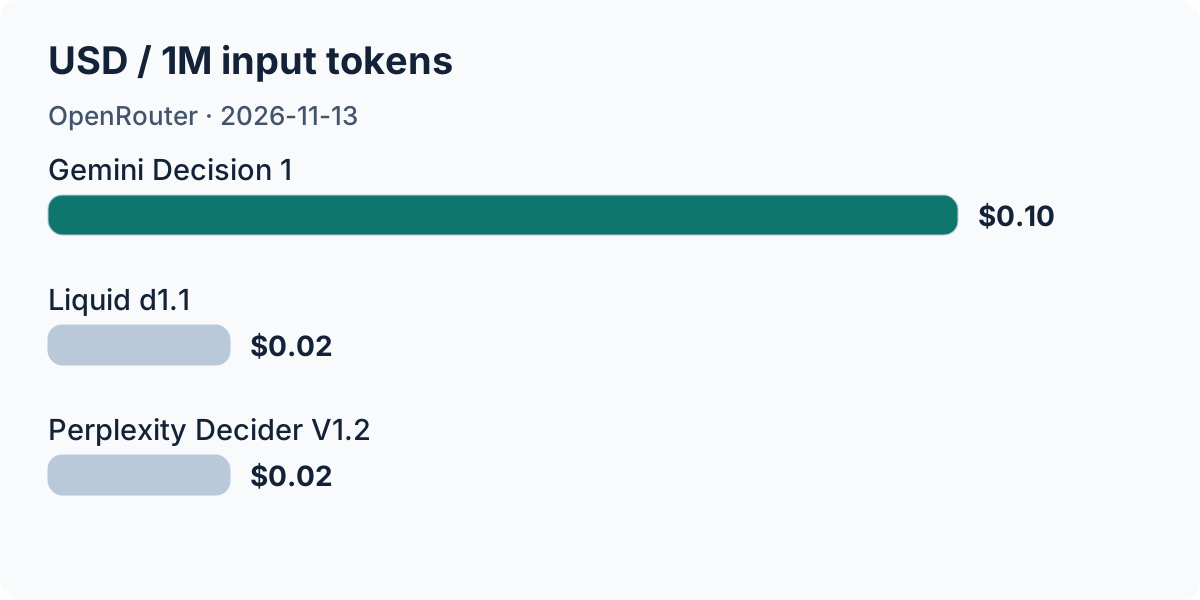
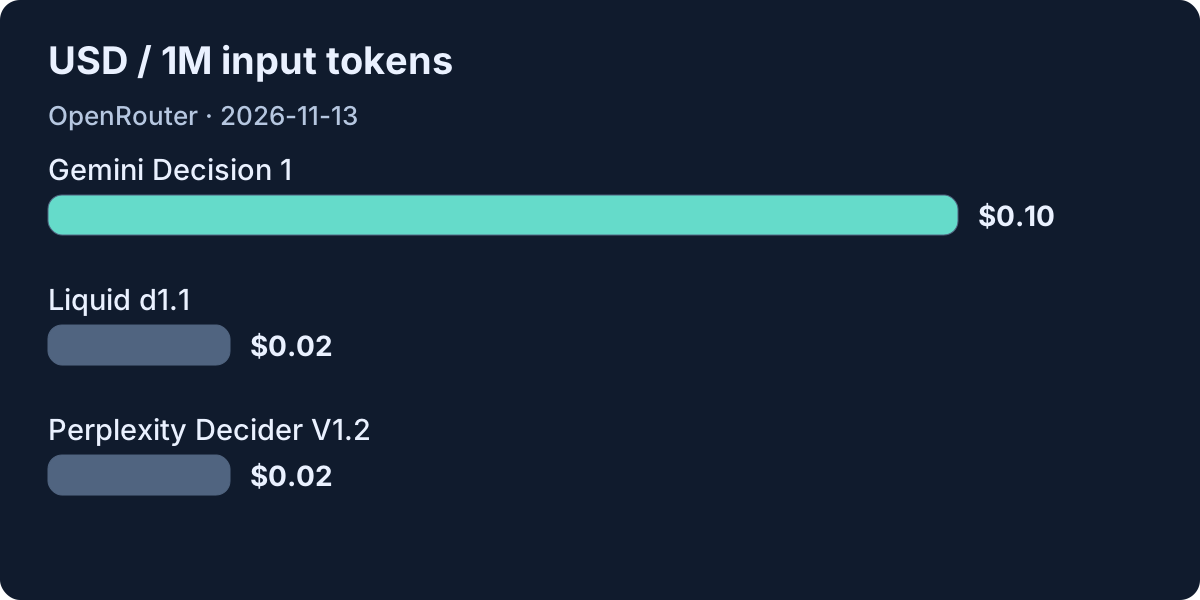
Sources: Gemini, Liquid, Perplexity. Gemini’s nominal input rate is five times the displayed rate for either alternative. Their input modalities and accuracy can differ. Benchmark the same workloads before choosing a provider.
Local deployment and privacy
No publicly downloadable weights have been confirmed for Gemini Decision 1. It is therefore not a documented local inference option for MLX, Ollama or llama.cpp. Apple Silicon can run the downstream model while Gemini Decision 1 handles selected remote classifications. The routing request itself still crosses the device’s privacy boundary.
OpenRouter explicitly marks Gemini Decision 1 as unavailable through EU in-region routing. Google’s API terms distinguish service tiers and regions; paid service data handling does not establish exclusive EU residency. Applications processing sensitive information need appropriate contractual and technical guarantees for their specific deployment.
Evaluate the whole workflow
A useful initial test includes at least several hundred labeled examples, covering ordinary, ambiguous and rare requests. Compare precision, recall and F1 by category; automated coverage versus routing errors; median and P95 latency; total token usage and downstream retries. A confidence threshold trades automation against errors. Evaluate probability calibration with reliability diagrams and a proper scoring rule.
The relevant cost is the complete pipeline, not just the router’s nominal token price. If a misrouted request causes extra model calls, a cheap classifier can increase costs. For fully offline applications, a local classifier or local LLM is a more appropriate baseline.
Related: Gemini API pricing, TypeSafe Jev Router and Gemma 4 local setup.
Transparency
Sources and review basis
These primary and reference sources form the basis of the technical assessment. Vendor claims and external benchmarks are identified as such in the article.
- blog.google developers-tools / gemini-decisions-api
- aistudio.google.com docs / decisions-api
- aistudio.google.com docs / pricing
- openrouter.ai google / gemini-decision-1
- vercel.com changelog / gemini-decision-1-now-available-on-ai-gateway
- aistudio.google.com docs / terms
- openrouter.ai features / in-region-routing
- openrouter.ai liquid / d1.1
- openrouter.ai perplexity / pplx-decider-v1.2
- scikit-learn.org modules / calibration.html