Checked October 13, 2026. Anthropic released Claude Fable 5.1 (claude-fable-5-1) on September 1, 2026 as its generally available frontier model for multi-hour coding sessions, deep research, and complex agentic workflows. On a Mac, Fable 5.1 is strictly a cloud model regardless of how much Unified Memory your machine has: you access it through Claude Code, the Anthropic Messages API, cloud partners (Amazon Bedrock, Google Cloud, Microsoft Foundry), or an API router such as OpenRouter. 123
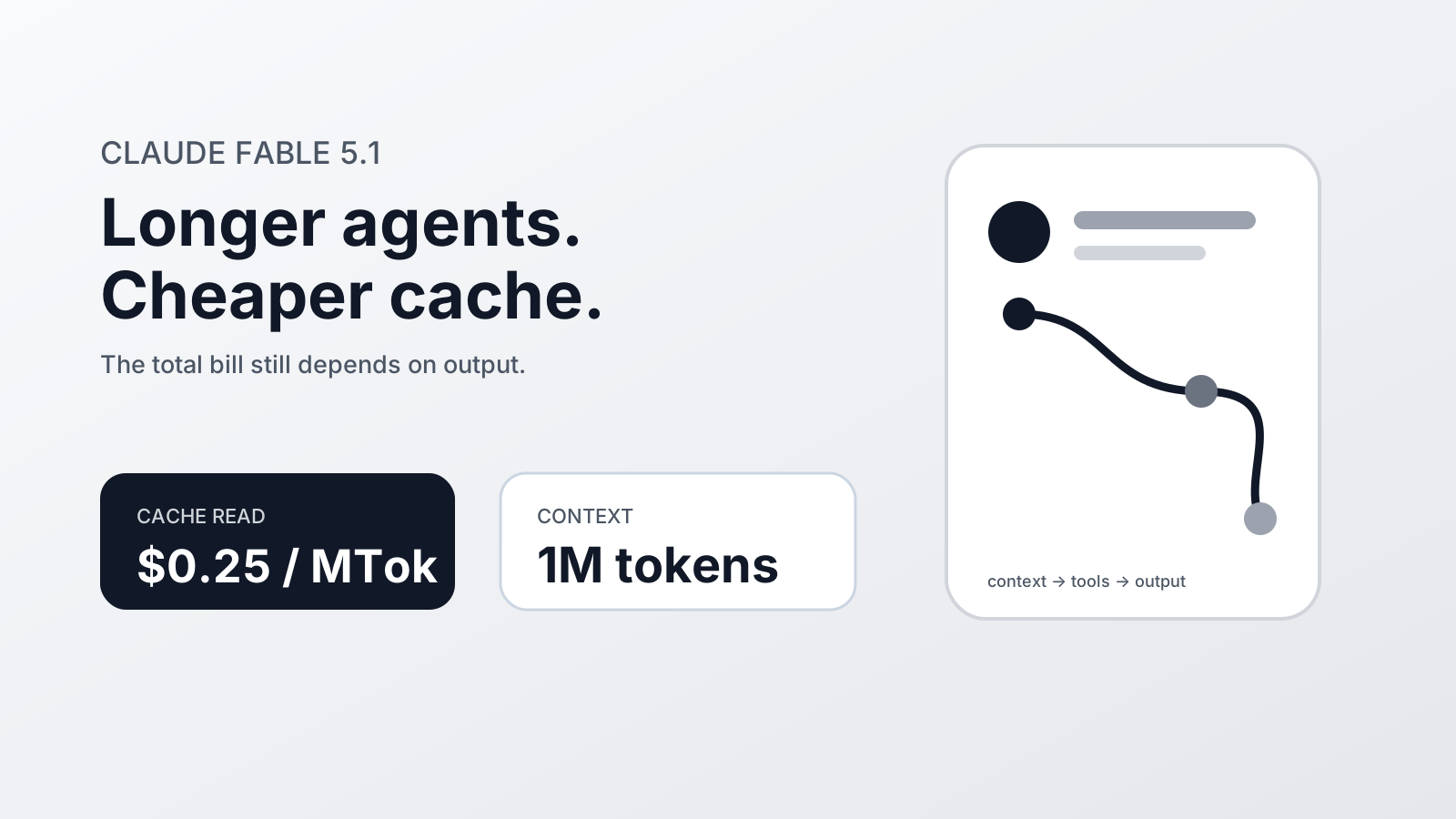
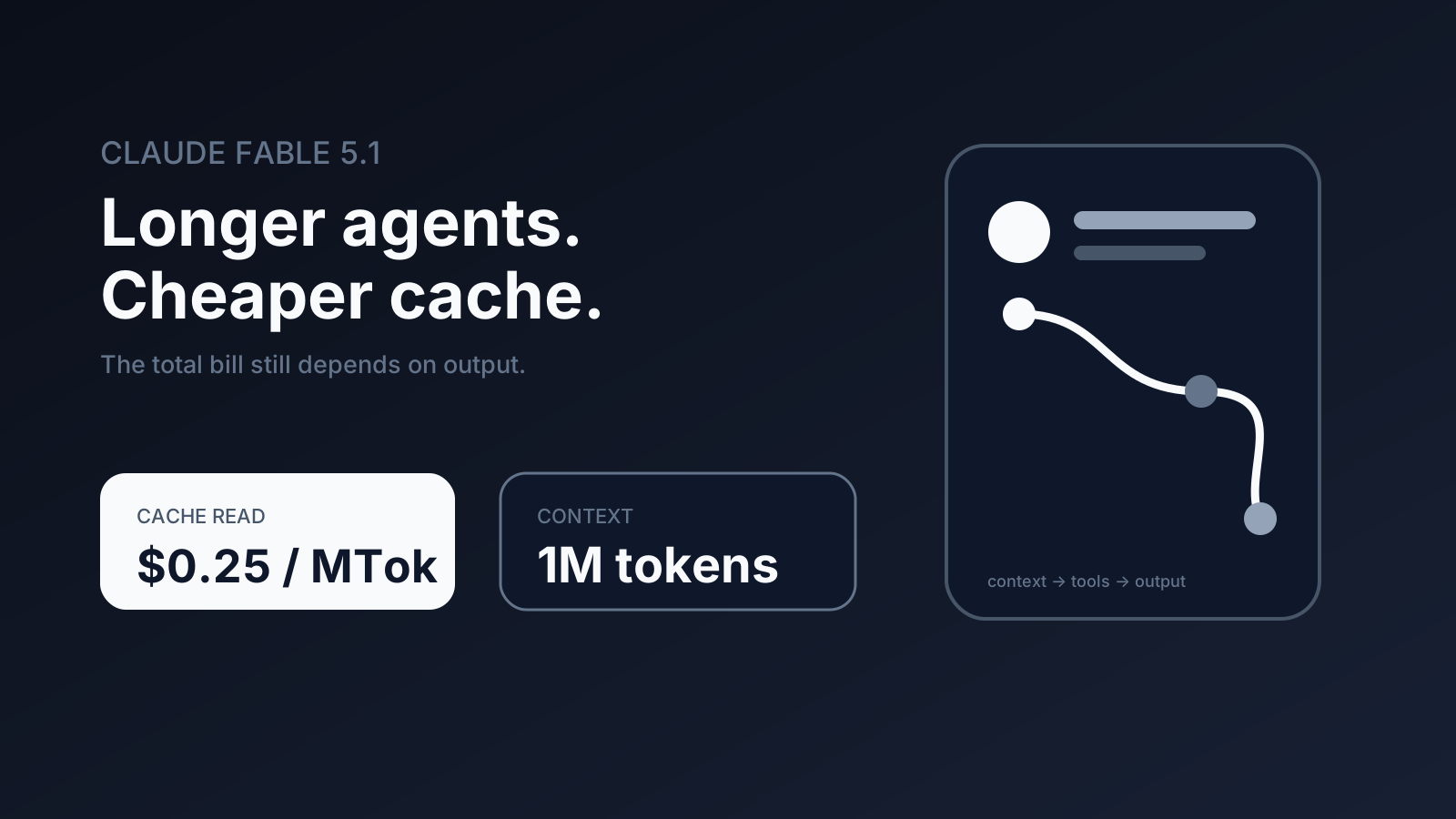
The headline pricing change is easy to misread. Standard fresh input and output still cost $10.00 and $50.00 per million tokens (U.S. list prices before applicable state sales tax). What changed is prompt-cache reads, which dropped 75% from $1.00 to $0.25 per million tokens. Anthropic estimates that this cuts typical token-billed workload costs by about 25%, with savings approaching 45% on heavily agentic tasks. 14
That vendor estimate does not mean every Fable 5.1 run is 25% to 45% cheaper. Independent evaluation by Artificial Analysis measured the opposite at maximum effort: Fable 5.1 cost $3.76 per Intelligence Index task versus $3.14 for Fable 5 (+19.7%) because it generated roughly 1.7 times as many output tokens. And following the late-September and early-October 2026 launches of Claude Opus 5.5 ($4/$20) and Claude Sonnet 5.5 ($2/$10), Fable 5.1 now has to justify a 2.5x to 5x fresh-token premium against Anthropic’s own newer models. 567
Key specifications and decision summary
- 1M-token context and 128K maximum output: The full 1,000,000-token context window bills at standard per-token rates with no long-context surcharge; the minimum cacheable prompt length is 512 tokens. 23
- $10.00 input / $50.00 output per million tokens: Base token rates are unchanged from Fable 5. Because Fable 5.1 is more prone to rewriting entire files on small edits, uncurbed output can quickly erase cache savings. 43
- Cache reads cost $0.25/MTok, down 75%: Writing to the 5-minute cache ($12.50/MTok) pays for itself after a single cache read. 4
- Benchmark Sonnet 5.5 and Opus 5.5 first: On Anthropic’s own Terminal-Bench 4.0 table, both Sonnet 5.5 (70.6%) and Opus 5.5 (66.4%) score higher than Fable 5.1’s launch figure (55.8%) at 60% to 80% lower base token prices. 167
- Artificial Analysis scored Fable 5.1 at 66 on its Intelligence Index at launch: That run cost $3.76 per task (versus $3.14 for Fable 5) and included roughly 4% output tokens routed to Opus 4.8 or Opus 5 by server-side safety classifiers. 5
- Not included in Claude Pro’s base quota: U.S. Claude Pro subscribers ($20/month or $17/month billed annually) pay for Fable 5.1 with extra usage credits starting from the first request. Claude Max ($100 or $200/month) and Team Premium ($125/seat/month) include Fable up to a shared 50% weekly allowance cap. 14
- Mandatory 30-day data retention: As a Covered Model,
claude-fable-5-1requires 30-day safety retention by default and returnsHTTP 400on standard Zero Data Retention (ZDR) workspaces unless authorized under Enterprise Frontier Safeguards. 189
Specs that matter
| Item | Claude Fable 5.1 |
|---|---|
| Released | September 1, 2026 (Status: GA) |
| Native Anthropic API ID | claude-fable-5-1 |
| Sister configuration (identical weights) | claude-mythos-5-1 (gated cyber/bio research access) |
| Amazon Bedrock ID | anthropic.claude-fable-5-1 |
| OpenRouter ID | anthropic/claude-fable-5.1 |
| Context window | 1,000,000 tokens (flat rate across full window) |
| Max output | 128,000 tokens |
| Fresh input | $10.00 / 1M tokens |
| Output (including thinking) | $50.00 / 1M tokens |
| 5-minute cache write | $12.50 / 1M tokens |
| 1-hour cache write | $20.00 / 1M tokens |
| Cache read | $0.25 / 1M tokens (-75% vs. Fable 5) |
| Batch API | $5.00 input / $25.00 output per 1M tokens (-50%) |
| Thinking mode | Adaptive thinking, always on (cannot be disabled) |
| Default API effort | high |
| Reliable knowledge cutoff | June 2026 |
| Modalities | Text, image, and PDF inputs / text output only |
| Default data retention | 30 days mandatory (Covered Model; blocks standard ZDR) |
| Local Apple Silicon runtime | Not available (cloud-only inference) |
First, get the model identifier right
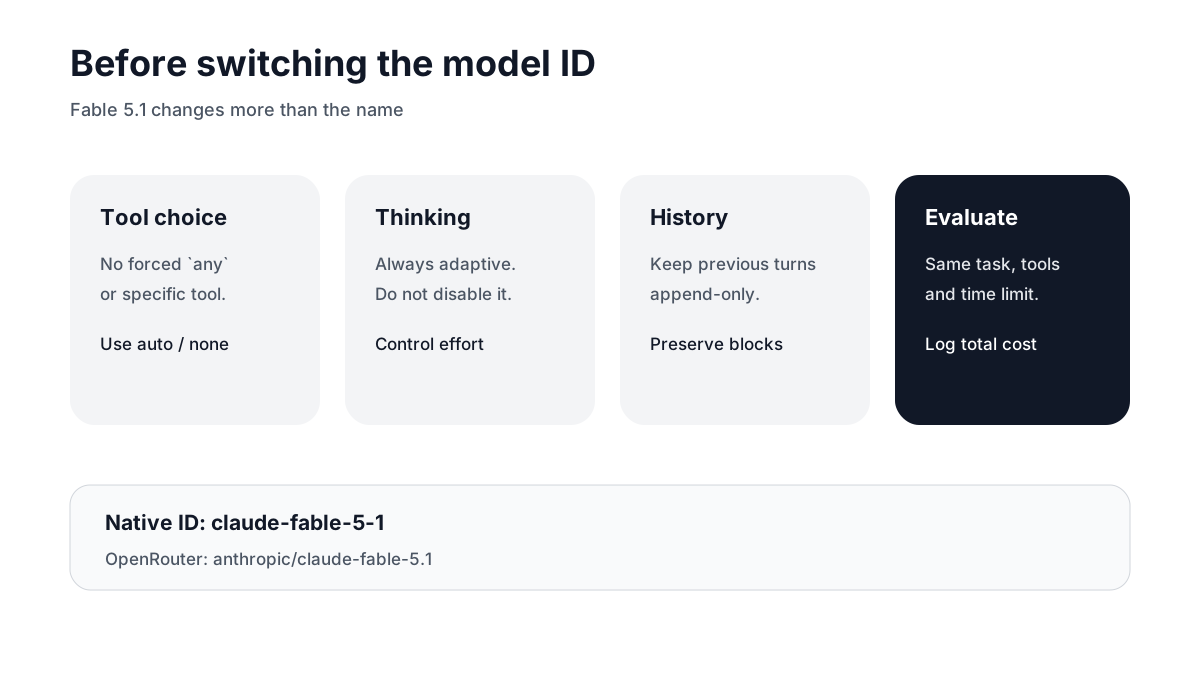
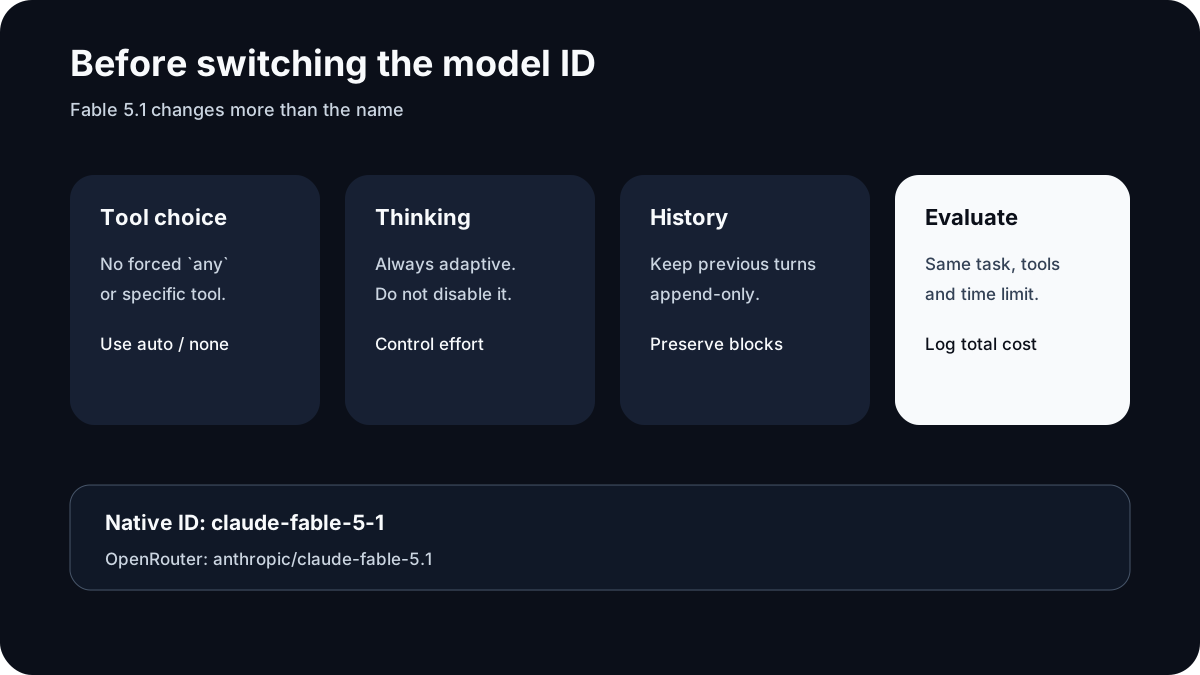
If you switch between OpenRouter, cloud hyperscalers, and Anthropic’s direct API, the model string changes by platform. OpenRouter uses the router slug:
anthropic/claude-fable-5.1Anthropic’s direct Messages API, Google Cloud Vertex AI, Microsoft Foundry, and the Claude Platform on AWS use:
claude-fable-5-1Amazon Bedrock uses the dot-prefixed anthropic.claude-fable-5-1. 23
Passing an OpenRouter slug to the native Anthropic API will fail immediately. AI on Mac uses this same distinction across all model guides; see our Claude Sonnet 5 guide for background.
Where Fable 5.1 improves and how it relates to Mythos 5.1
According to the Claude Fable 5.1 & Claude Mythos 5.1 System Card published on September 1, 2026, Fable 5.1 and Mythos 5.1 share identical model weights. Mythos 5.1 is the gated configuration with looser classifiers for vetted cybersecurity and life-science partners, whereas Fable 5.1 is the generally available production release with active safety routing. 110
Anthropic tuned the 5.1 release for multi-hour unattended work: repository-wide refactoring, root-cause incident investigation, and multi-stage research. Anthropic also updated its safety classifiers so that legitimate vulnerability discovery triggers roughly 60% fewer false-positive blocks (reducing interventions in Claude Code by about 60% per session), while benign biology and medical prompts trigger false positives 85% less often than on Fable 5. 13
Vendor-reported benchmarks show the largest gains over Fable 5 on long-horizon terminal and research tasks:
- Terminal-Bench-Science 0.1: 52.6% for Fable 5.1 versus 24.7% for Fable 5 (Anthropic notes a standard error of roughly +/-3.5 to +/-4.5 percentage points). 1
- Terminal-Bench 4.0: 55.8% for Fable 5.1 versus 42.0% for Fable 5. 1
- GDPval-AA v2 (real-world occupational tasks): 1853 Elo for Fable 5.1, ahead of Fable 5 (1723) and Opus 5 (1824). 1
Treat these vendor numbers with two caveats. First, Anthropic evaluated Fable 5.1 with production safeguards enabled, meaning flagged cyber or biology prompts can route to an Opus fallback model. Second, Anthropic’s late-September 2026 releases of Opus 5.5 (66.4% on Terminal-Bench 4.0) and Sonnet 5.5 (70.6% on Terminal-Bench 4.0) now surpass Fable 5.1’s September 1 launch score on that same agentic coding benchmark. 167
Independent testing: top launch score, higher output bill, and 4% fallback routing
Artificial Analysis evaluated Fable 5.1 prior to launch. At maximum effort (max), it scored 66 on the Artificial Analysis Intelligence Index, placing it ahead of Opus 5 (63), Fable 5 (62), and GPT-5.6 Sol (61) at the time of release. 5
Three methodological details matter more than the headline rank:
- 4% server-side fallback in the benchmark run: Artificial Analysis tested Fable 5.1 with Anthropic’s default server-side safety fallback active. Roughly 4% of output tokens across the Intelligence Index evaluation were generated by Claude Opus 4.8 (cyber routing) or Claude Opus 5 (biology routing). The score of 66 therefore measures the deployed Fable 5.1 service rather than a strictly isolated checkpoint. 15
- Higher attempt rate versus abstention: Artificial Analysis noted that Fable 5.1 attempts answers more frequently instead of abstaining when uncertain. That raises coverage on hard questions but also increases incorrect answers; on the AA-Omniscience factual test, the two effects largely canceled out. 5
- 1.7x output volume pushed task cost up 19.7%: At maximum effort, Fable 5.1 averaged $3.76 per Intelligence Index task, compared with $3.14 for Fable 5. Even with cache reads discounted by 75%, Fable 5.1 generated roughly 1.7 times as many output tokens billed at $50.00 per million. 5
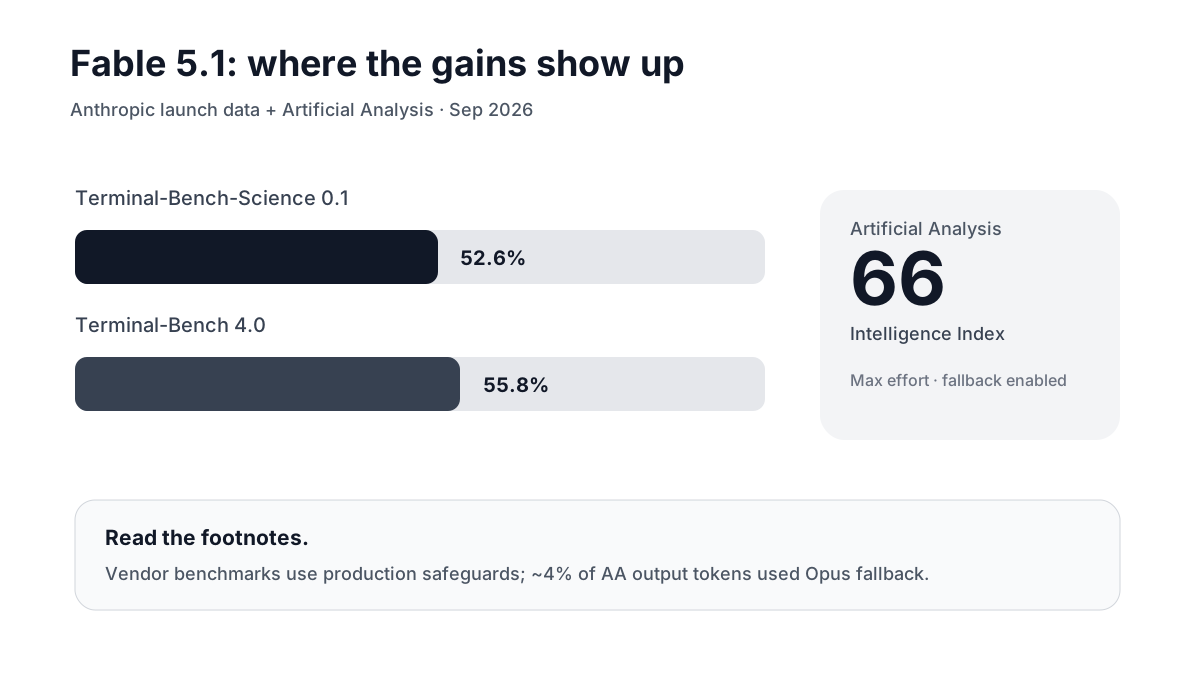
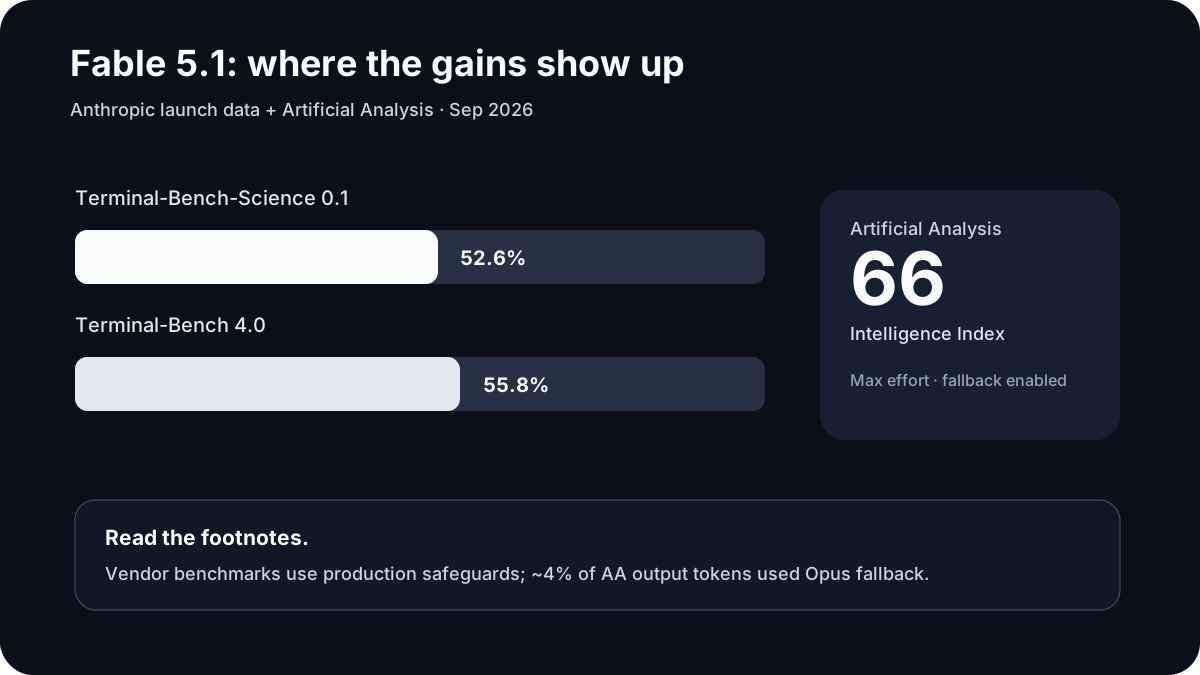
Methodology note: The Artificial Analysis score of 66 is a September 1, 2026 launch snapshot; current leaderboards may use different index versions and scales.
Why the cache price matters and where whole-file rewrites inflate the bill
Fable 5.1 keeps the same standard API rate card as Fable 5 except for cache hits:
- Fresh input: $10.00 / MTok
- Output (including thinking tokens): $50.00 / MTok
- 5-minute cache write: $12.50 / MTok (1.25x base input)
- 1-hour cache write: $20.00 / MTok (2.0x base input)
- Cache read: $0.25 / MTok (2.5% of base input, down from $1.00 on Fable 5) 4
Because a 5-minute cache write adds only $2.50/MTok over fresh input while each subsequent cache read saves $9.75/MTok, caching breaks even on the very first cache hit.
However, Anthropic’s release notes document a behavioral quirk that directly impacts output spend: when editing files, Fable 5.1 is more likely than Fable 5 to rewrite the entire file rather than emit a targeted diff. At $50.00 per million output tokens, repeated whole-file rewrites inside an agent loop can quickly outweigh your input-cache savings unless your system prompt explicitly enforces targeted edits. 3
Three illustrative workloads: Fable 5.1 vs. Fable 5, Opus 5.5, and Sonnet 5.5
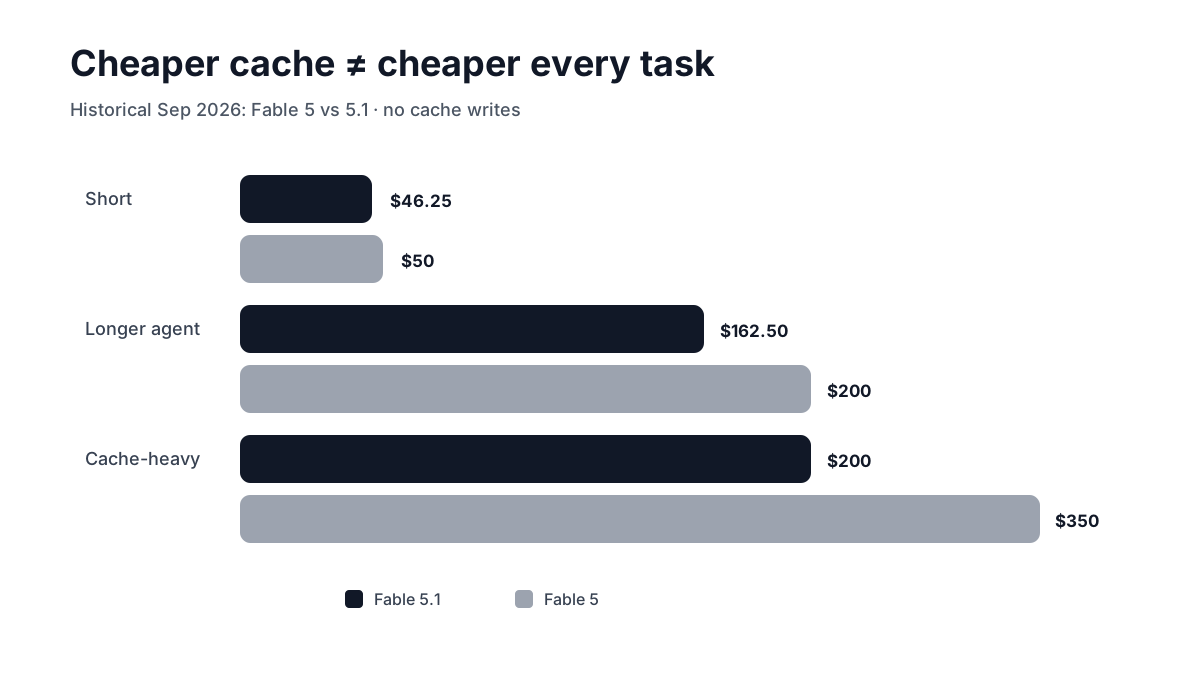
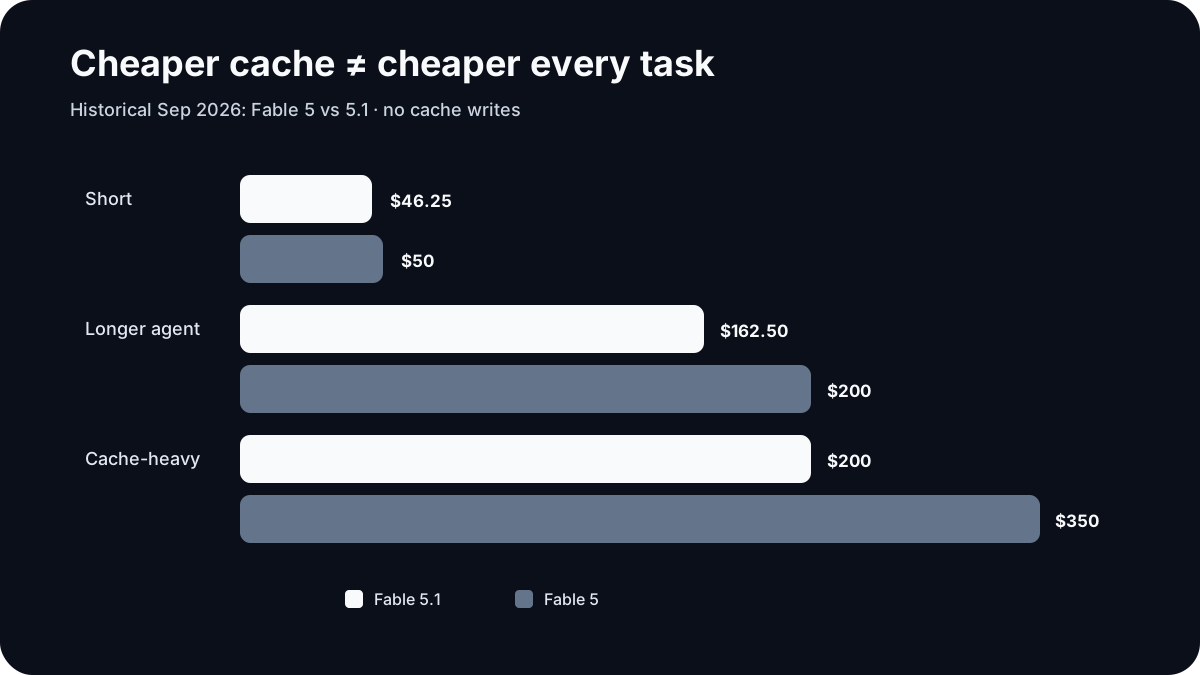
The table below gives illustrative rate-card calculations, not measured production workload costs, based on Anthropic’s published API list prices as of October 13, 2026. One-time cache writes, U.S. state sales taxes, and router markups are excluded, and identical token volumes are assumed across models to isolate the rate-card arithmetic:
| Workload | Fresh input | Cache reads | Output | Fable 5.1 | Fable 5 (Legacy) | Saving vs. Fable 5 | Comparison: Opus 5.5 | Comparison: Sonnet 5.5 |
|---|---|---|---|---|---|---|---|---|
| Short | 2M | 5M | 0.5M | $46.25 | $50.00 | 7.50% | $19.00 | $9.50 |
| Longer agent | 5M | 50M | 2M | $162.50 | $200.00 | 18.75% | $70.00 | $35.00 |
| Cache-heavy agent | 5M | 200M | 2M | $200.00 | $350.00 | 42.86% | $100.00 | $50.00 |
Plain-text formula:
total_cost = (fresh_input_MTok * input_rate)
           + (cache_read_MTok * cache_read_rate)
           + (output_MTok * output_rate)
Worked example for the “Longer agent” profile (5M fresh input, 50M cache reads, 2M output):
- Claude Fable 5.1:
(5 * $10.00) + (50 * $0.25) + (2 * $50.00) = $50.00 + $12.50 + $100.00 = $162.50 - Claude Fable 5:
(5 * $10.00) + (50 * $1.00) + (2 * $50.00) = $50.00 + $50.00 + $100.00 = $200.00 - Claude Opus 5.5:
(5 * $4.00) + (50 * $0.20) + (2 * $20.00) = $20.00 + $10.00 + $40.00 = $70.00 - Claude Sonnet 5.5:
(5 * $2.00) + (50 * $0.10) + (2 * $10.00) = $10.00 + $5.00 + $20.00 = $35.00
Anthropic’s “up to approximately 45%” saving estimate is mathematically sound when cache reads reach 100x output volume (42.86% in the third row). Yet at identical token counts, Opus 5.5 still runs for half the cost ($100.00) and Sonnet 5.5 for one-quarter ($50.00). 1467
Fable 5.1 vs. Opus 5.5, Sonnet 5.5, and Haiku 5.5 in October 2026
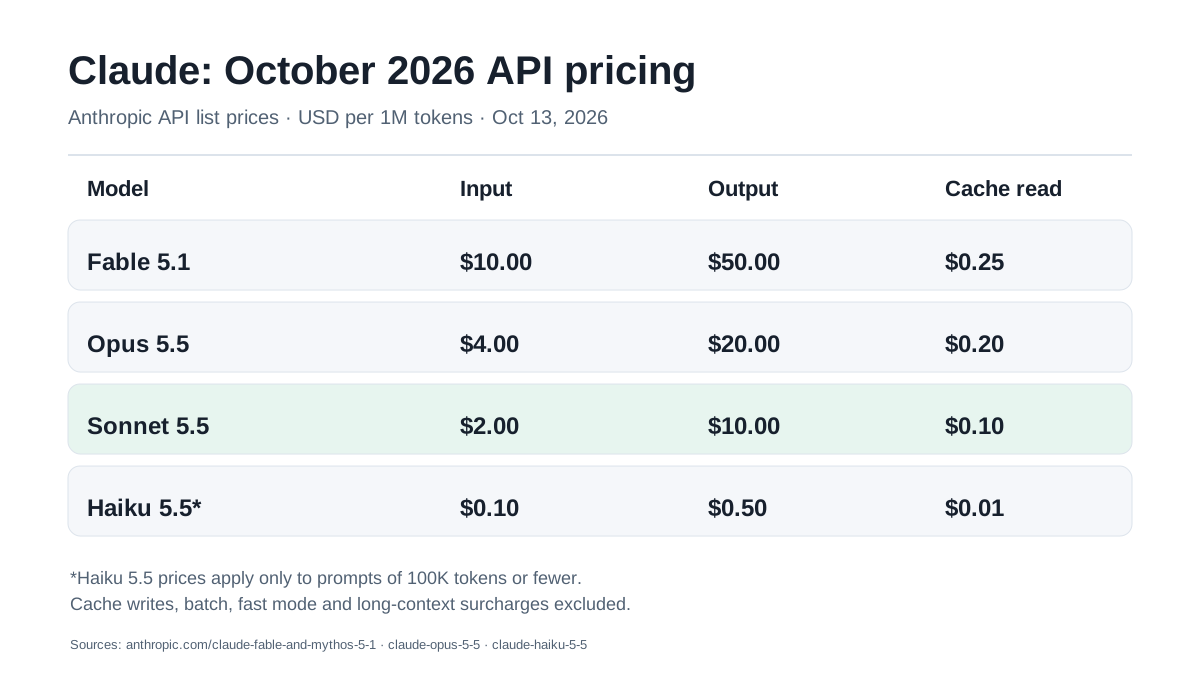
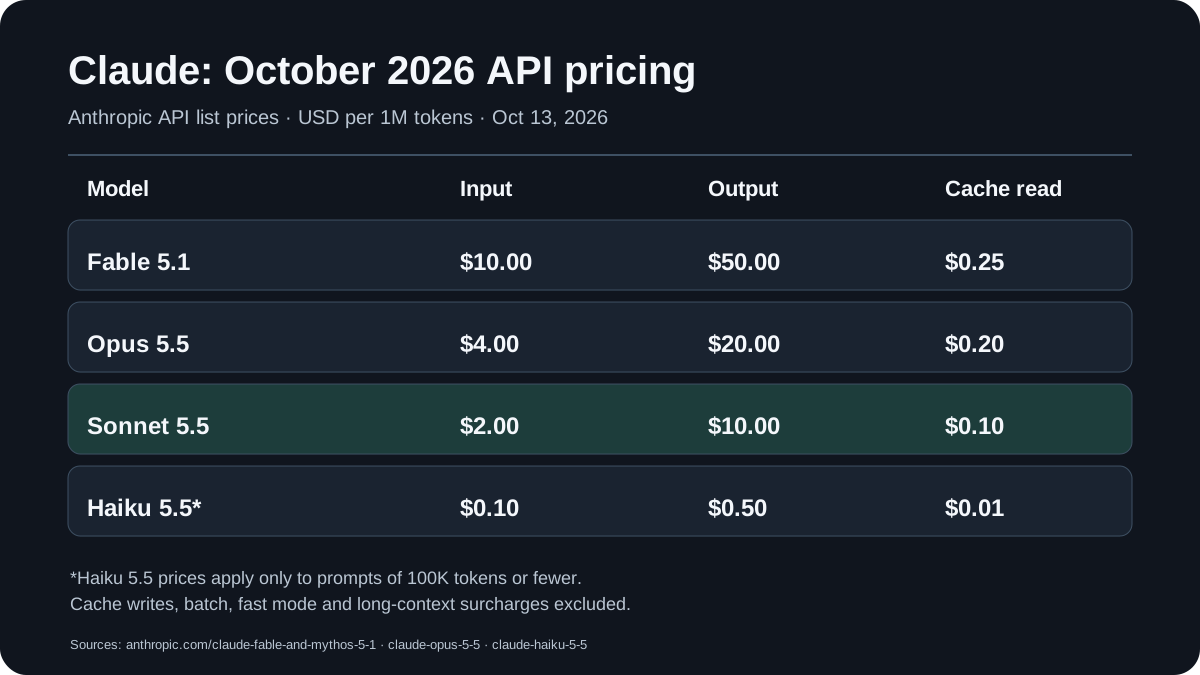
The September 1 comparison against legacy Opus 5 ($5/$25) is now obsolete. Anthropic launched Claude Opus 5.5 on September 22, 2026, Claude Sonnet 5.5 on September 28, 2026, and Claude Haiku 5.5 on October 7, 2026. According to Anthropic, Opus 5.5 performs at the level of Fable 5.1 on most work while cutting fresh-token prices by 60%. 6711
| Model (Anthropic API) | Release Date | Fresh input / 1M | Output / 1M | Cache write (5m / 1h) | Cache read / 1M | Terminal-Bench 4.0 (Vendor) |
|---|---|---|---|---|---|---|
| Claude Fable 5.1 | Sep 1, 2026 | $10.00 | $50.00 | $12.50 / $20.00 | $0.25 | 55.8% |
| Claude Opus 5.5 | Sep 22, 2026 | $4.00 | $20.00 | $5.00 / $8.00 | $0.20 | 66.4% |
| Claude Sonnet 5.5 | Sep 28, 2026 | $2.00 | $10.00 | $2.50 / $4.00 | $0.10 | 70.6% |
| Claude Haiku 5.5 (prompts up to 100K) | Oct 7, 2026 | $0.10 | $0.50 | $0.125 / $0.20 | $0.01 | 39.2% |
| Claude Haiku 5.5 (prompts >100K) | Oct 7, 2026 | $0.50 | $2.50 | $0.625 / $1.00 | $0.05 | 39.2% |
All rates are U.S. dollar API list prices per million tokens checked on October 13, 2026; Batch API jobs receive a 50% discount on base input and output. Note two October 7, 2026 pricing updates: first, Anthropic cut Sonnet 5.5’s cache-read rate in half from $0.20 to $0.10 per million tokens, making Sonnet 5.5 exactly half the price of Opus 5.5 across every billing line. Second, while Fable 5.1, Opus 5.5, and Sonnet 5.5 bill their entire 1M context window at flat base rates, Haiku 5.5 charges 5x higher rates across the entire request once a prompt exceeds 100,000 tokens. 46711
For routine coding and document workflows on macOS, benchmark Sonnet 5.5 first; use Haiku 5.5 (keeping prompts under 100K tokens) for subagents and context compaction, and move up to Opus 5.5 for open-ended multi-tool engineering. Reserve Fable 5.1 for workloads where Opus 5.5 demonstrably stalls. See the Opus 5.5 guide and Sonnet 5.5 pricing guide for details.
U.S. Claude subscriptions: Pro, Max, and Team are not API rate cards
Keep API tokens and subscription fees separate. Anthropic’s publicly listed U.S. consumer prices are $20/month for Pro ($17/month billed annually, with $200 upfront), $100/month for Max 5x, and $200/month for Max 20x, before any applicable state or local sales tax. These fees do not buy unrestricted Fable API tokens. 12
- Pro: Fable 5 and Fable 5.1 require additional usage credits from the first request; they are not included in Pro’s standard usage. 13
- Max 5x/20x and Team Premium: Fable usage can account for up to 50% of the regular shared weekly quota. That is not a bonus 50%; other Claude usage also draws down the same weekly pool. After hitting the Fable cap, further Fable requests require paid usage credits. 13
- Team Standard: Fable uses pay-as-you-go credits rather than included usage. Enterprise seat rules depend on the seat class. 13
For unattended Mac agents: Limits depend on the actual token and tool workload, not on a promised number of messages. Check weekly usage and any enabled usage-credit spending cap. 1312
API migration: breaking changes and agent-loop fixes
Upgrading an existing harness to claude-fable-5-1 requires handling several breaking API rules (HTTP 400) and behavioral shifts documented in Anthropic’s migration guide. 283
1. Forced tool choice returns HTTP 400
tool_choice: {"type": "any"} and forcing a named tool ({"type": "tool", "name": "..."}) are unsupported and return HTTP 400. Only auto and none are accepted. To guarantee structured tool invocation, pair tool_choice: {"type": "auto"} with strict: true tool schemas or structured JSON outputs, backed by an explicit instruction in the user turn or a mid-conversation role: "system" message. 8
2. Mandatory adaptive thinking breaks content[0].text parsers
You cannot disable thinking on Fable 5.1. Sending thinking: {"type": "disabled"} or a fixed manual budget (thinking: {"type": "enabled", "budget_tokens": N}) returns HTTP 400. Assistant response prefilling and non-default sampling parameters (temperature, top_p, top_k) also return HTTP 400. 83
Because responses can start with thinking blocks, legacy code that reads response.content[0].text by position can fail or return empty text. Always select response blocks by filtering for block.type == "text". 8
3. Keep conversation history strictly append-only (prefix_binding_mismatch)
Fable 5.1 validates preserved thinking blocks against the exact preceding conversation prefix. Mutating earlier turns, editing the initial system prompt, or modifying tool definitions mid-session invalidates saved thinking blocks (HTTP 400 when binding enforcement is active). Furthermore, earlier models (such as Opus 4.8, Opus 5, or Sonnet 5) cannot read Fable 5.1 thinking blocks: Switching a conversation down to an older model drops those blocks (model_binding_mismatch), whereas switching to claude-mythos-5-1 preserves them. 8
To keep long-running agent harnesses reliable:
- Freeze top-level
systemandtoolsdefinitions at session start and pass priorthinkingblocks back unchanged. - Send mid-session instructions or effort adjustments as turn-scoped
role: "system"messages. Passingoutput_configinside arole: "system"message (beta) lets you raise or lower effort for a specific step without invalidating your prompt cache. - Test custom message builders with the
thinking-binding-controls-2026-08-01beta header andprefix_mismatch_behavior: "drop_block", and inspectinput_transformationsin the API response. 8
4. Three prompt adjustments to control latency and output cost
Anthropic highlights three behavioral differences in Fable 5.1 that show up without any code change:
- Prevent whole-file rewrites: Explicitly instruct the model in your system prompt to make targeted diffs/edits rather than rewriting whole files on small changes. 3
- Batch parallel tool calls: Fable 5.1 is more likely than Fable 5 to emit one tool call per turn when independent reads are only implied. Add an explicit one-line instruction to batch independent tool calls in parallel. 3
- Enable progress updates between tool calls: Because reasoning between tool calls lives inside
thinkingblocks, Fable 5.1 writes less user-facing narration at high effort. Setthinking.displayto"updates"(beta) or"summarized"if your UI expects progress text. 83
Using Fable 5.1 through OpenRouter on macOS
OpenRouter lists the model as anthropic/claude-fable-5.1, which is convenient if your macOS workflows already use an OpenAI-compatible client or route across multiple frontier labs. 14
Python API example (no local project file access)
import os
from openai import OpenAI

client = OpenAI(
    base_url="https://openrouter.ai/api/v1",
    api_key=os.environ["OPENROUTER_API_KEY"],
)

response = client.chat.completions.create(
    model="anthropic/claude-fable-5.1",
    messages=[
        {
            "role": "system",
            "content": (
                "Batch independent read and search tool calls in parallel within a single turn. "
                "When modifying code, emit targeted diffs rather than rewriting entire files."
            ),
        },
        {
            "role": "user",
            "content": "Audit this Astro project for broken internal links and i18n drift.",
        },
    ],
    max_tokens=8000,
)

# Log the actual served model and token breakdown in production
print("Served model:", response.model)
print("Token usage:", response.usage)
print(response.choices[0].message.content)
Scope of this example: It demonstrates router connectivity only. It does not supply Astro project files or register file/search tools, so it cannot actually audit a local repository. Tool batching requires a properly equipped agent.
Remember that thinking tokens count toward max_tokens and bill at the $50.00/MTok output rate. Set a generous max_tokens ceiling and control verbosity in the prompt so the response does not truncate inside a thinking block. 48
Safeguards, ZDR blocks, and Enterprise Frontier Safeguards
Anthropic operates Fable 5.1 as a Covered Model with heightened safeguards for cybersecurity and life-science domains: 1910
- Mandatory 30-day data retention blocks standard ZDR: Using
claude-fable-5-1requires 30-day data retention for safety monitoring by default. If your organization uses a standard Zero Data Retention (ZDR) API workspace, calls toclaude-fable-5-1will fail with anHTTP 400 invalid_request_errorunless expressly authorized by Anthropic (by contrast, Opus 4.8, Opus 5.5, and Sonnet 5.5 support standard ZDR). 187 - Enterprise Frontier Safeguards (EFS): Announced on September 1, 2026 for regulated enterprises (such as financial services, healthcare, and critical infrastructure), EFS allows activity logs used for safety monitoring to stay inside the customer’s own cloud storage (Amazon S3, Azure Blob Storage, or Google Cloud Storage) under customer-managed encryption keys, with automated safety flags routed directly to the customer’s security team rather than human reviewers at Anthropic. Until EFS is provisioned, eligible enterprise customers can be granted interim ZDR access for Fable 5.1. 19
- Automatic Opus fallback routing: In most Claude applications, prompts flagged by cybersecurity safeguards automatically route to Claude Opus 4.8, while biology safeguards route to Claude Opus 5 (you are not charged Fable rates for rerouted requests). On the direct API, handle
stop_reason: "refusal", inspectstop_details.category, and configurefallbacks: "default"(beta) if you want automatic fallback behavior. 18
Privacy boundary for Mac users: If your contractual or regulatory obligations prohibit 30-day provider-side retention and no explicit exception applies, keep the workload local on your Mac using MLX, Ollama, or LM Studio. Requirements depend on the provider and processing agreement. To size your Apple Silicon memory requirements (from 16 GB to 512 GB Unified Memory), see our Unified Memory guide and Mac AI Matchmaker to estimate model, quantization and context memory needs.
Decision matrix: When to use Fable 5.1 on Mac
| Your macOS workload | Recommended model / path | Why (as of October 2026) |
|---|---|---|
| Everyday coding, bug fixes, document & spreadsheet generation | Claude Sonnet 5.5 (claude-sonnet-5-5) | 80% cheaper per fresh token ($2/$10), $0.10/MTok cache reads since October 7, 2026, and 70.6% on Terminal-Bench 4.0. 7 |
| Complex multi-tool agents, large refactors, architecture review | Claude Opus 5.5 (claude-opus-5-5) | 60% cheaper than Fable 5.1 ($4/$20, $0.20 cache reads), matches Fable 5.1 on most work per Anthropic, and supports standard ZDR. 6 |
| High-volume subagents, triage, compaction (prompts up to 100K) | Claude Haiku 5.5 (claude-haiku-5-5) | $0.10 input / $0.50 output / $0.01 cache read when prompts stay under the 100,000-token cliff. 11 |
| Multi-hour unattended agents & deep research where Opus 5.5 stalls | Claude Fable 5.1 (claude-fable-5-1) | Worth testing when massive cache reuse ($0.25/MTok) meets multi-hour runs where a single failed attempt costs more than $50/MTok output. 14 |
| Confidential local files / strict ZDR without EFS | Local on Apple Silicon (MLX / Ollama / LM Studio) | Zero cloud retention; calculate exact model and KV-cache RAM using the Mac AI Matchmaker. |
Reproducible A/B evaluation checklist before paying the Fable premium
Do not pick Fable 5.1 from a leaderboard score. Run a controlled 10-to-20-task A/B evaluation against claude-opus-5-5 and claude-sonnet-5-5 on your own repository:
- Lock the harness: Use identical system prompts (including the anti-whole-file-rewrite and parallel tool-batching rules), identical tool schemas (
tool_choice: {"type": "auto"}), and the same starting effort (high). - Log full telemetry per task: Record fresh input tokens, cache writes, cache reads, output tokens (including thinking), wall-clock runtime, failed tool calls,
stop_reason: "refusal"or Opus fallback events, and manual developer repair time. - Compare total cost per accepted PR: Only route workloads to Fable 5.1 where its first-pass completion rate lowers your total cost of ownership compared with Opus 5.5.
Sources and methodology
Verification date and scope: All specifications, U.S. API list prices, subscription rules, migration breaking changes, and benchmark figures were verified on October 13, 2026 against Anthropic’s official platform documentation, the Fable 5.1 / Mythos 5.1 System Card, OpenRouter listings, and Artificial Analysis evaluation reports. No unlogged in-house benchmark scores are claimed; the three workload cost scenarios are transparent calculations from published October 13, 2026 API list prices (excluding state sales taxes and third-party router fees).
Footnotes
-
Anthropic: Introducing Claude Fable 5.1 and Claude Mythos 5.1 (Published September 1, 2026; checked October 13, 2026) | Source ↩ ↩2 ↩3 ↩4 ↩5 ↩6 ↩7 ↩8 ↩9 ↩10 ↩11 ↩12 ↩13 ↩14 ↩15 ↩16 ↩17 ↩18
-
Anthropic Claude Platform Docs: Claude Fable 5.1 Model Overview (Checked October 13, 2026) | Source ↩ ↩2 ↩3 ↩4
-
Anthropic Claude Platform Docs: What’s new in Claude Fable 5.1 (Checked October 13, 2026) | Source ↩ ↩2 ↩3 ↩4 ↩5 ↩6 ↩7 ↩8 ↩9 ↩10 ↩11
-
Anthropic Claude Platform Docs: Pricing (Includes October 7, 2026 cache-read update; checked October 13, 2026) | Source ↩ ↩2 ↩3 ↩4 ↩5 ↩6 ↩7 ↩8 ↩9
-
Artificial Analysis: Claude Fable 5.1 tops the Artificial Analysis Intelligence Index (Published September 1, 2026; checked October 13, 2026) | Source ↩ ↩2 ↩3 ↩4 ↩5 ↩6
-
Anthropic: Introducing Claude Opus 5.5 (Published September 22, 2026; checked October 13, 2026) | Source ↩ ↩2 ↩3 ↩4 ↩5 ↩6 ↩7
-
Anthropic: Introducing Claude Sonnet 5.5 (Published September 28, 2026; checked October 13, 2026) | Source ↩ ↩2 ↩3 ↩4 ↩5 ↩6 ↩7 ↩8
-
Anthropic Claude Platform Docs: Claude Fable 5.1 and Claude Mythos 5.1 migration guide (Checked October 13, 2026) | Source ↩ ↩2 ↩3 ↩4 ↩5 ↩6 ↩7 ↩8 ↩9 ↩10 ↩11
-
Anthropic: Developing Enterprise Frontier Safeguards with our customers (Published September 1, 2026; checked October 13, 2026) | Source ↩ ↩2 ↩3
-
Anthropic: Claude Fable 5.1 & Claude Mythos 5.1 System Card (PDF, published September 1, 2026; checked October 13, 2026) | Source ↩ ↩2
-
Anthropic: Introducing Claude Haiku 5.5 (Published October 7, 2026; checked October 13, 2026) | Source ↩ ↩2 ↩3
-
Anthropic Help: Fable models on your plan (Oct 13, 2026) | Help ↩ ↩2 ↩3 ↩4
-
OpenRouter: Anthropic: Claude Fable 5.1 (anthropic/claude-fable-5.1): API Pricing & Specs (Checked October 13, 2026) | Source ↩