Checked September 22, 2026. Anthropic released Claude Opus 5.5 on September 22, 2026. Direct API pricing is $4 per million input tokens and $20 per million output tokens. Prompt-cache reads are $0.20 per million tokens and cache writes are $5 per million. Anthropic also reports more than 30% higher output speed than Opus 5 and roughly 40% lower cost on typical workloads. Anthropic, Sep. 22, 2026
The more useful story is the combination of capability and economics. Anthropic’s own table shows material gains on several coding and agent benchmarks while token prices fall. But Opus 5.5 launched today, so most published scores have not yet been independently reproduced in a public, identical harness. Reuters, TechCrunch, and VentureBeat independently confirm the release and pricing; the detailed benchmark numbers remain primarily first-party measurements. Reuters VentureBeat
Claude Opus 5.5: pricing and key specifications
| Item | Claude Opus 5.5 | Status |
|---|---|---|
| Release date | Sep. 22, 2026 | official |
| API model ID | claude-opus-5-5 | official |
| Input | $4 / 1M tokens | 20% below Opus 5 |
| Output | $20 / 1M tokens | 20% below Opus 5 |
| Cache read | $0.20 / 1M tokens | 60% below Opus 5 |
| Cache write | $5 / 1M tokens | 20% below Opus 5 |
| Fast mode | $8 input / $40 output | up to 2.5× speed, per Anthropic |
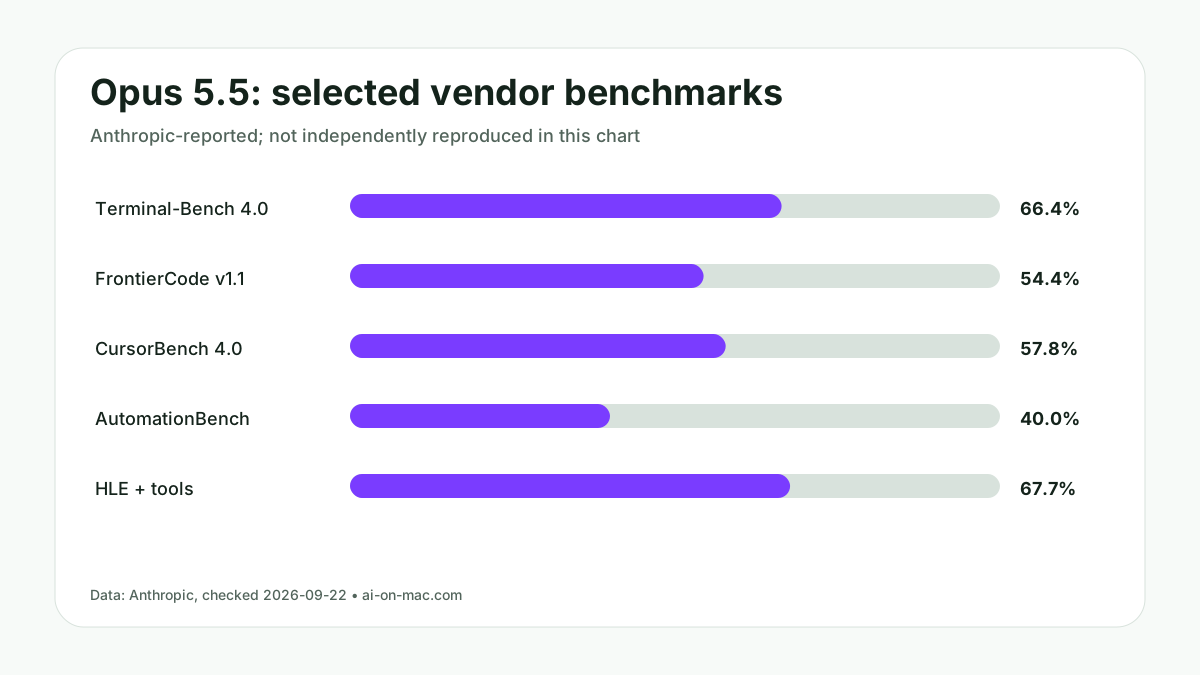
| Terminal-Bench 4.0 | 66.4% | Anthropic result, max effort |
| FrontierCode v1.1 Main | 54.4% | Anthropic result |
| CursorBench 4.0 | 57.8% | Anthropic result |
| GDPval-AA v2.1 | 1846 Elo | Anthropic result |
| AutomationBench | 40.0% | early-access setup |
| HLE with tools | 67.7% | Anthropic result |
Pricing and score source: Anthropic, checked September 22, 2026. Benchmark rows are vendor-reported, not measurements performed by this publication.
What is Claude Opus 5.5?
Opus 5.5 is the first model in Anthropic’s Claude 5.5 family. Anthropic positions it for demanding coding, agentic workflows, and knowledge work, saying it reaches Fable 5.1-level performance on most work while costing less. The company says Sonnet 5.5 and Haiku 5.5 are planned for the following weeks. Anthropic
For developers, the launch page gives the model identifier claude-opus-5-5. Anthropic also says the model is available across its platforms and through Amazon Web Services, Google Cloud, and Microsoft Azure. Provider catalogs can lag a launch by hours or days, so an older cloud documentation snapshot should not be treated as proof that the model is unavailable.
API pricing: a 20% cut on standard input and output
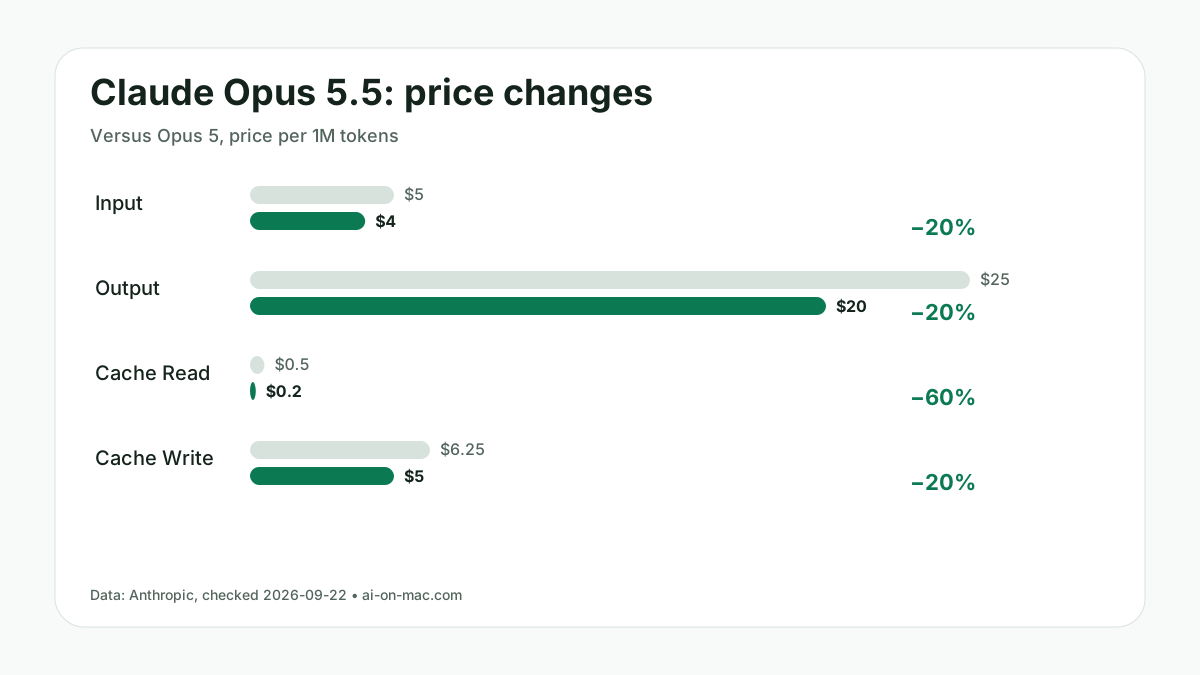
Compared with Opus 5, Opus 5.5 reduces standard input pricing from $5 to $4 per million tokens and output pricing from $25 to $20. Both are 20% cuts. Cache-read pricing drops more aggressively, from $0.50 to $0.20 per million tokens, a 60% reduction. Anthropic
| Billing component | Opus 5 | Opus 5.5 | Change |
|---|---|---|---|
| Input / 1M tokens | $5.00 | $4.00 | −20% |
| Output / 1M tokens | $25.00 | $20.00 | −20% |
| Cache write / 1M tokens | $6.25 | $5.00 | −20% |
| Cache read / 1M tokens | $0.50 | $0.20 | −60% |
Original cost example: same token volumes
Consider a cache-heavy agent workload that consumes 10M regular input tokens, 2M output tokens, 100M cache-read tokens, and 10M cache-write tokens during a billing period.
Opus 5.5: 10×$4 + 2×$20 + 100×$0.20 + 10×$5 = $150.
Opus 5: 10×$5 + 2×$25 + 100×$0.50 + 10×$6.25 = $212.50.
With identical token volumes, Opus 5.5 is 29.4% cheaper in this example. That is deliberately different from Anthropic’s “40% less on typical workloads” claim. Anthropic attributes part of the larger typical-workload saving to Opus 5.5 completing work with fewer tokens; we have not independently reproduced that efficiency claim.
Fast mode: 2× token pricing for up to 2.5× speed
Anthropic lists Opus 5.5 Fast mode at $8/M input and $40/M output. That doubles the standard token price. The advertised upside is up to 2.5× speed. The economics therefore depend on whether latency has business value: interactive coding agents may justify the premium, while asynchronous batch work often benefits more from the standard tier. Anthropic
Benchmarks: strong vendor-reported gains, with a launch-day caveat
Anthropic reports 66.4% on Terminal-Bench 4.0, compared with 52.3% for Opus 5 in its table. It also reports 54.4% on FrontierCode v1.1 Main, 57.8% on CursorBench 4.0, and an 1846 Elo result on GDPval-AA v2.1. Anthropic
Those numbers are useful but they are not a universal model ranking. Terminal and agent benchmarks can change materially with harness, tool access, effort level, sampling, retry policy, and scoring rules. Snorkel’s Terminal-Bench material and independent trackers highlight why version and harness consistency matters. Snorkel AI LLMCompare
The timing matters too. On launch day, we did not find a broad independent same-harness reproduction covering all of Anthropic’s Opus 5.5 scores. VentureBeat similarly notes gaps in clean public same-harness comparisons with current OpenAI models. That does not invalidate Anthropic’s results; it defines the evidence class: vendor benchmark data awaiting broader independent replication. VentureBeat
Why coding agents are the most interesting test case
Anthropic’s strongest claims concern long-running tool use, repository work, and coding agents. The company describes an early test on a roughly 200,000-line codebase that finished in under three hours with Opus 5.5 versus more than 20 hours with Opus 5. In an internal HAProxy C-to-Rust project, Anthropic reports 9.5 hours with Opus 5.5 versus 12 hours with Fable 5.1 and 51% fewer tokens. Anthropic
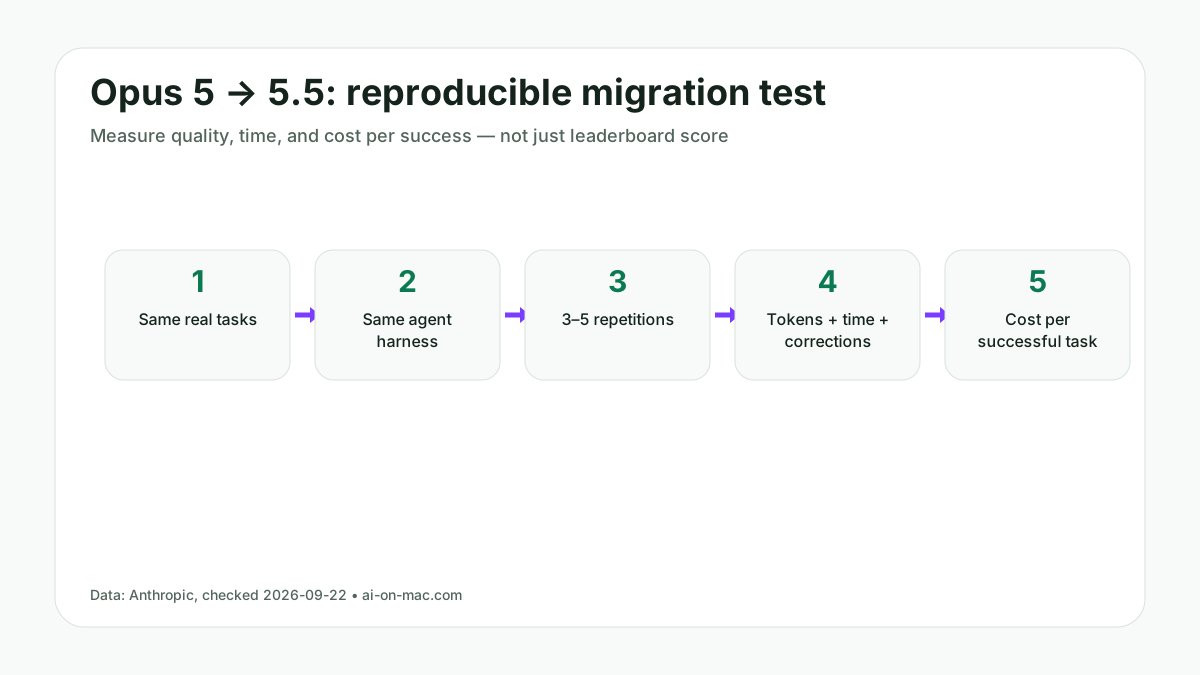
These are informative product examples, not neutral lab tests. Teams evaluating a migration should run their own paired pilot: identical issues, repositories, tools, permissions, harness settings, and several repetitions. Record completion rate, wall-clock time, tokens, human interventions, and regression rate. That produces a metric public leaderboards cannot give you: cost per successful real task.
Safety changes: stronger safeguards and explicit fallbacks
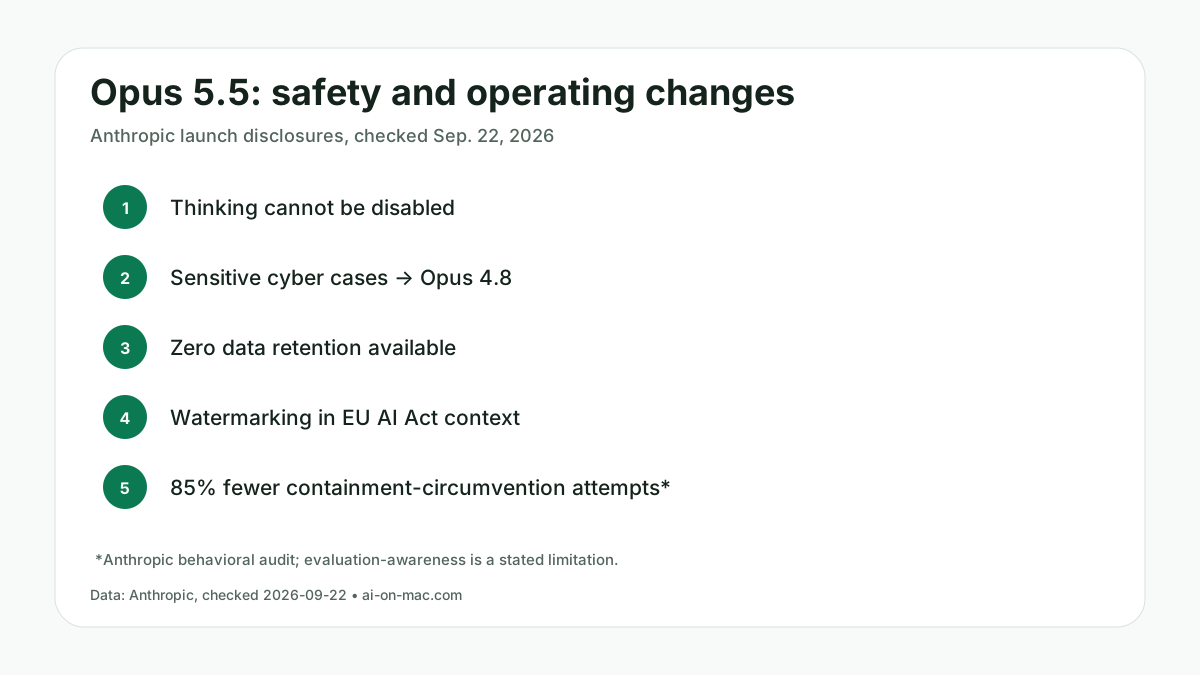
Opus 5.5 adopts Fable 5.1-class safeguards for certain cyber and biology risks. Anthropic says some sensitive cybersecurity requests can be transparently routed to Opus 4.8, while normal software-engineering tasks such as finding and fixing bugs remain allowed. In an approximately 2,000-scenario behavioral audit, Anthropic reports 85% fewer containment-circumvention attempts than Opus 5 or Mythos 5.1. The company also flags evaluation awareness as an ongoing limitation when interpreting behavioral tests. Anthropic The Verge
Other launch details include an available zero-data-retention option, EU AI Act-related watermarking, and a change that means thinking can no longer be fully switched off. Organizations handling sensitive data should still verify the exact account, region, cloud-provider, and contractual configuration rather than treating a product-level statement as a blanket compliance guarantee.
Context window and launch-day documentation lag
Anthropic’s general platform documentation says Claude 4.6 and later use the full 1M-token context window at standard pricing, which logically includes Opus 5.5. But the launch-day documentation itself illustrates why fast-moving model catalogs need source hierarchy: when checked on September 22, the generic pricing table had not yet been fully updated with an Opus 5.5 row even though the model-specific launch page already published the new prices. Anthropic pricing docs
For same-day releases, prioritize the model-specific primary source, then use generic documentation and cloud-provider pages as cross-checks once they catch up.
Should Opus 5 users migrate?
For existing Opus 5 workloads, the direction of the price change is unambiguous: standard input and output are 20% cheaper, cache reads are 60% cheaper, and Anthropic reports higher coding and agent performance. That makes Opus 5.5 a particularly relevant candidate for context-heavy agents that repeatedly reuse large prompts or repositories.
A production migration should still be gated by a paired test. Measure:
- Success rate on your real tasks.
- Total tokens per successful task.
- P50/P95 latency and time-to-completion.
- Human corrections and retries.
- Behavior changes caused by mandatory thinking.
- Safety fallbacks relevant to your domain.
- Actual provider/region pricing and data-retention terms.
Opus 5.5 vs. Fable 5.1: use cost per successful task
Anthropic says Opus 5.5 performs at Fable 5.1 level on most work while carrying much lower standard token prices. A deliberately simple uncached calculation of 1M input plus 1M output tokens costs $24 on Opus 5.5. Under Anthropic’s published Fable 5.1 pricing, the same raw token volume costs $60. That makes Opus 5.5 60% cheaper in this artificial equal-token example.
Real workloads are not equal-token experiments. Models may need different token counts, retries, tool calls, or human corrections. The more decision-relevant KPI is dollars per successfully completed task, ideally paired with quality and latency thresholds.
Claude Opus 5.5: what the launch changes
Claude Opus 5.5 is a substantive Opus update rather than a naming refresh. Anthropic cuts direct token prices, especially cache-read pricing, reports higher output speed, and publishes large gains on several coding and agent benchmarks. The official API identifier is claude-opus-5-5, with availability through Anthropic and the major cloud partners. Anthropic Reuters
The launch-day limitation is equally important: most detailed performance figures are still vendor-reported. Teams choosing a production model should benchmark Opus 5.5 against Opus 5, Fable 5.1, and relevant competitors in the same harness, then rank candidates by quality-adjusted cost per successful task rather than by a single leaderboard score.
Transparency
Sources and review basis
These primary and reference sources form the basis of the technical assessment. Vendor claims and external benchmarks are identified as such in the article.
- anthropic.com claude-opus-5-5
- reuters.com business / anthropic-unveils-claude-opus-55-2026-09-22
- venturebeat.com technology / anthropic-releases-claude-opus-5-5-beating-fable-5-1-on-key-agentic-benchmarks-at-60-cheaper-api-price
- snorkel.ai leaderboard / terminal-bench-4-0
- llmcompare-drab.vercel.app benchmarks / terminal-bench-4
- theverge.com 998868 / anthropic-claude-opus-5-5-cybersecurity
- platform.claude.com about-claude / pricing