Research checked: September 29, 2026
Anthropic released Claude Sonnet 5.5 on September 28, 2026. It keeps Sonnet 5’s API token price while Anthropic claims substantial gains in output speed, coding, agentic work and token efficiency.
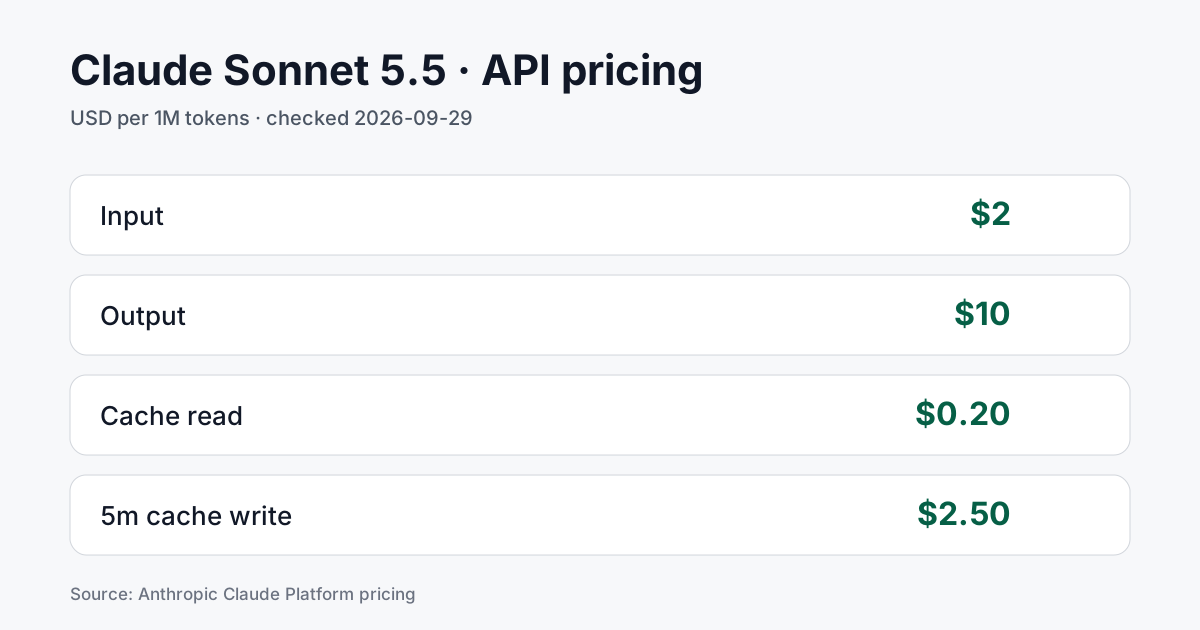
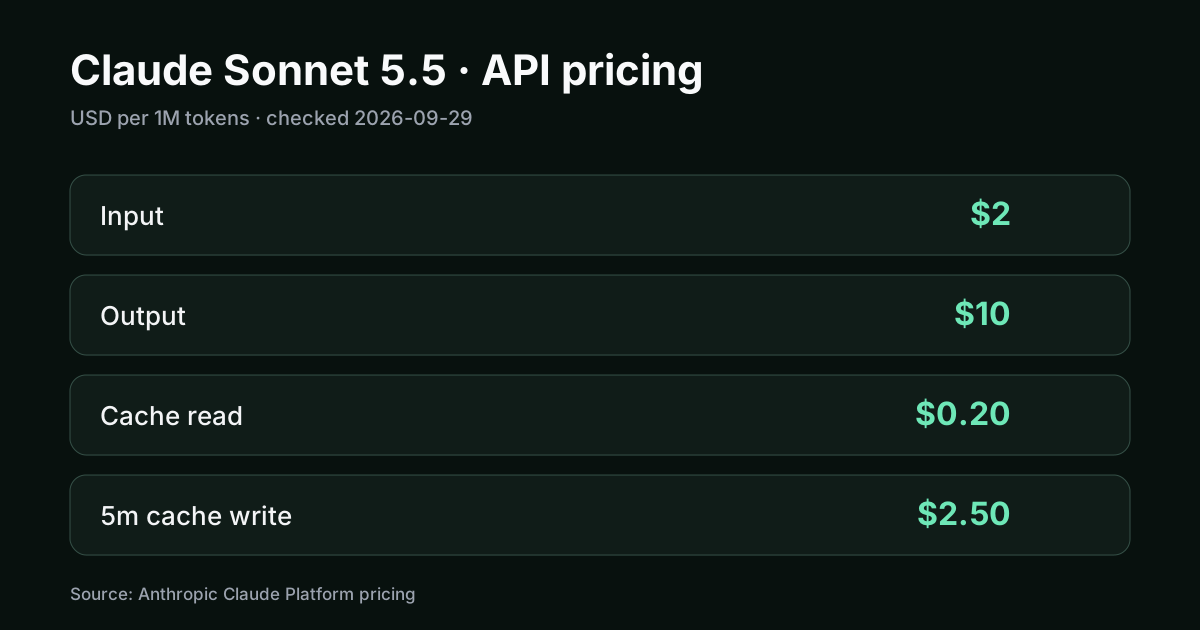
The core specification is a 1-million-token context window, up to 128,000 standard output tokens, and pricing of $2 per million input tokens and $10 per million output tokens.
Claude Sonnet 5.5 keeps Sonnet 5’s token price but changes important API behavior. It adds stronger coding and agent performance, new thinking behavior and provider-specific model IDs that can matter during migration.
Claude Sonnet 5.5 specifications
| Specification | Claude Sonnet 5.5 |
|---|---|
| Release | September 28, 2026 |
| Native Claude API ID | claude-sonnet-5-5 |
| Context window | 1,000,000 tokens |
| Standard maximum output | 128,000 tokens |
| Batch output beta | up to 300,000 tokens |
| Input | $2 / 1M tokens |
| Output | $10 / 1M tokens |
| 5-minute cache write | $2.50 / 1M tokens |
| 1-hour cache write | $4 / 1M tokens |
| Cache read | $0.20 / 1M tokens |
| Thinking | Adaptive |
| Default API effort | High |
| Knowledge cutoff | June 2026 |
| Training cutoff | June 2026 |
Source: Anthropic Claude Platform, checked September 29, 2026.
Which Claude Sonnet 5.5 model ID should you use?
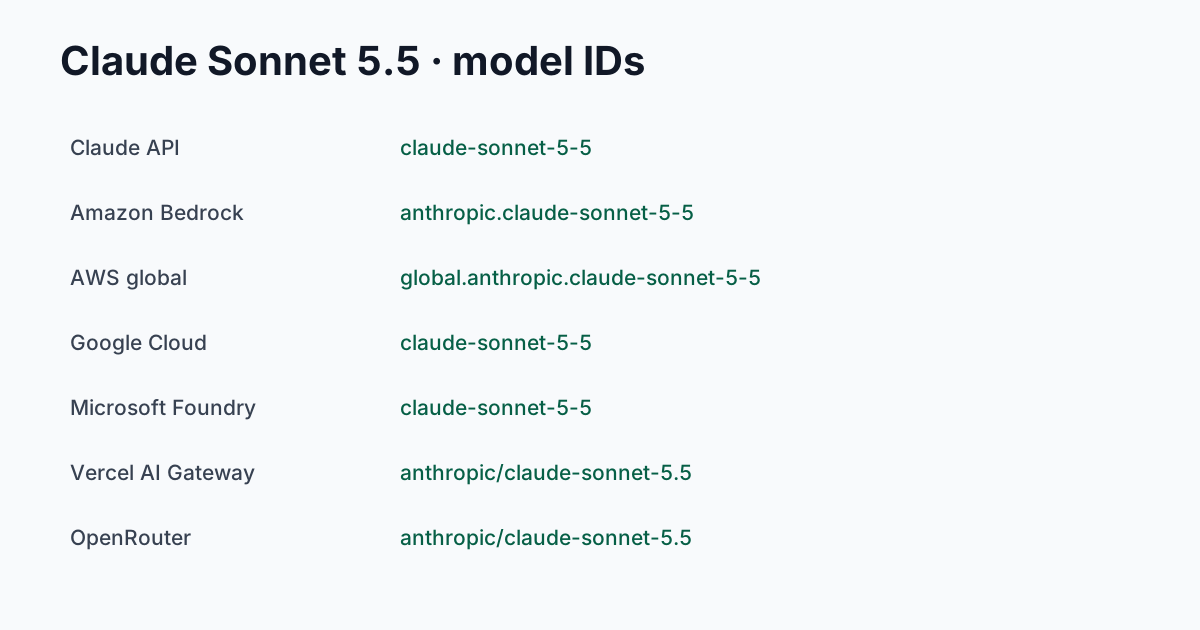
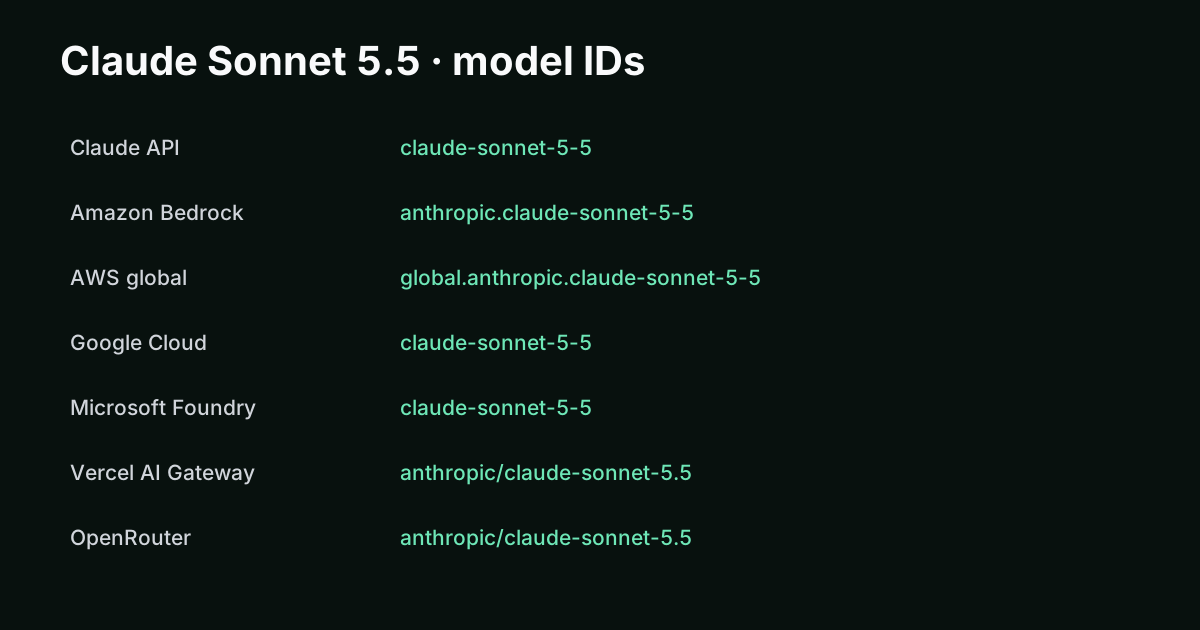
The correct identifier depends on the provider:
- Claude API:
claude-sonnet-5-5 - Vercel AI Gateway:
anthropic/claude-sonnet-5.5 - OpenRouter:
anthropic/claude-sonnet-5.5 - Amazon Bedrock:
anthropic.claude-sonnet-5-5 - AWS Global Inference:
global.anthropic.claude-sonnet-5-5 - Google Cloud:
claude-sonnet-5-5 - Microsoft Foundry:
claude-sonnet-5-5
This is operationally important. A model slug copied from a gateway is not necessarily valid in Anthropic’s native SDK.
What changed from Sonnet 5?
Anthropic emphasizes two headline improvements:
- more than 30% faster output
- up to 30% lower cost per completed task
The second claim does not mean token pricing was reduced.
Sonnet 5 and Sonnet 5.5 both cost $2 per million input tokens and $10 per million output tokens. Anthropic attributes the task-level saving to lower token consumption and fewer tool calls.
That makes the result workload-dependent rather than a universal 30% billing reduction.
Benchmark results
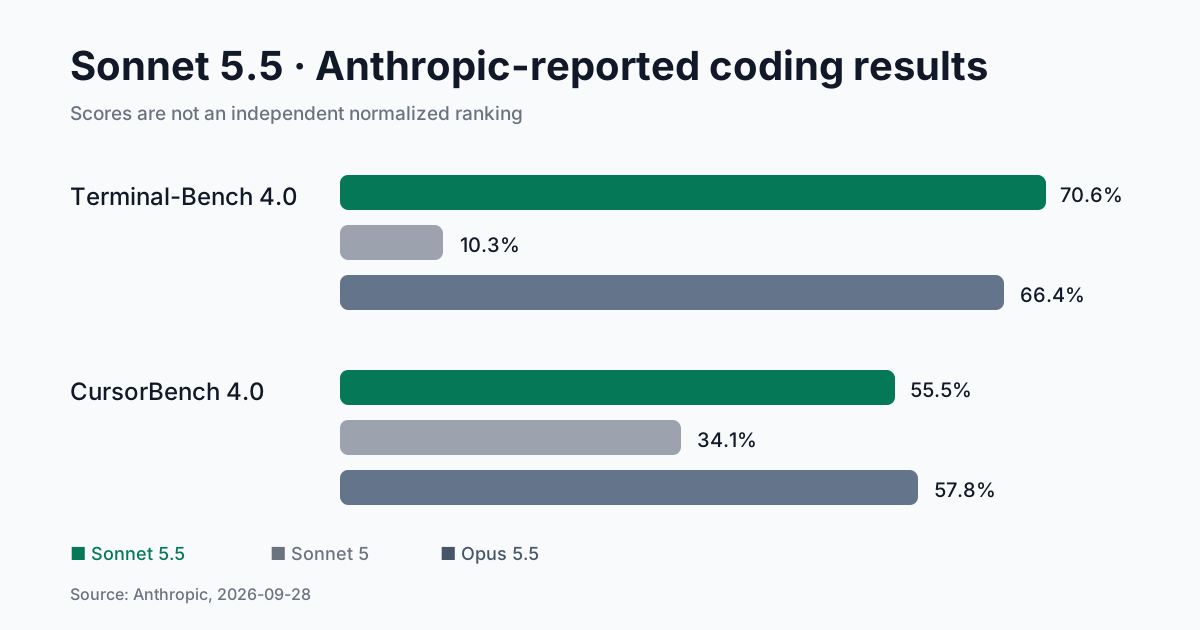
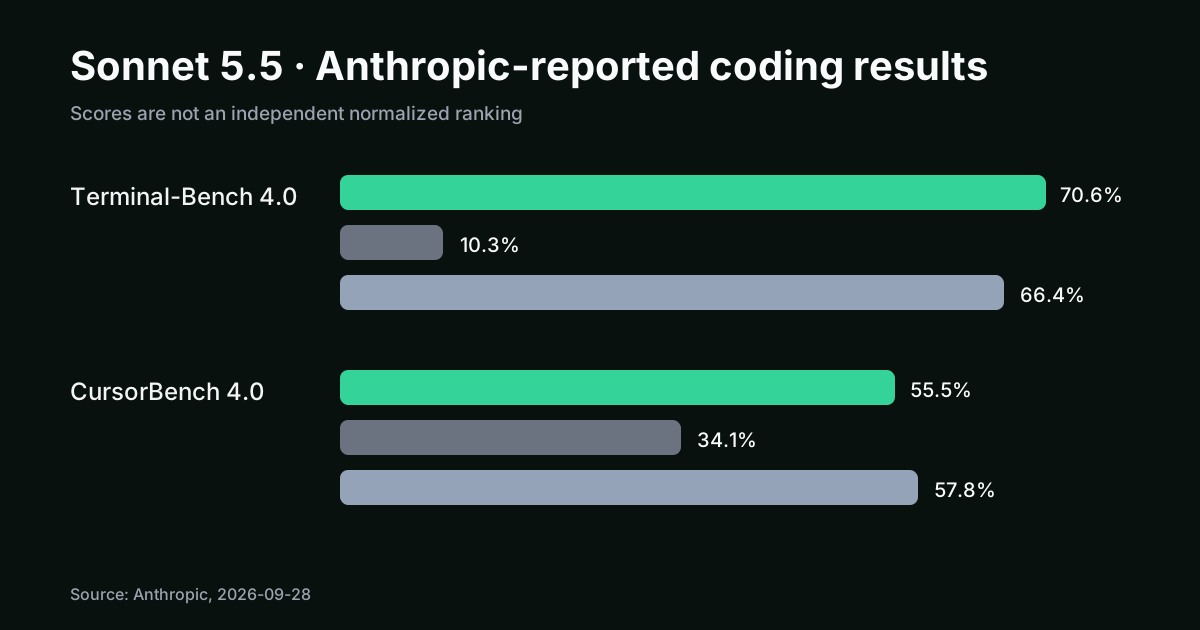
Anthropic reports:
| Benchmark | Sonnet 5.5 | Sonnet 5 | Opus 5.5 |
|---|---|---|---|
| Terminal-Bench 4.0 | 70.6% | 10.3% | 66.4% |
| FrontierCode 1.1 | 46.2% Max / 52.1% Xhigh | 42.4% | 54.4% |
| CursorBench 4.0 | 55.5% | 34.1% | 57.8% |
| GDPval-AA v2.1 | 1844 | 1449 | 1846 |
| AA-Briefcase v1.1 | 1811 | 1359 | 1822 |
These are Anthropic-reported results, not a normalized independent leaderboard.
Max effort is not automatically optimal
One of the most useful details in Anthropic’s launch data is the FrontierCode result.
Sonnet 5.5 reaches:
- 52.1% at Xhigh
- 46.2% at Max
Anthropic says Max triggered additional code-review subagents more often. In some runs, that caused timeouts or out-of-scope modifications.
For production use, teams should therefore benchmark effort settings against their own tasks instead of automatically selecting Max.
Independent results
Vals AI reports a Vals Index of 69.22 ± 0.96% for Sonnet 5.5.
Its published results include:
- Code Migration: 69.83%
- Vibe Code Bench v1.1: 92.39%
- Terminal-Bench 4.0: 53.03%
The Vals Terminal-Bench result differs substantially from Anthropic’s 70.6%.
That does not prove either number is wrong. Agentic benchmarks are highly sensitive to harness configuration, effort settings, tool behavior, fallback policies and timeouts.
Manufacturer and independent benchmark results should therefore be displayed separately.
What does Claude Sonnet 5.5 cost in practice?
A request with 10,000 input tokens and 2,000 output tokens costs:
- Input: 10,000 / 1,000,000 × $2 = $0.02
- Output: 2,000 / 1,000,000 × $10 = $0.02
- Total: $0.04
One thousand requests with the same token profile would cost approximately $40 in token charges.
Prompt caching
If 8,000 of 10,000 input tokens are cache reads:
- 2,000 new input tokens: $0.004
- 8,000 cached tokens: $0.0016
- 2,000 output tokens: $0.02
- Total: $0.0256
The initial cache write is billed separately.
Batch API
Batch processing reduces standard input and output rates by 50%, resulting in effective rates of $1 input and $5 output per million tokens.
Major migration changes
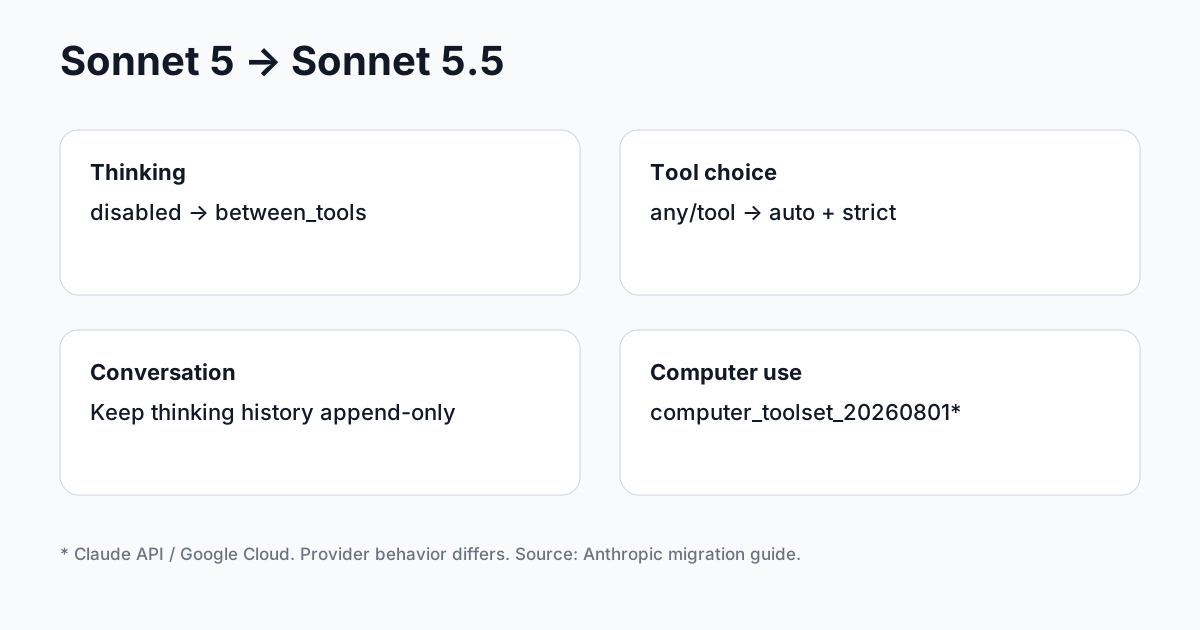
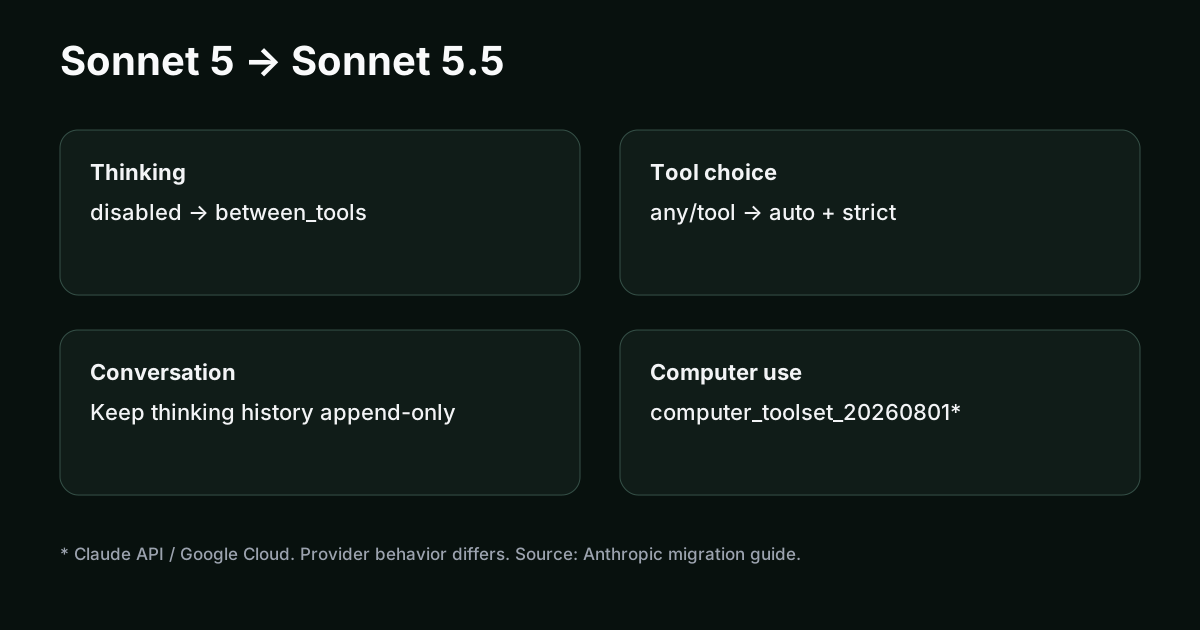
thinking: disabled is no longer supported
Sonnet 5 allowed:
{"thinking":{"type":"disabled"}}Sonnet 5.5 rejects that configuration.
For reduced up-front reasoning, Anthropic provides:
{"thinking":{"type":"between_tools"}}This works at Low, Medium and High effort.
Forced tool choice was removed
tool_choice: any and forcing one specific tool are no longer supported.
Anthropic recommends automatic tool selection and Strict Tool Use where valid tool arguments are required.
Thinking blocks are more tightly bound to model and conversation state
Sonnet 5.5 conversations should generally be treated as append-only. Mutating earlier messages, tools or system prompts can invalidate preserved thinking blocks.
Computer Use changed
On Claude API and Google Cloud, computer_20251124 is replaced by computer_toolset_20260801.
Provider behavior can differ.
Effort levels should be re-evaluated
Low, Medium, High, Xhigh and Max should not be assumed to behave identically to their Sonnet 5 counterparts.
Context and output limits
Claude Sonnet 5.5 supports:
- 1,000,000 context tokens
- 128,000 standard output tokens
- up to 300,000 Batch API output tokens in beta
The output limit is separate from the total context window.
Sonnet 5.5 vs Opus 5.5
| Model | Input / 1M | Output / 1M |
|---|---|---|
| Sonnet 5.5 | $2 | $10 |
| Opus 5.5 | $4 | $20 |
Sonnet 5.5 therefore costs half as much per standard input and output token as Opus 5.5.
Anthropic positions Sonnet 5.5 for well-defined coding, agent and professional workflows where speed and economics matter, while Opus 5.5 remains aimed at more difficult open-ended tasks requiring sustained judgment.
Who should use Sonnet 5.5?
Sonnet 5.5 is especially relevant for:
- coding agents
- tool-based automation
- long-context document workflows
- knowledge work
- high-volume API workloads
- applications where Opus-level reasoning is not always necessary
A blind model swap is less appropriate for workflows that are sensitive to tool selection, reasoning settings or agent-loop behavior.
Bottom line: migration comes before features
Claude Sonnet 5.5 combines a 1M-token context window, relatively low $2/$10 API pricing, and benchmark performance that approaches flagship territory on several bounded tasks.
The main caveat is migration behavior. Sonnet 5.5 is not a fully compatible drop-in replacement in every Sonnet 5 configuration.
Thinking, tool choice, conversation state, computer use and effort levels should all be tested before production rollout.
Frequently Asked Questions
What is the difference between Claude Sonnet 5 and Sonnet 5.5?
Sonnet 5.5 shipped on September 28, 2026. The token price stays at $2 per million input and $10 per million output tokens, while Anthropic reports more than 30 percent faster output and up to 30 percent lower cost per completed task. The API behaves differently though: thinking disabled and forced tool choice no longer work.
How much does Claude Sonnet 5.5 cost through the API?
A request with 10,000 input and 2,000 output tokens costs $0.04 without caching, so 1,000 such requests cost about $40. If 8,000 of the input tokens are cache reads, the same request drops to $0.0256. The Batch API applies 50 percent lower rates, which works out to an effective $1 input and $5 output per million tokens.
Which model ID do I use for Claude Sonnet 5.5?
The Claude API uses claude-sonnet-5-5, OpenRouter and Vercel AI Gateway use anthropic/claude-sonnet-5.5, Amazon Bedrock uses anthropic.claude-sonnet-5-5 and AWS Global Inference uses global.anthropic.claude-sonnet-5-5. A gateway ID does not automatically work in the native Anthropic SDK.
Can I swap Sonnet 5.5 in for Sonnet 5 directly?
Not in every configuration. The thinking disabled option returns a 400 error and between_tools replaces it. Forcing tool choice with tool_choice any or a specific tool is no longer supported. Conversations should be treated as append-only, and computer use on the Claude API and Google Cloud requires the computer_toolset_20260801 toolset.
Is Sonnet 5.5 worth switching to for agent workflows?
Sonnet 5.5 makes sense for coding agents, automated tool workflows and long document contexts because the 1M context window is retained and the coding benchmarks are clearly above Sonnet 5. For workflows sensitive to tool behavior or agent loops, test thinking, tool choice and effort levels against your own tasks first.
Why do the Anthropic and Vals AI benchmark numbers differ?
Anthropic reports 70.6 percent on Terminal-Bench 4.0 for Sonnet 5.5 while Vals AI reports 53.03 percent. Agentic benchmarks react strongly to harness, effort level, tool configuration, timeouts and fallbacks. Neither number is automatically wrong, and both should be shown separately with their methodology labeled.
Transparency
Sources and review basis
These primary and reference sources form the basis of the technical assessment. Vendor claims and external benchmarks are identified as such in the article.
- anthropic.com claude-sonnet-5-5
- platform.claude.com sonnet-5-5 / overview
- platform.claude.com sonnet-5-5 / whats-new-sonnet-5-5
- platform.claude.com sonnet-5-5 / migration-guide
- platform.claude.com about-claude / pricing
- platform.claude.com build-with-claude / extended-thinking
- platform.claude.com build-with-claude / prompt-caching
- platform.claude.com build-with-claude / effort
- platform.claude.com build-with-claude / preserved-thinking
- aws.amazon.com machine-learning / introducing-claude-sonnet-5-5-on-aws
- docs.cloud.google.com claude / sonnet-5-5
- learn.microsoft.com concepts / models-from-partners
- vercel.com changelog / claude-sonnet-5-5-now-available-on-ai-gateway
- vals.ai models / anthropic_claude-sonnet-5-5
- venturebeat.com technology / anthropic-launches-claude-sonnet-5-5-with-30-cost-reduction-per-task-due-to-faster-speeds-and-fewer-tool-calls
- tbench.ai www.tbench.ai