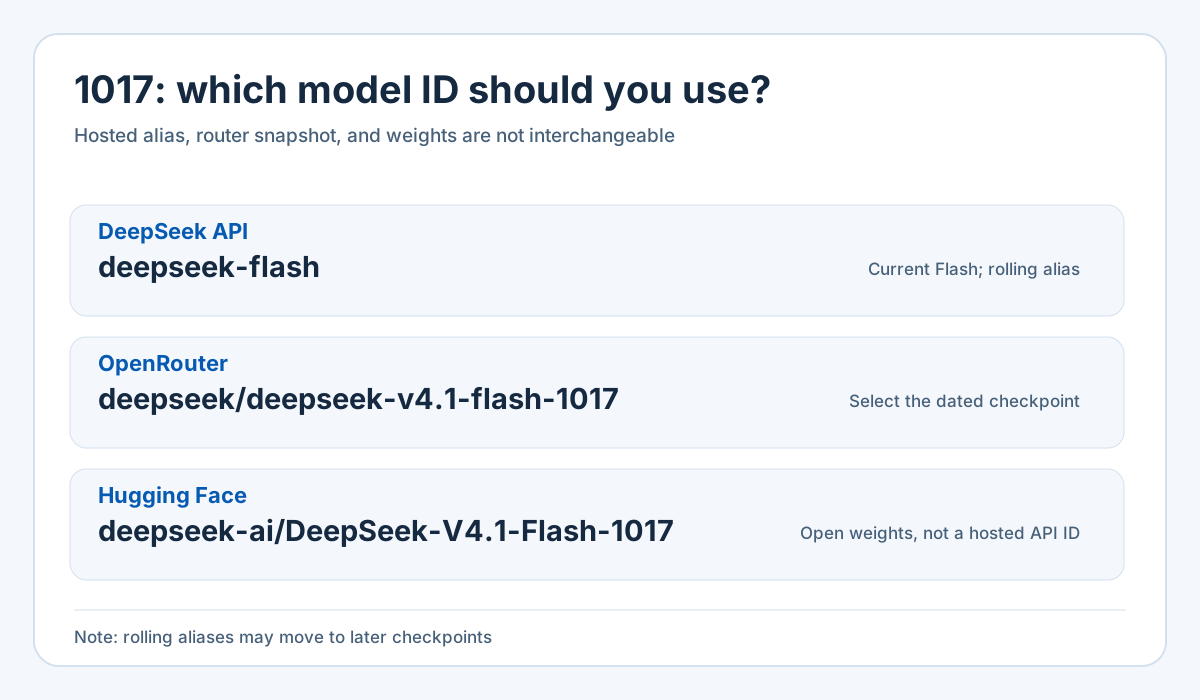
Research cutoff: October 17, 2026. DeepSeek has shipped DeepSeek-V4.1-Flash-1017, a new checkpoint of the Flash model introduced on September 10. The update is live in DeepSeek’s web interface, mobile app, and API. Existing integrations using the deepseek-flash API alias automatically move to the October model; DeepSeek says the method of access and its pricing have not changed. A separate dated snapshot, deepseek/deepseek-v4.1-flash-1017, is listed on OpenRouter. 123
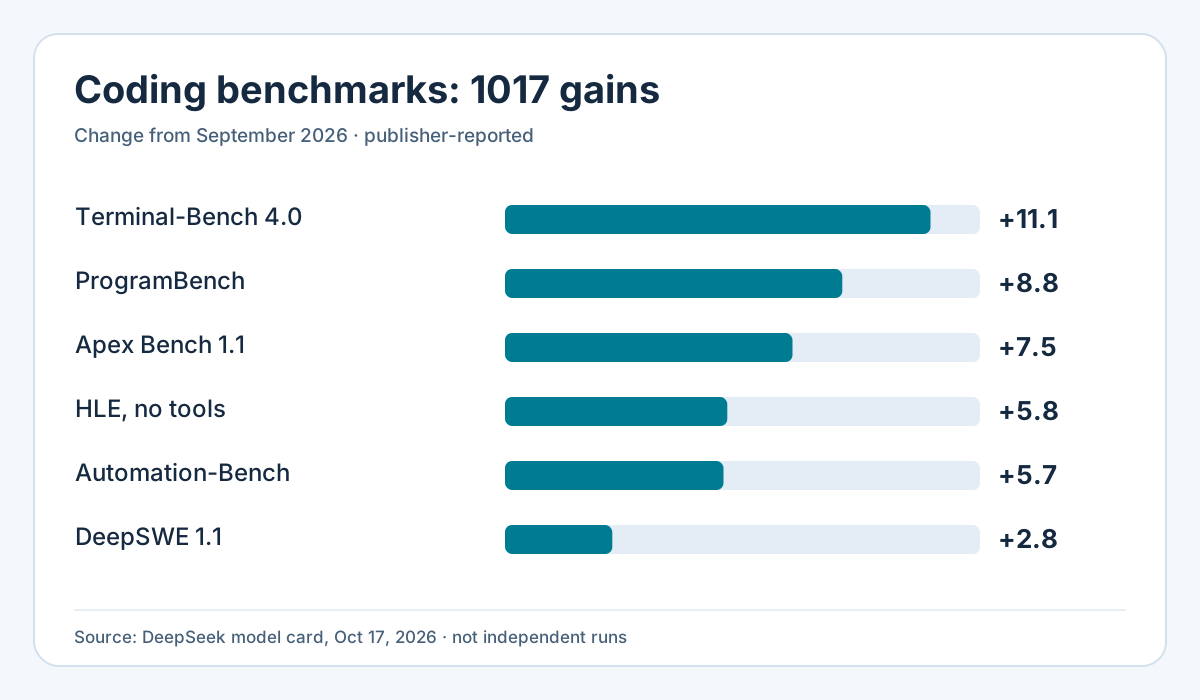
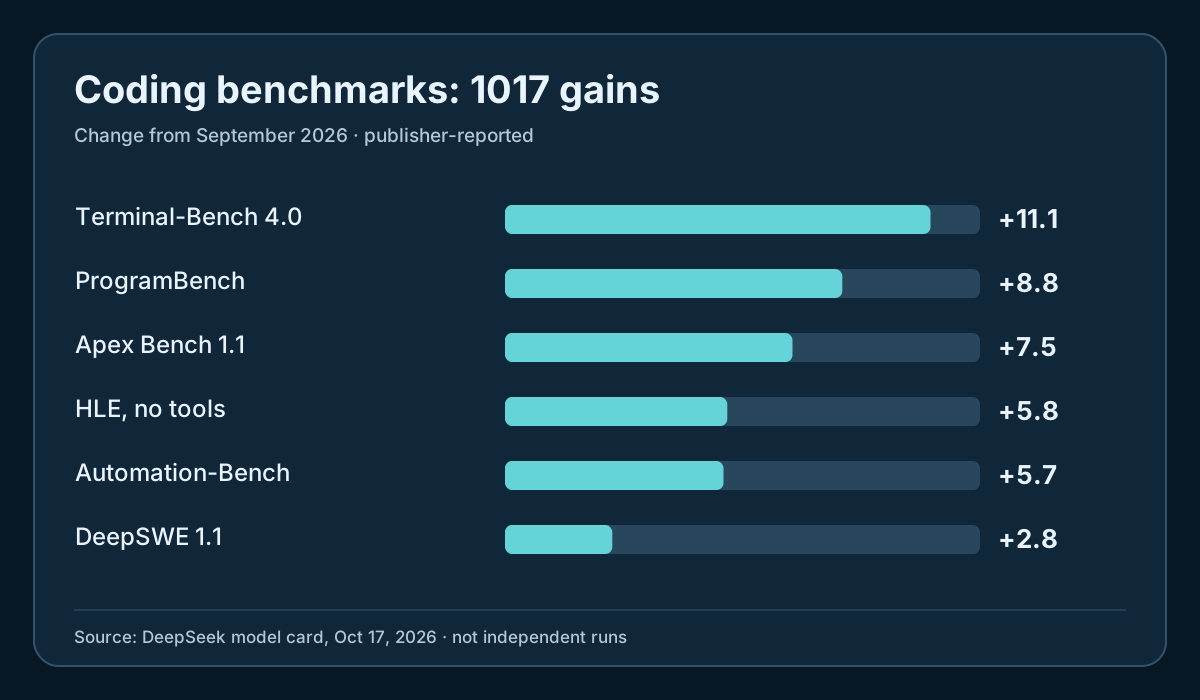
The notable change is in the publisher’s coding and agent benchmark table. Terminal-Bench 4.0 moves from 31.2 to 42.3; ProgramBench increases from 20.3 to 29.1; and the automation benchmark increases from 54.8 to 60.5. Those are meaningful reported gains, but they are not a verified improvement in success rates, latency, or invoice amounts for your own agent. The useful question is whether the new checkpoint finishes more of your jobs at a lower fully loaded cost. 4
What that means in practice: Anyone already using the official DeepSeek API with deepseek-flash receives the October update without swapping model strings. Anyone running reproducible evaluations through OpenRouter should use the dated snapshot, since a rolling alias can drift in later releases. For long-running agents the metric that matters is real cost per completed task, including cache hits, output tokens, tool use, and retries.
What changes – and what stays the same?
| Item | Confirmed detail | Important qualification |
|---|---|---|
| Snapshot | DeepSeek-V4.1-Flash-1017 | Checkpoint update, not a renamed family 1 |
| First-party API model | deepseek-flash | Rolling alias; may shift again after later releases 2 |
| OpenRouter model | deepseek/deepseek-v4.1-flash-1017 | Provider-specific pricing and capacity 3 |
| Maximum context | 1,048,576 tokens | Large context does not imply perfect recall 56 |
| First-party output cap | 384K tokens (393,216) | Endpoint or provider limits may differ 27 |
| Input and output types | Text and images in; text out | Does not generate images 78 |
| Agent tools | Tool calls supported | Reasoning-history rules must be honored 910 |
| Weight license | MIT | Open weights are not cheap local inference 411 |
| First-party rates | Unchanged | Off-peak and peak must be separated 12 |
DeepSeek attributes the update to reinforcement learning with self-feedback and shows examples of complete applications and 3D projects. Demonstrations establish the intended use case; they do not replace a blinded evaluation. 1
Reading the benchmark claims correctly
| Evaluation | V4.1 Flash (Sep) | Flash 1017 (Oct) | Change (points) |
|---|---|---|---|
| Terminal-Bench 4.0 | 31.2 | 42.3 | +11.1 |
| ProgramBench | 20.3 | 29.1 | +8.8 |
| Apex Bench v1.1 | 64.6 | 72.1 | +7.5 |
| Humanity’s Last Exam, no tools | 36.8 | 42.6 | +5.8 |
| Automation-Bench v1.0.6 | 54.8 | 60.5 | +5.7 |
| Chartography, with tools | 78.9 | 83.0 | +4.1 |
| Agents’ Last Exam | 31.8 | 35.4 | +3.6 |
| BabyVision, with tools | 89.6 | 92.5 | +2.9 |
| DeepSWE v1.1 | 74.2 | 77.0 | +2.8 |
| NL2Repo-Bench | 65.4 | 68.2 | +2.8 |
| ZeroBench-main, with tools | 49.0 | 51.0 | +2.0 |
Source: DeepSeek’s October 17, 2026 Hugging Face model card. The deltas are our arithmetic, not independent measurements. The rows represent different tasks and metrics and cannot be averaged into a single quality index. The HLE text-only subset (44.0 vs. 39.1) is reported separately and should not be mixed into the full HLE result. DeepSeek says Terminal-Bench 4.0 used the Claude Code harness and DeepSWE v1.1 used Mini-SWE-V2. 4121314
The +11.1-point Terminal-Bench 4.0 movement deserves attention because that benchmark exercises terminal-heavy autonomous work. Its organizers publish details about task fixes, resource calibration, and scoring sensitivity. Comparing a DeepSeek publisher result with another company’s public leaderboard number without matching harnesses and run conditions risks giving the wrong impression. 12
No general leaderboard crown follows from this chart. DeepSeek’s own six-model table is mixed: Flash 1017 leads some reported rows while other models lead in others. Shorter outputs and faster runs are company claims pending a controlled end-to-end comparison. 14
What is missing on launch day: No first-party test series with a fixed harness, identical tasks, multiple runs, total token cost, and wall-clock timing. The claim “faster and cheaper per task” therefore remains a vendor claim until such measurements exist.
API prices in US dollars: cheap input is not the whole bill
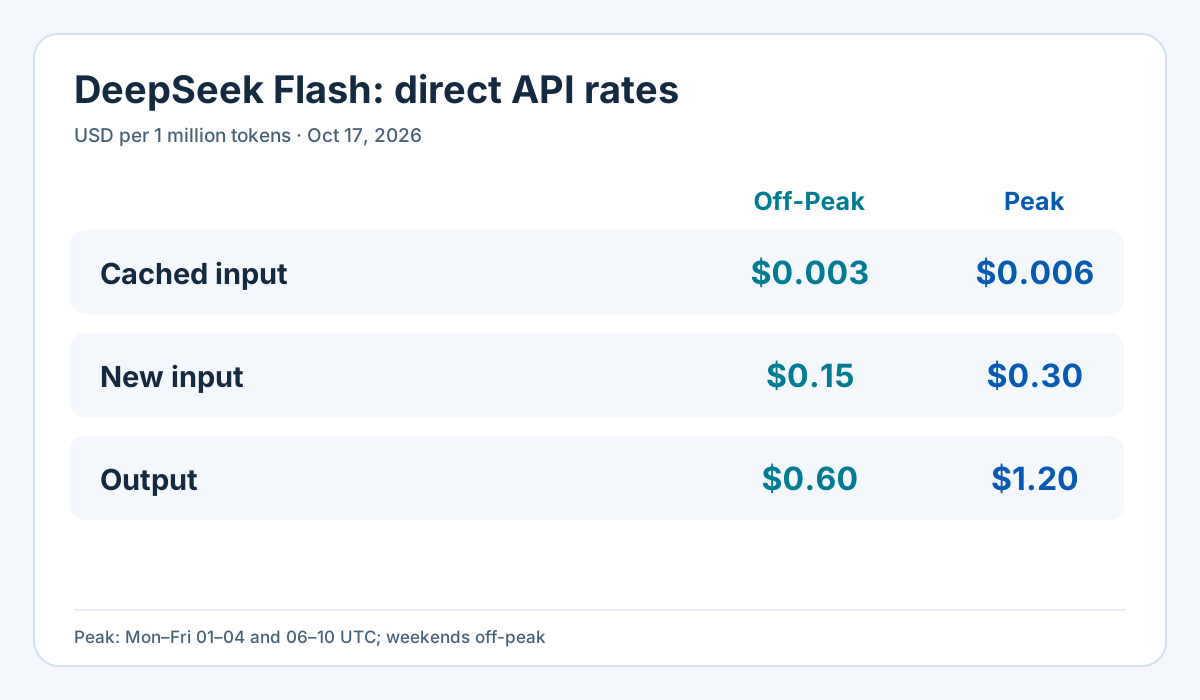
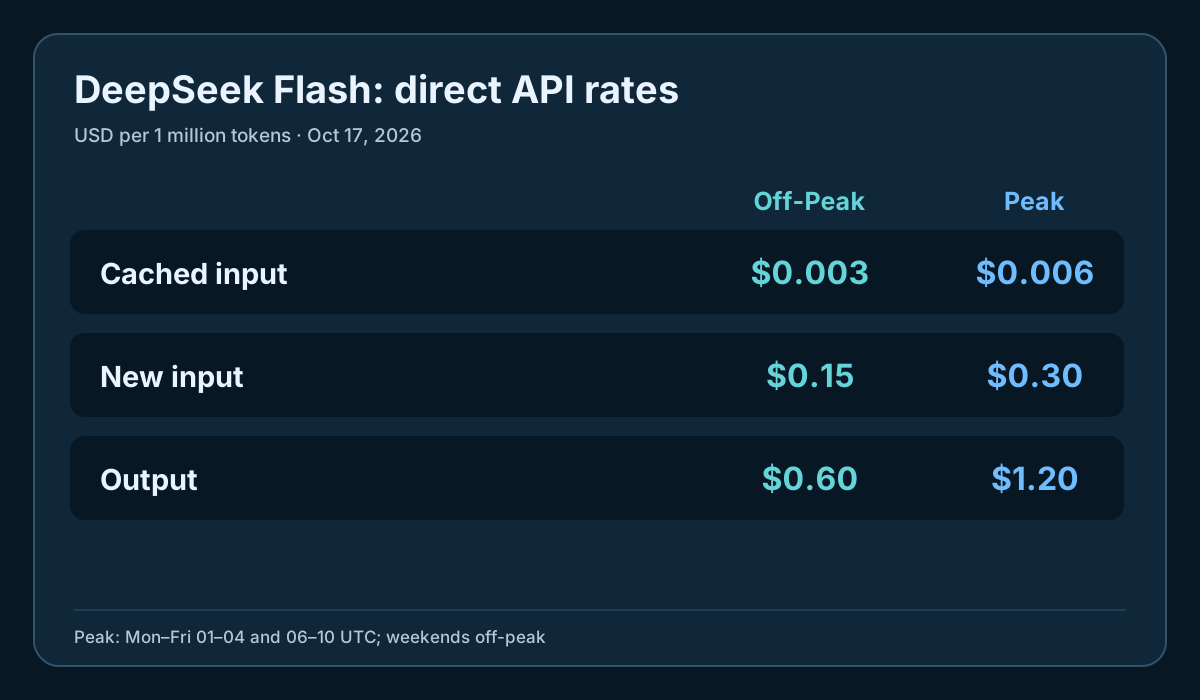
DeepSeek’s first-party pricing page bills three token categories separately, per million tokens: 2
| Meter | Off-peak | Peak |
|---|---|---|
| Cached input | $0.003 | $0.006 |
| Uncached input | $0.15 | $0.30 |
| Output | $0.60 | $1.20 |
On weekdays, peak periods are 01:00–04:00 UTC and 06:00–10:00 UTC, excluding Chinese public holidays. Weekends and Chinese public holidays are entirely off-peak. These are DeepSeek direct-API list prices in USD; they are not guaranteed OpenRouter checkout prices. Taxes, currency conversion, third-party tool fees, failed-task retries, and provider discounts may affect the amount paid. 23
Three reproducible usage calculations
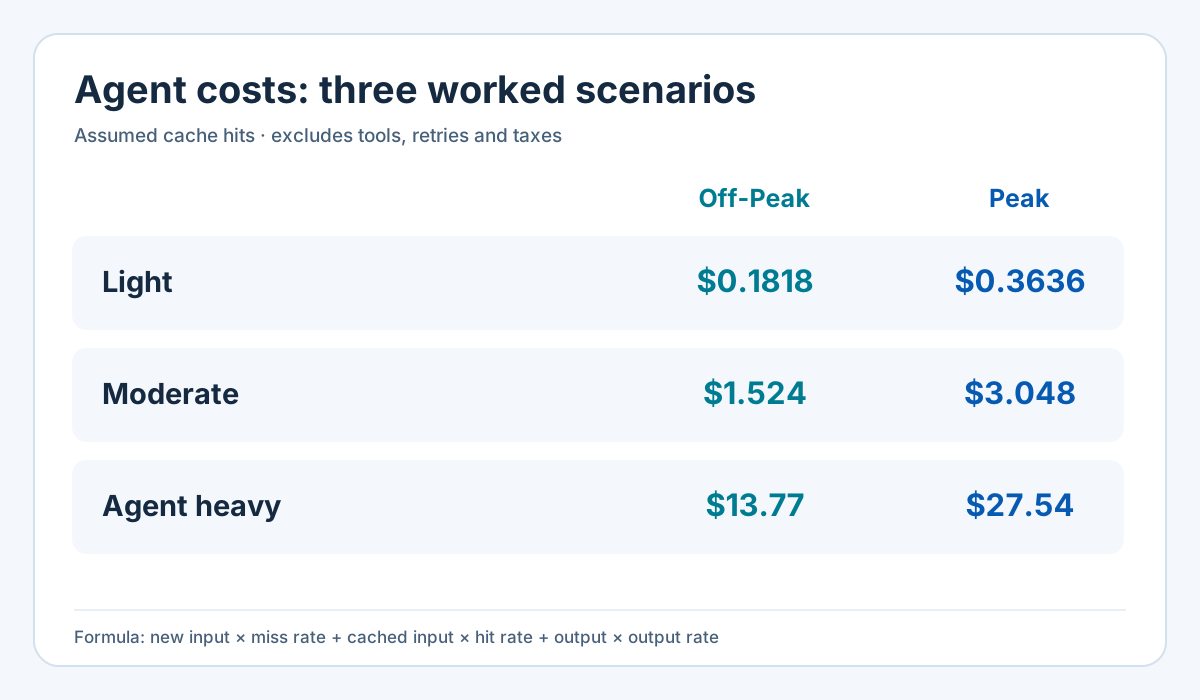
These are illustrative workloads, not measured consumption by Hermes, Codex, or DeepSeek Harness. Cached input is included inside the total input count, not added twice.
| Monthly-style sample workload* | Uncached input | Cached input | Output | Off-peak | Peak |
|---|---|---|---|---|---|
| Light | 0.4M | 0.6M | 0.2M | $0.1818 | $0.3636 |
| Moderate | 2M | 8M | 2M | $1.524 | $3.048 |
| High-volume agent | 10M | 90M | 20M | $13.77 | $27.54 |
“Monthly-style” only describes the aggregate token amounts selected. No monthly fee, usage tier, volume discount, or account quota is implied. All requests are assumed successful; tool fees, retries, and applicable taxes are excluded.
The exact formula is uncached_input_million × input_miss_rate + cached_input_million × cache_hit_rate + output_million × output_rate. In the moderate off-peak case, 2 × $0.15 + 8 × $0.003 + 2 × $0.60 = $1.524. Without caching, 10M fresh input and 2M output would cost $2.70; the assumed caching saves $1.176, or 43.6% of the token bill. Prefix reuse has to occur in real requests: DeepSeek calls the cache best-effort and provides prompt_cache_hit_tokens and prompt_cache_miss_tokens in usage accounting. 15
A second charge should be kept outside that calculation. DeepSeek introduced standalone Search and Fetch APIs at $0.75 per 1,000 successful requests for each endpoint. Server-side calls made through DeepSeek Harness, Claude Code, and Codex receive a temporary introductory waiver; DeepSeek states billing begins October 31, 2026 at 16:00 UTC. That is a separate meter from generated model tokens. 12
Choosing between a rolling model and a pinned snapshot
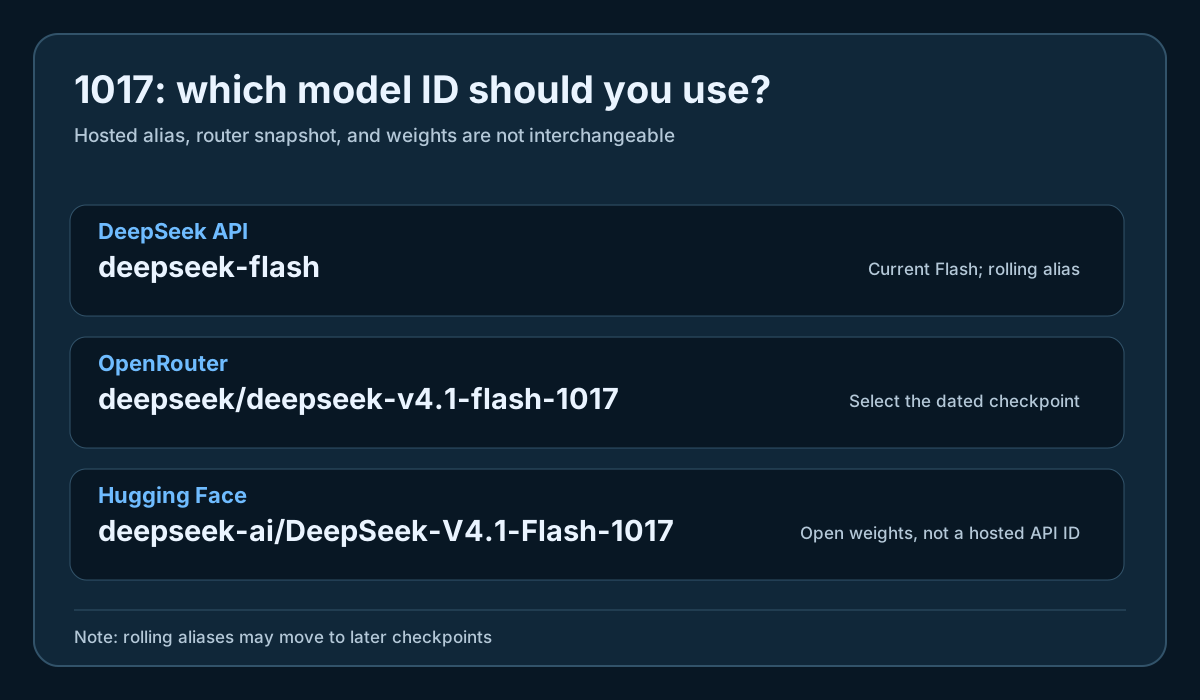
The official API’s deepseek-flash identifier points to the latest active Flash checkpoint. It is an excellent default for straightforward integrations, but it is not suitable as the only identifier in a long-running controlled evaluation if the vendor may silently refresh the alias later. Record the actual served version alongside model ID and time. The Anthropic-compatible endpoint is also available at https://api.deepseek.com/anthropic. 27
OpenRouter publishes a dated deepseek/deepseek-v4.1-flash-1017 entry. Its router may choose among providers unless routing constraints are supplied. The displayed cheapest provider price can change and may not apply to every feature. The model listing also does not guarantee EU-only in-region routing for the 1017 checkpoint. 3
Finally, the Hugging Face repository deepseek-ai/DeepSeek-V4.1-Flash-1017 holds the released weights and a prompt-encoding reference. That repository name is a download location, not a valid replacement for deepseek-flash in DeepSeek’s hosted API. 41617
A first-party Python request
import os
from openai import OpenAI

client = OpenAI(
    api_key=os.environ["DEEPSEEK_API_KEY"],
    base_url="https://api.deepseek.com",
)

result = client.chat.completions.create(
    model="deepseek-flash",
    messages=[{"role": "user", "content": "Review this unit test for edge cases."}],
    reasoning_effort="high",
    extra_body={"thinking": {"type": "enabled"}},
)
print(result.choices[0].message.content)
print(result.usage)
This example uses the documented endpoint and parameters; it has not been executed for this article. DeepSeek’s Chat Completions documentation describes separate thinking and non-thinking modes. Developers implementing an agent loop should also preserve the correct reasoning_content across tool-call turns. JSON-object output and strict tool-schema enforcement are distinct options, the latter documented as beta. 71018
Agent compatibility: what to test before switching production jobs
DeepSeek specifically recommends DeepSeek Harness v0.2.1-rc.1 or later for Flash 1017. That recommendation comes from the October release; it does not confirm what is installed on a given workstation or whether every package mirror exposes that build. DeepSeek also documents integrations with Codex and Claude Code. 11920
A defensible before/after test keeps the repository revision, task descriptions, tool permissions, agent build, and evaluation criteria constant. Record the actual model and provider, reasoning effort, cache-hit counts, output tokens, retries, wall-clock time, human interventions, and final success. The score to optimize is all-in spend per accepted completion, not solely dollars per million tokens.
A small experimental protocol is enough to start: ten tasks drawn from an existing repository, three clean repetitions per task and model, frozen toolchain, passing tests required for acceptance, all failing tasks included in cost totals. Compare median duration and success-adjusted spend and publish anonymized logs. This protocol is a recommendation, not a test already run by AI on Mac.
Open weights do not make this a small Mac model
The underlying V4.1 architecture uses a mixture-of-experts Causal Encoder-Decoder. DeepSeek’s September description gives 552B backbone parameters, with roughly 8B active on input and 16B active on output. The October checkpoint’s Hugging Face metadata displays approximately 763B parameters in total, reflecting a different accounting scope that includes additional components such as sparse Engram memory. These figures should not be conflated. 2145
The October model repository lists approximately 510 GB of files. A theoretical ideal 4-bit storage floor for 763B parameters alone is around 381.5 decimal GB, before quantization overhead, runtime memory, KV cache, and non-weight data. That arithmetic is not a validated hardware minimum, but it shows why ordinary consumer Macs are unlikely to serve the complete checkpoint locally. Running an agent on a Mac through a cloud API is different from running the model weights on the Mac. 516
Our assessment
DeepSeek V4.1 Flash 1017 is a credible update worth testing for autonomous coding workloads, with particularly strong reported gains in terminal and program-reconstruction evaluations. Direct API users already receive it through the rolling alias. The published evidence does not yet establish lower real-world end-to-end spending or universal superiority to other frontier models.
The best next step is to track success-adjusted cost on a reproducible workload. For the architecture, memory footprint, and September release context, read our existing DeepSeek V4.1 Flash foundation article. The October update is covered separately here to keep historical baselines and current releases clear.
Editorial disclosure: This is sourced analysis, not hands-on testing. Publication should preserve a correction channel, author attribution, and any applicable commercial disclosures. No affiliation or sponsorship with DeepSeek is asserted.
Sources and references
Footnotes
Frequently Asked Questions
When did DeepSeek V4.1 Flash 1017 launch?
On October 17, 2026. The new checkpoint replaces the September build behind the API alias `deepseek-flash` and is also listed as the dated snapshot `deepseek/deepseek-v4.1-flash-1017` on OpenRouter.
How much does DeepSeek V4.1 Flash 1017 cost per 1 million tokens?
DeepSeek direct API rates are unchanged at $0.003 (cache hit, off-peak), $0.15 (cache miss, off-peak), and $0.60 (output, off-peak) per million tokens. Peak windows double each value. OpenRouter pricing is separate.
Are the benchmark gains independently confirmed?
No. The table comes from DeepSeek's own October 17, 2026 model card and was not independently replicated by AI on Mac. The deltas are our arithmetic on top of DeepSeek's published numbers; methodological caveats are documented.
How much context and output does the model support?
The configuration sets `max_position_embeddings` to 1,048,576 tokens. The official pricing page lists a maximum output of 384K tokens (393,216 tokens).
Can DeepSeek V4.1 Flash 1017 run locally on a regular Mac?
The released weights span hundreds of gigabytes; at idealized 4-bit per parameter the full 763B checkpoint would need about 381 GB. For typical Macs the cloud API remains the realistic path.
Which agent version does DeepSeek recommend?
The October 17, 2026 release notes recommend DeepSeek Harness v0.2.1-rc.1 or later. Codex, Claude Code, and additional integrations are documented but were not live-tested by us.