Researched and edited with AI assistance. Editorial responsibility: Julian Dominic Altmann. Fact-checked November 4, 2026. Source analysis, not a hands-on legal model evaluation.
GLM-5.3-FlashX-Legal is Z.ai’s specialized API offering for contract analysis, legal research, document comparisons and multi-step legal-agent workflows. OpenRouter listed it on November 2, 2026 under z-ai/glm-5.3-flashx-legal. Published Z.ai rates are $0.37 per million input tokens, $0.075 for cached input and $1.25 per million output tokens, with a provider-advertised 1,048,576-token context window. Z.ai prices · OpenRouter listing
Those numbers make specialist legal inference accessible to developers. They do not establish that the model can complete attorney work without supervision. A separate question for Mac users is whether the legal-specific weights can be downloaded; this review could not verify an official checkpoint for that exact variant.
Published model specifications
| Property | November 4, 2026 source check |
|---|---|
| Developer | Z.ai |
| Z.ai model identifier | glm-5.3-flashx-legal |
| OpenRouter identifier | z-ai/glm-5.3-flashx-legal |
| Router listing | November 2, 2026 |
| Context / maximum output | 1,048,576 / 131,072 tokens, per OpenRouter |
| Input / output | Text, image, video / text |
| Features | Function calling, structured output, streaming |
| Thinking | Enabled-only according to the vendor model guide |
| Standard input / cache read / output | $0.37 / $0.075 / $1.25 per 1M tokens |
| Exact Legal model checkpoint | No independently verified public download |
| OpenRouter EU in-region | Not currently offered for this endpoint |
Z.ai’s model documentation explicitly lists the legal API identifier. The context and modality figures are published specifications, not measured accuracy for a million-token case file.
What is different about a legal-specialized model?
Legal work frequently requires more than generating a fluent answer. A contract review might require tracing defined terms across exhibits, identifying exceptions, comparing revisions and delivering a complete list of supported findings.
Z.ai describes legal-domain mid-training and reinforcement learning in task environments intended to resemble professional workflows. Target applications include legal research, contract review, cross-document consistency checks and drafting. These are vendor claims about intended uses, not evidence of a particular success rate on real client matters. GLM-Legal announcement
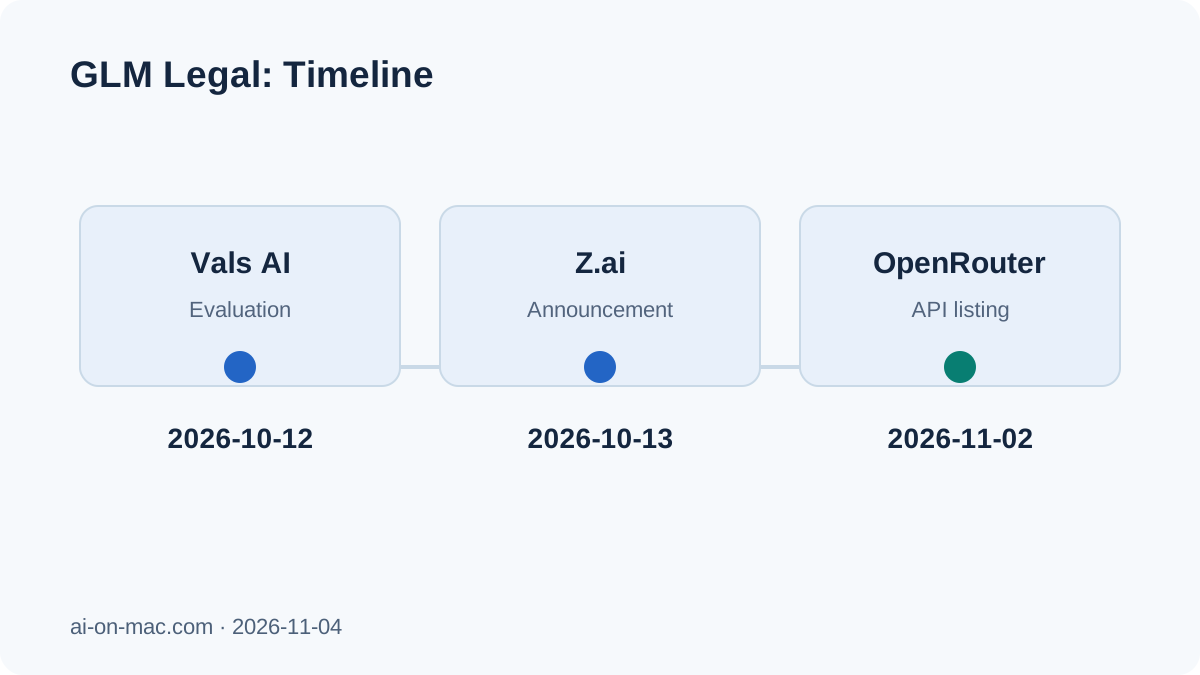
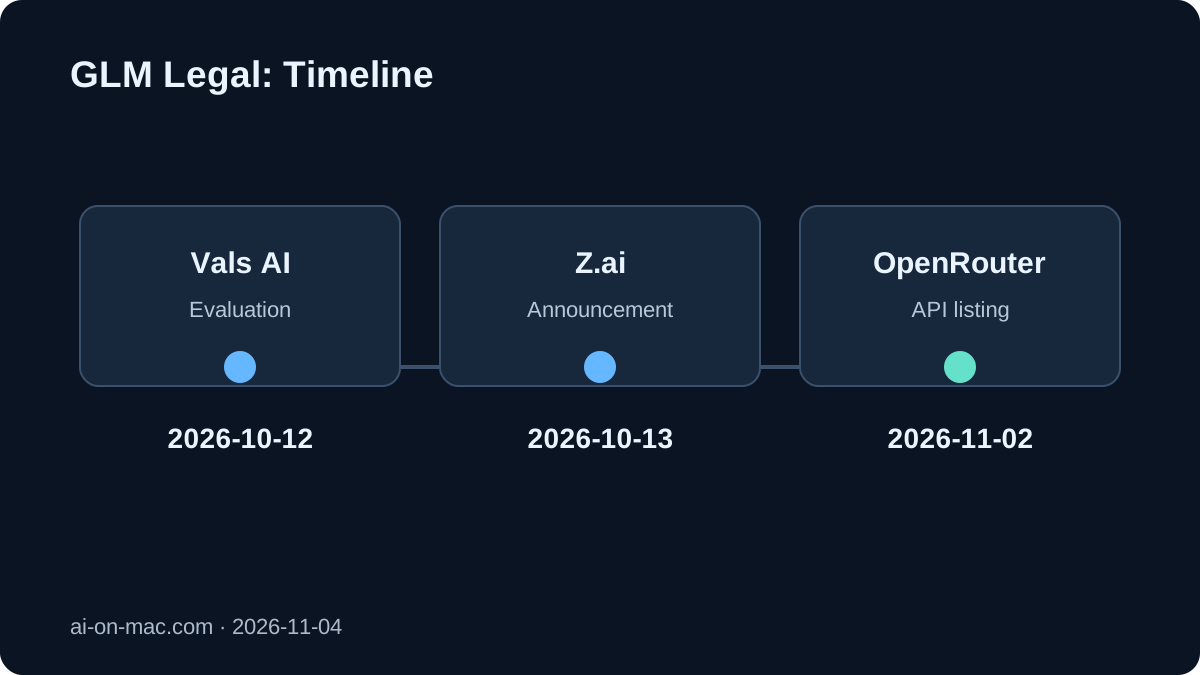
The distinction between model versions matters. Vals evaluated GLM Legal in October 2026. The concrete FlashX-Legal router listing was introduced on November 2. Neither event proves that Vals reran the same test against the later endpoint.
Independent benchmarks: three different measurements
Vals AI’s GLM Legal page reports:
| Evaluation | Result | Scope |
|---|---|---|
| Harvey Legal Agent Benchmark | 19.17% | Strict all-pass completion of legal-agent tasks |
| LegalBench | 86.23% | Selected legal reasoning and classification tasks |
| Legal Research Bench | 41.83% | Legal research evaluation |
These numbers do not share a single denominator or measure a universal “percentage of correct legal advice.” Under Harvey’s strict all-pass grading, a task must meet every required criterion. A 19.17% rate does not mean the other outputs were entirely useless, but it does raise serious concerns about unsupervised end-to-end execution. Harvey benchmark methodology
The current Vals table displays 86.23% on LegalBench, while an older October update mentions 86.24%. This article uses the current displayed value. Vals also documents provider and parameter choices that may differ by evaluation.
Crucially, the October scores are not a separately independently reproduced evaluation of the November FlashX-Legal API route. Nor should readers extrapolate the results to every jurisdiction or to live US client work without their own controlled validation.
How much does legal inference actually cost?
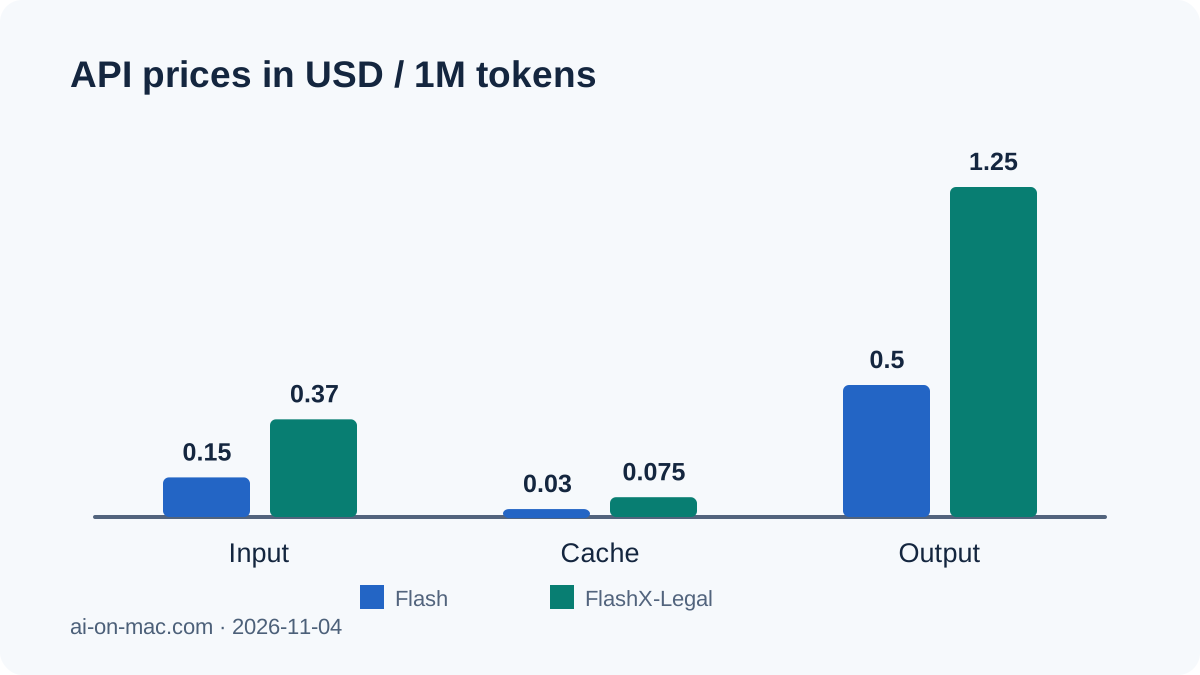
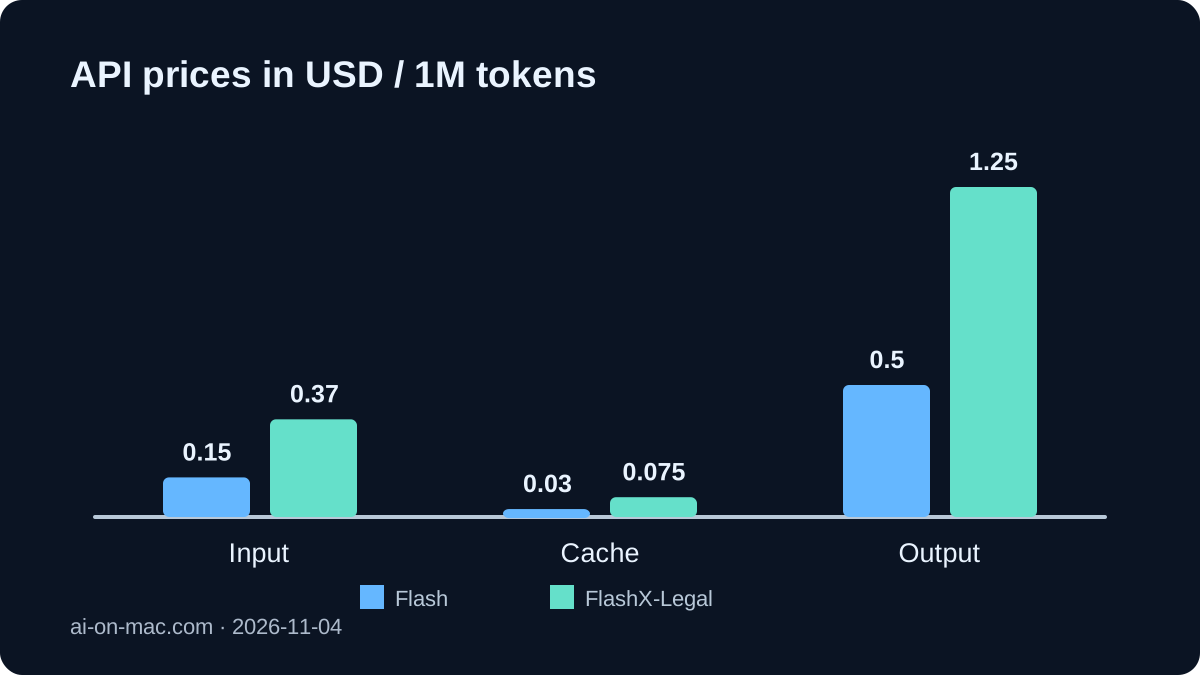
The official vendor rates separate GLM-5.3-Flash from the FlashX-Legal offering. Dollar values below are list prices per million tokens, excluding taxes and any additional provider or tool charges. Official Z.ai price table
| Token category | GLM-5.3-Flash | FlashX-Legal |
|---|---|---|
| Standard input | $0.15 | $0.37 |
| Cached input | $0.03 | $0.075 |
| Output | $0.50 | $1.25 |
FlashX-Legal’s standard input rate is approximately 2.47× the Flash baseline; output is 2.5×. This is a tariff comparison, not a statement that the models consume identical tokens or deliver equal work quality.
Three illustrative workflows
These are calculations, not measured usage. Assume uncached input, no taxes, no tool fees and no retries.
| Workload | Input | Output | Calculated API cost |
|---|---|---|---|
| Occasional review | 0.5M | 0.1M | $0.31 |
| Regular document processing | 5M | 1M | $3.10 |
| Intensive agent run | 50M | 10M | $31.00 |
Formula: cost = input millions × $0.37 + output millions × $1.25. For example, five million input tokens and one million output tokens cost 5 × $0.37 + 1 × $1.25 = $3.10.
Repeated context, reasoning output, tool invocations and retries may change the result. Cache pricing applies only to eligible recognized hits. For real deployments, a better metric is total spend per accepted deliverable, including attorney review and correction time.
OpenRouter configuration and API identity
The first-party Z.ai model code is glm-5.3-flashx-legal. OpenRouter’s namespaced identifier is z-ai/glm-5.3-flashx-legal. Do not interchange them between different API providers.
A minimal OpenRouter request using fictional content:
curl https://openrouter.ai/api/v1/chat/completions \
  -H "Authorization: Bearer $OPENROUTER_API_KEY" \
  -H "Content-Type: application/json" \
  -d '{
    "model": "z-ai/glm-5.3-flashx-legal",
    "messages": [{
      "role": "user",
      "content": "Identify ambiguity in this fictional clause: Either party may terminate on reasonable notice. State uncertainties and do not invent legal authority."
    }]
  }'
This is a documentation-based example, not a live API test. A production client must handle enabled reasoning, tool calls, output validation and relevant provider restrictions. Connecting a tool does not guarantee accurate document retrieval or valid legal citations.
Apple Silicon: available foundation weights are not Legal weights
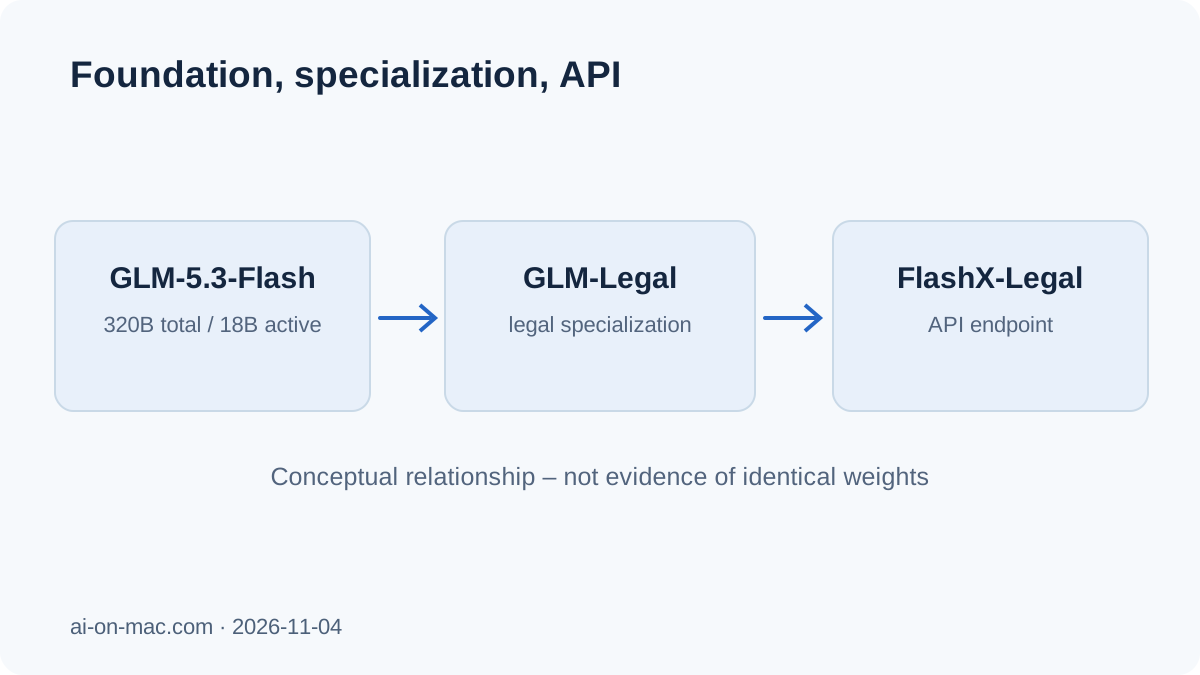
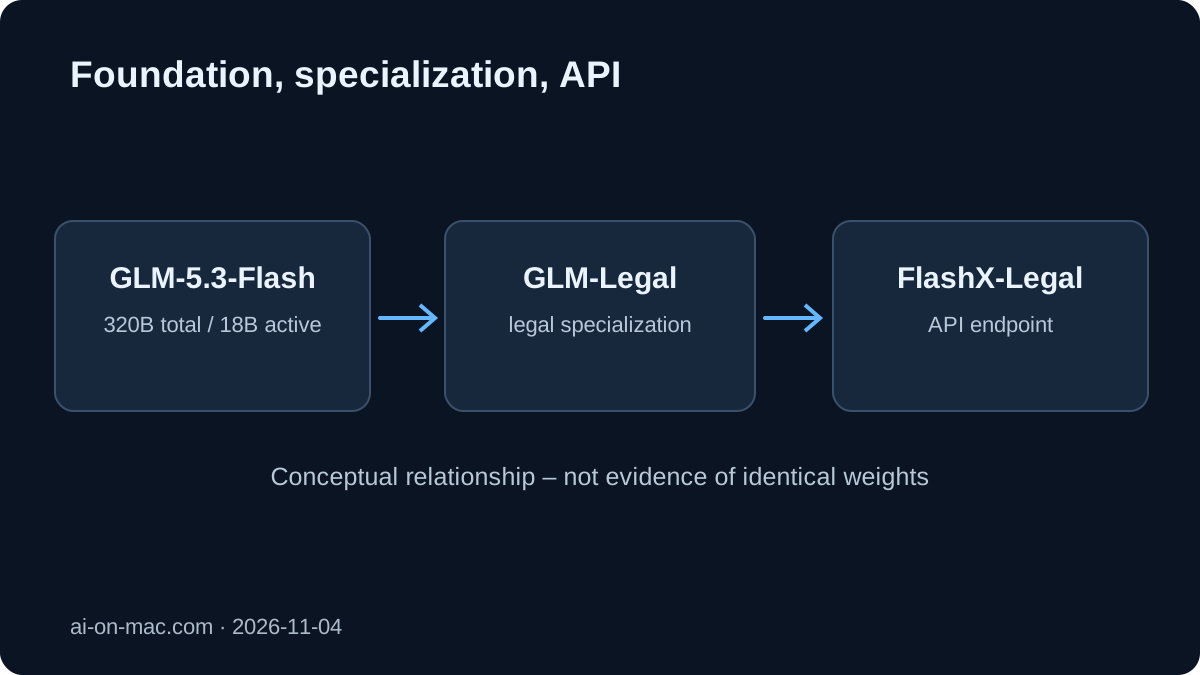
Z.ai publishes a GLM-5.3-Flash checkpoint on Hugging Face. The foundation has approximately 320 billion total parameters and 18 billion activated per token, according to the vendor. The activated figure affects computation, not the total number of weights that must be accommodated in an inference setup.
At idealized four-bit representation, 320 billion parameters require approximately 160 billion bytes for the weights alone. Quantization metadata, execution overhead and context memory come on top. A mainstream Mac with 32 or 64 GB unified memory is not a practical in-memory configuration for the full model. This is a size calculation, not a measured Mac benchmark.
No official checkpoint was conclusively verified for the exact FlashX-Legal specialized variant in this review. A directory’s generic “open weights” label should not be treated as a download link for that specific model. Developers requiring local-only inference should evaluate a verifiably available smaller checkpoint instead.
See also GLM-5.3-Flash on Mac and local Ollama setup on Apple Silicon.
Privacy, provider routing and confidentiality
Z.ai’s published API Data Processing Addendum says it generally processes customer data in Singapore and asserts that API input and generated content are not retained after real-time processing. These are contractual provider statements, not an independent audit of every downstream system.
OpenRouter specifically says the FlashX-Legal route is not currently supported by EU in-region routing. Data residency should therefore be assessed for the actual provider, routing, retrieval tools, logs and contracts—not inferred from the user’s location or a generic regional product description.
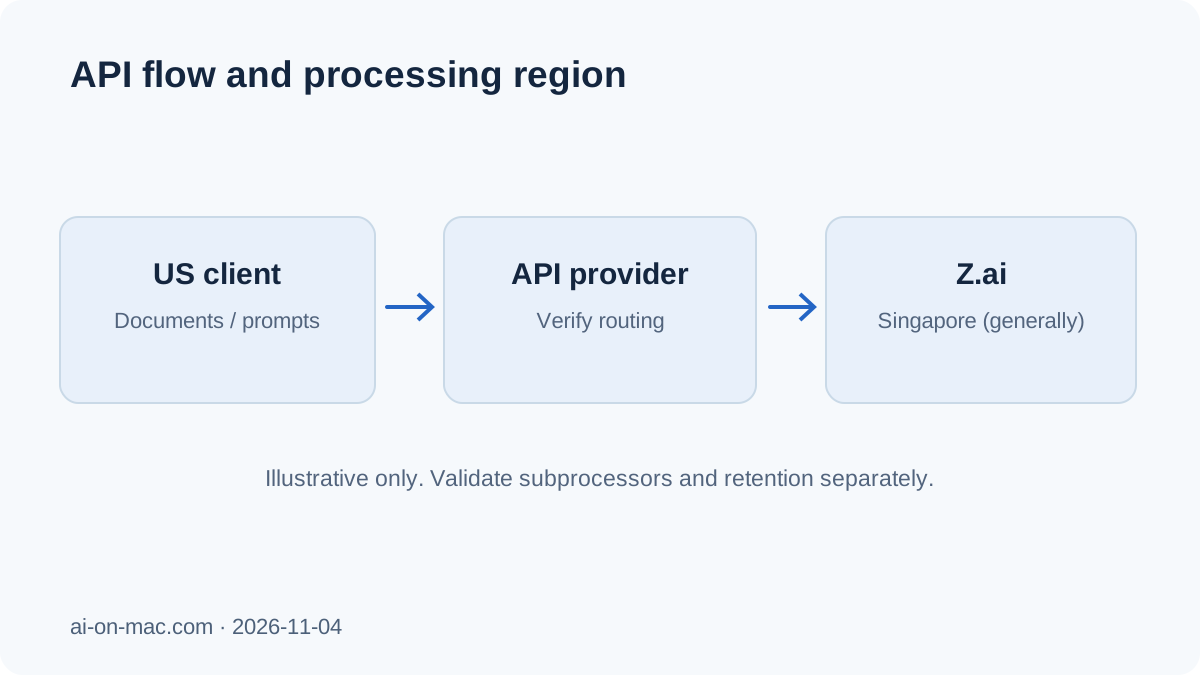
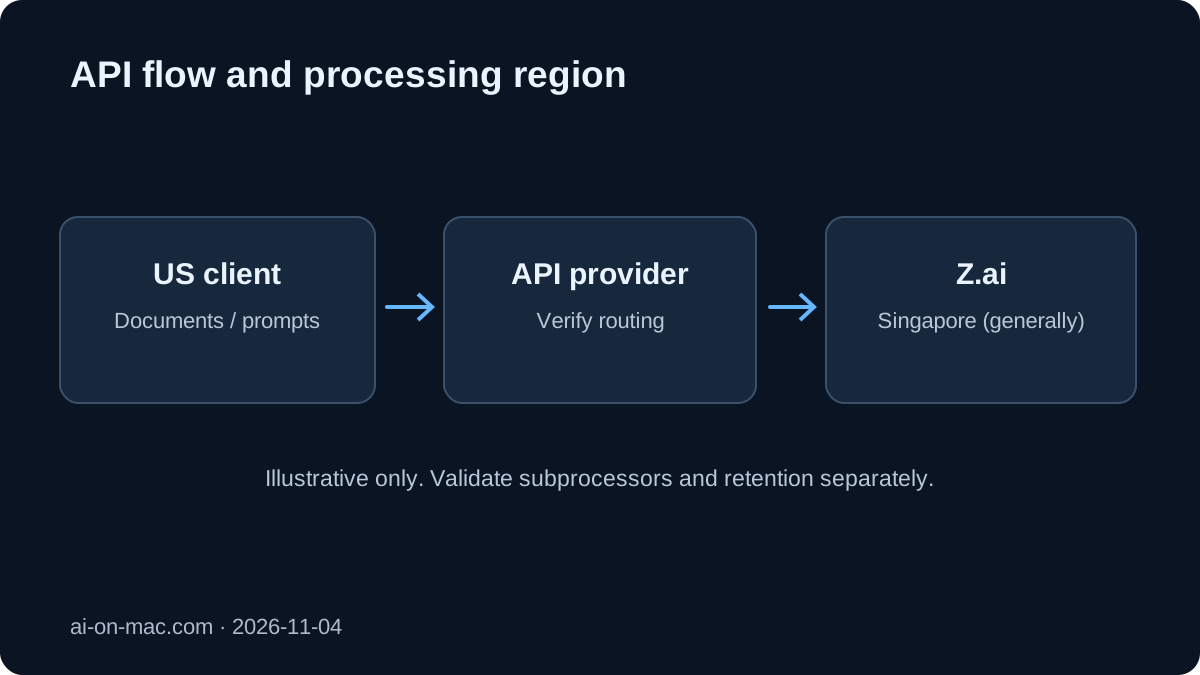
For US legal teams, confidentiality obligations, privilege, client contractual requirements and applicable state rules may be relevant. European customers additionally need to examine GDPR processing and international transfers. A vendor model card alone cannot establish that an entire legal workflow is compliant.
Start with public or synthetic materials. Do not send privileged client files through an unreviewed external AI pipeline.
Evaluation plan: cost per accepted legal task
A useful pilot should specify 20 representative, nonconfidential tasks before generating outputs. Use the same document sets and evaluation rubric across models, and score: correct sources, issue spotting, missed exceptions, unsupported assertions, structured-output compliance, retries, latency and total human correction time.
Record exact endpoint and model IDs. Separate the October benchmark model from the November API variant, and do not claim apples-to-apples accuracy where task sets, effort settings or scaffolds differ.
GLM-5.3-FlashX-Legal is a real, low-priced specialist API worth controlled experimentation, not a proven autonomous attorney. The public evidence does not establish a local FlashX-Legal checkpoint or reliable completion of unsupervised legal matters. Test quality and confidentiality first, then compute cost per professionally accepted result.
Methodology: source-backed review of Z.ai, OpenRouter, Vals, Harvey and published provider terms. No original API performance test or legal advice.
Frequently Asked Questions
How much does GLM 5.3 FlashX Legal cost?
Z.ai lists $0.37 per million standard input tokens, $0.075 per million cached input tokens and $1.25 per million output tokens, before applicable taxes and extra charges.
Can I download GLM FlashX Legal to run on my Mac?
A public checkpoint specifically identified as the FlashX-Legal variant was not verified. The available GLM-5.3-Flash foundation weights are not proof that legal-specific weights were released.
Do the benchmarks prove it can handle legal matters autonomously?
No. Vals measured October GLM Legal on specific benchmarks, not an independently reproduced November FlashX-Legal endpoint run or universal accuracy in legal practice.
Transparency
Sources and review basis
These primary and reference sources form the basis of the technical assessment. Vendor claims and external benchmarks are identified as such in the article.
- docs.z.ai vlm / glm-5.3-flash
- docs.z.ai overview / pricing
- openrouter.ai z-ai / glm-5.3-flashx-legal
- autoclaw.z.ai model / GLM-Legal
- vals.ai models / zai_glm-legal
- harvey.ai blog / introducing-harveys-legal-agent-benchmark
- huggingface.co zai-org / GLM-5.3-Flash
- docs.z.ai legal-agreement / privacy-policy
- openrouter.ai business / eu
- gesetze-im-internet.de brao / __43a.html
- gesetze-im-internet.de brao / __43e.html