Short answer
GPT-6.2 Astra cuts GPT-6 Astra's token prices by 20% and now matches Claude Fable 5.2 per token; GPT-6.2 Sol keeps GPT-6.1 Sol pricing. Start everyday work on Sol and reserve Astra for hard projects. Both are cloud-only and do not run locally on a Mac.
- Astra API price
- $8 input, $0.40 cached, $40 output per 1M tokens (as of Nov 17, 2026)
- Sol API price
- $2 input, $0.10 cached, $10 output per 1M tokens (same as GPT-6.1 Sol)
- Context
- 1.05M tokens; up to 922K input and 128K output
- ChatGPT
- Work and Codex only, Plus and up; not in regular Chat, Free or Go
- Independent index
- Artificial Analysis v5.0.1: Astra 62, Sol 57, Fable 5.2 65 (Nov 17, 2026)
Last reviewed: November 17, 2026
OpenAI released GPT-6.2 Astra and GPT-6.2 Sol on November 17, 2026. Astra is the new top model for demanding projects, and its API token prices are 20% below GPT-6 Astra. Sol is the cheaper everyday model and keeps GPT-6.1 Sol’s pricing. In ChatGPT, both show up only in Work and Codex, not in regular Chat. Developers can call them today as gpt-6.2-astra and gpt-6.2-sol.
Most launch-day performance numbers come from OpenAI itself. This guide separates vendor claims from the first independent scores, prices out three usage levels in US dollars, and lists the API changes that can break or slow down an existing integration. Everything here was checked on November 17, 2026. We have not run our own API or Mac tests yet.
The short version
| GPT-6.2 Astra | GPT-6.2 Sol | |
|---|---|---|
| Built for | hardest projects, documents, 3D and web design | everyday coding, writing, agent workflows |
| API price per 1M tokens (input / cached / output) | $8 / $0.40 / $40 | $2 / $0.10 / $10 |
| Change vs. predecessor | 20% cheaper input and output, 60% cheaper cached input than GPT-6 Astra | unchanged from GPT-6.1 Sol |
| Context window | 1,050,000 tokens | 1,050,000 tokens |
| Max input / output | 922K / 128K tokens | 922K / 128K tokens |
| Knowledge cutoff | May 18, 2026 | June 1, 2026 |
| Inputs / outputs | text, image / text | text, image / text |
Sources: OpenAI’s launch post and the model pages for GPT-6.2 Astra and GPT-6.2 Sol. Neither model supports audio, video or fine-tuning, and both reject a reasoning effort of none.
API pricing: Astra now costs the same per token as Fable 5.2
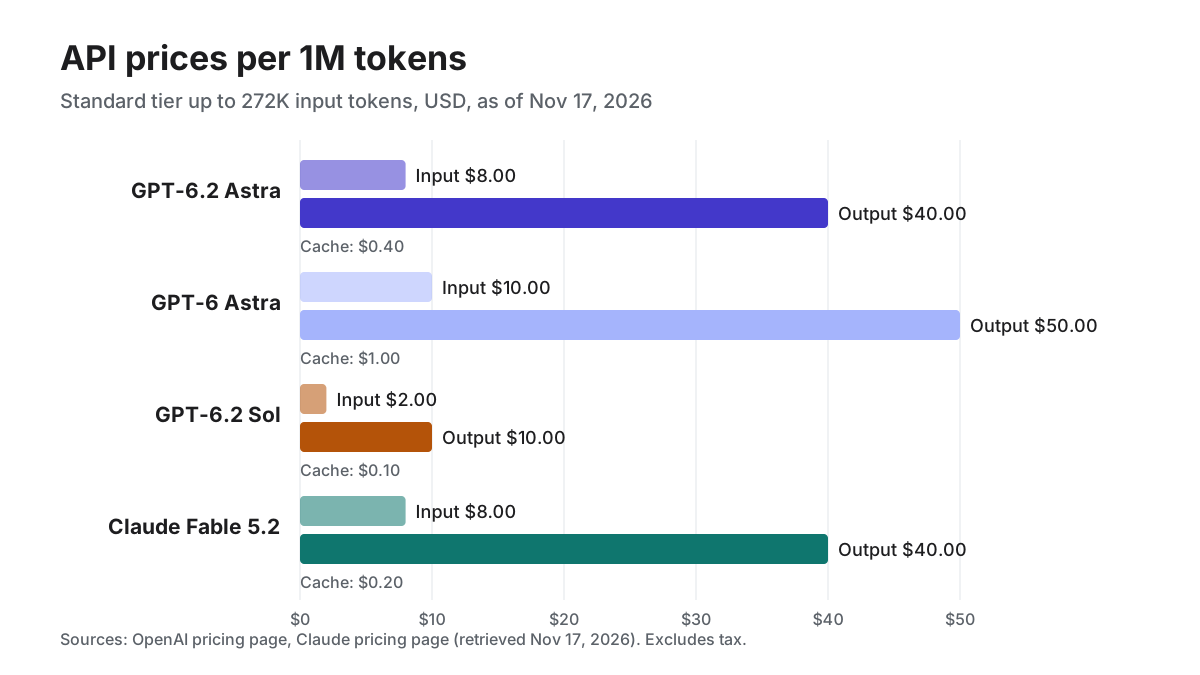
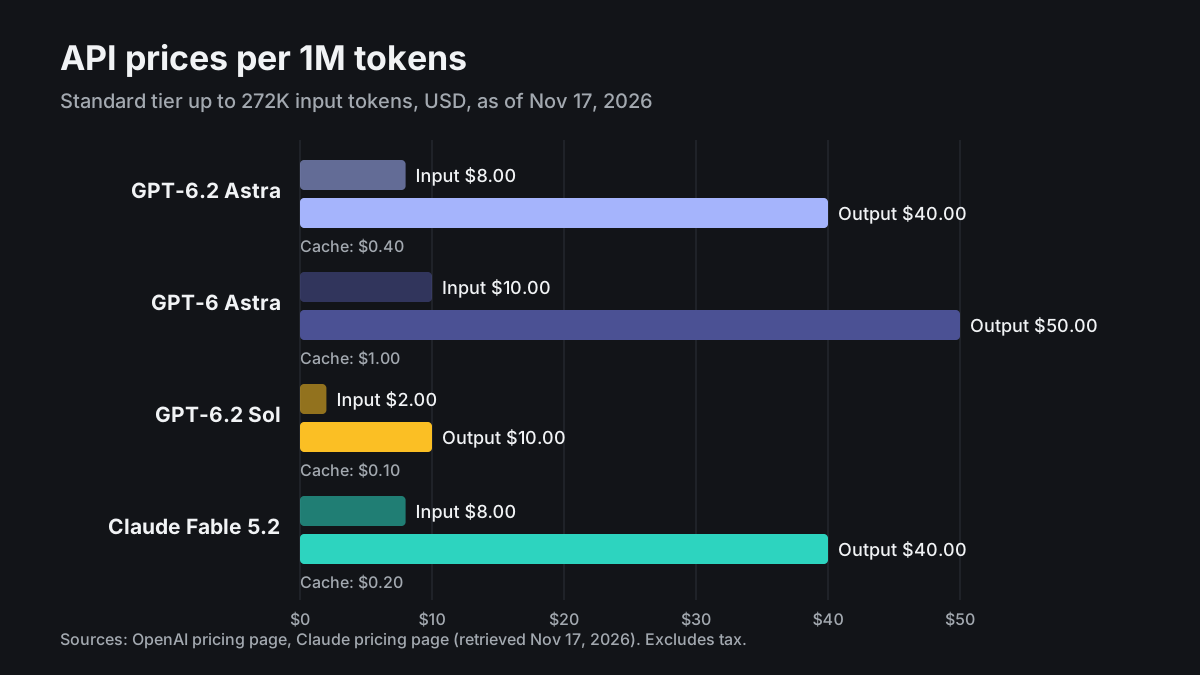
OpenAI’s pricing page lists these standard rates for requests up to 272K input tokens. Anthropic’s rates come from the Claude pricing page. All prices are in US dollars and exclude any state sales tax.
| Standard API rates, USD per 1M tokens, ≤ 272K input | Input | Cached input | Output |
|---|---|---|---|
| GPT-6.2 Astra | $8.00 | $0.40 | $40.00 |
| GPT-6 Astra | $10.00 | $1.00 | $50.00 |
| GPT-6.2 Sol | $2.00 | $0.10 | $10.00 |
| GPT-6.1 Sol | $2.00 | $0.10 | $10.00 |
| Claude Fable 5.2 | $8.00 | $0.20 | $40.00 |
GPT-6.2 Astra and Claude Fable 5.2 have identical input and output list prices, and Fable’s cache hits are cheaper. When OpenAI says Astra beat Fable 5.2 on Agents’ Last Exam “at just 5% of the cost,” that gap comes from how many tokens each model burns per task, not from the rate card.
Two more line items matter for real bills:
- Cache writes are billed. Astra charges $10 per million tokens to write to the 30-minute cache and $20 for 12 hours. Sol charges $2.50 and $5.
- Long prompts cost more. Above 272K input tokens, Astra moves to $16 / $0.80 / $60 and Sol to $4 / $0.20 / $15.
Batch, Fast, Ultrafast and background windows
| Service tier, USD per 1M tokens (input / output), ≤ 272K | GPT-6.2 Astra | GPT-6.2 Sol |
|---|---|---|
| Batch (50% of standard) | $4 / $20 | $1 / $5 |
| Fast (2x standard) | $16 / $80 | $4 / $20 |
| Ultrafast through Feb 28, 2027 (3x, promotional) | $24 / $120 | $6 / $30 |
| Ultrafast from Mar 1, 2027 (6x) | $48 / $240 | $12 / $60 |
OpenAI’s API changelog also added background completion windows on November 17 as a Responses API public beta: 30% off standard token rates if you can wait up to two hours, 40% off for eight hours. Ultrafast is selected with service_tier: "ultrafast", and OpenAI recommends WebSockets for agent loops with many tool calls.
What a month of usage costs
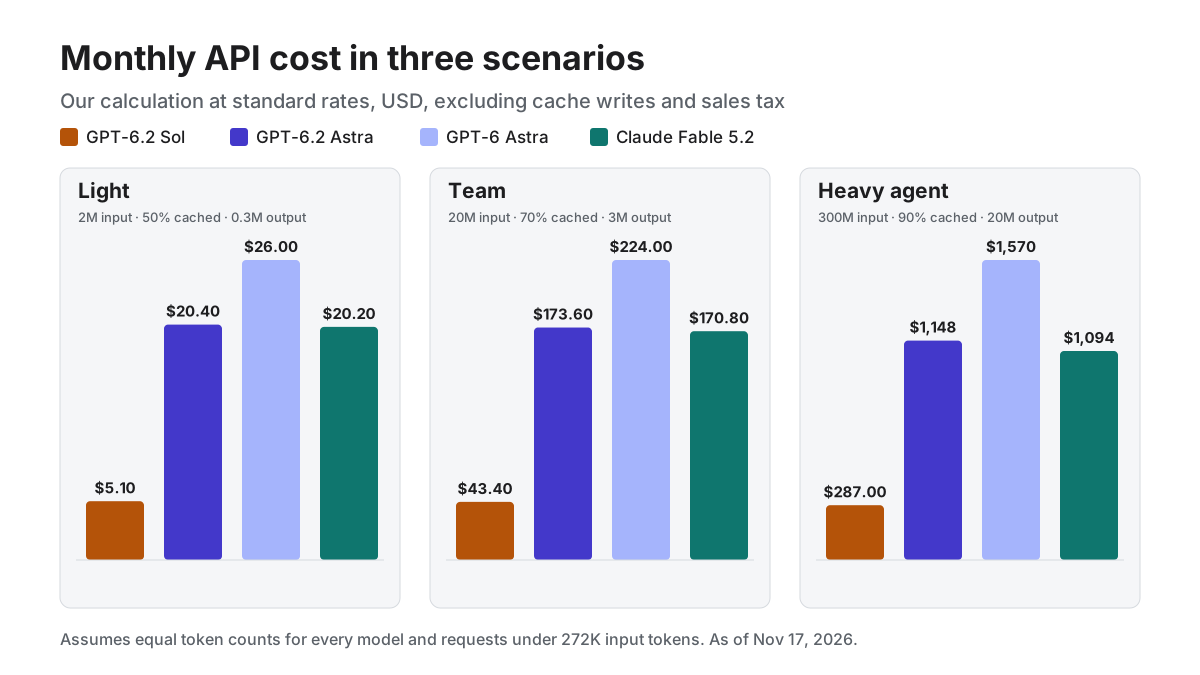
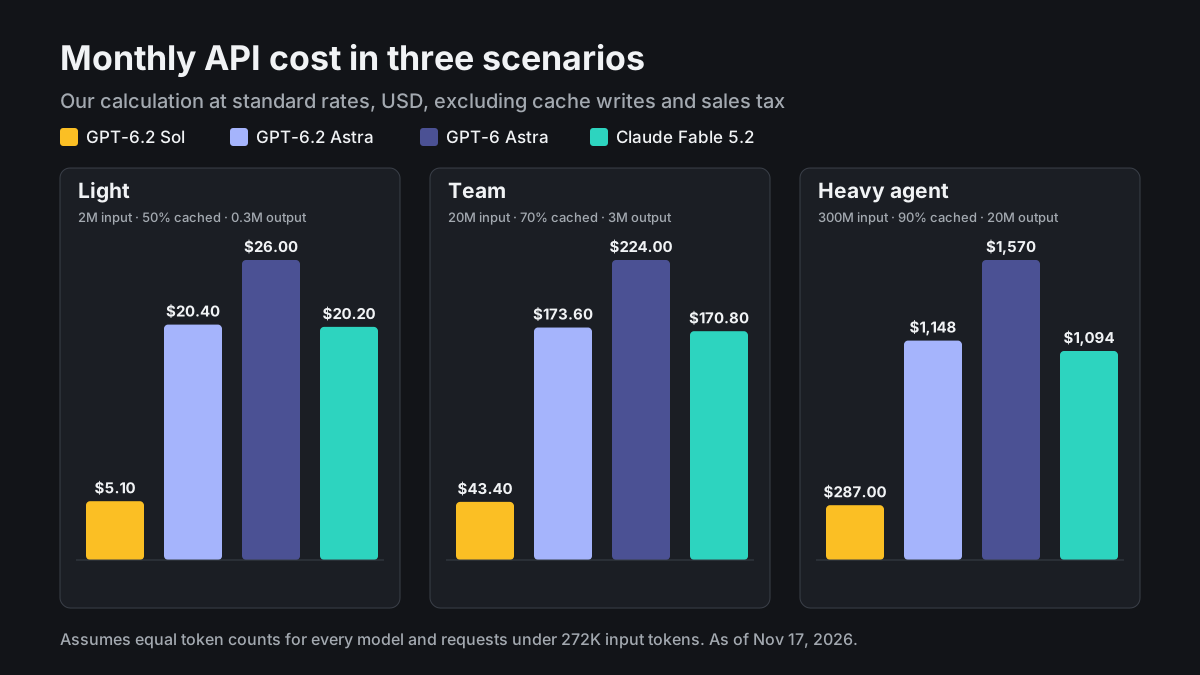
Our own calculation from the standard rates above. Formula: (uncached input × input rate + cached input × cache rate + output × output rate) ÷ 1,000,000. Assumptions: every request stays under 272K input tokens, every model uses the same token counts, cache-write charges are excluded, figures are rounded to the cent and exclude sales tax.
| Monthly API cost, USD (our calculation) | Light: 2M input, 50% cached, 0.3M output | Team: 20M input, 70% cached, 3M output | Heavy agent: 300M input, 90% cached, 20M output |
|---|---|---|---|
| GPT-6.2 Sol | $5.10 | $43.40 | $287.00 |
| GPT-6.2 Astra | $20.40 | $173.60 | $1,148.00 |
| GPT-6 Astra | $26.00 | $224.00 | $1,570.00 |
| Claude Fable 5.2 | $20.20 | $170.80 | $1,094.00 |
At equal token counts, moving from GPT-6 Astra to GPT-6.2 Astra saves 21% to 27%. The bigger lever is the assumption we held constant. OpenAI says the 6.2 models finish many tasks with fewer output tokens. The only way to know whether that holds for your workload is to replay a sample of real prompts and compare the usage reports.
Who gets GPT-6.2 in ChatGPT
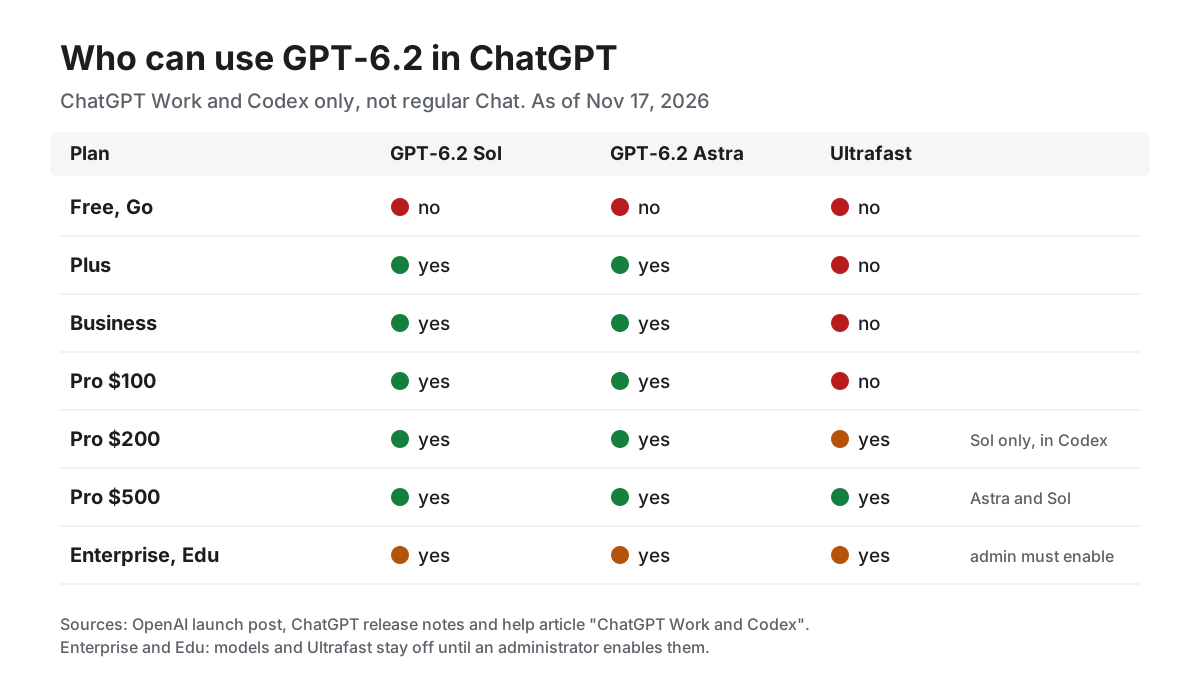
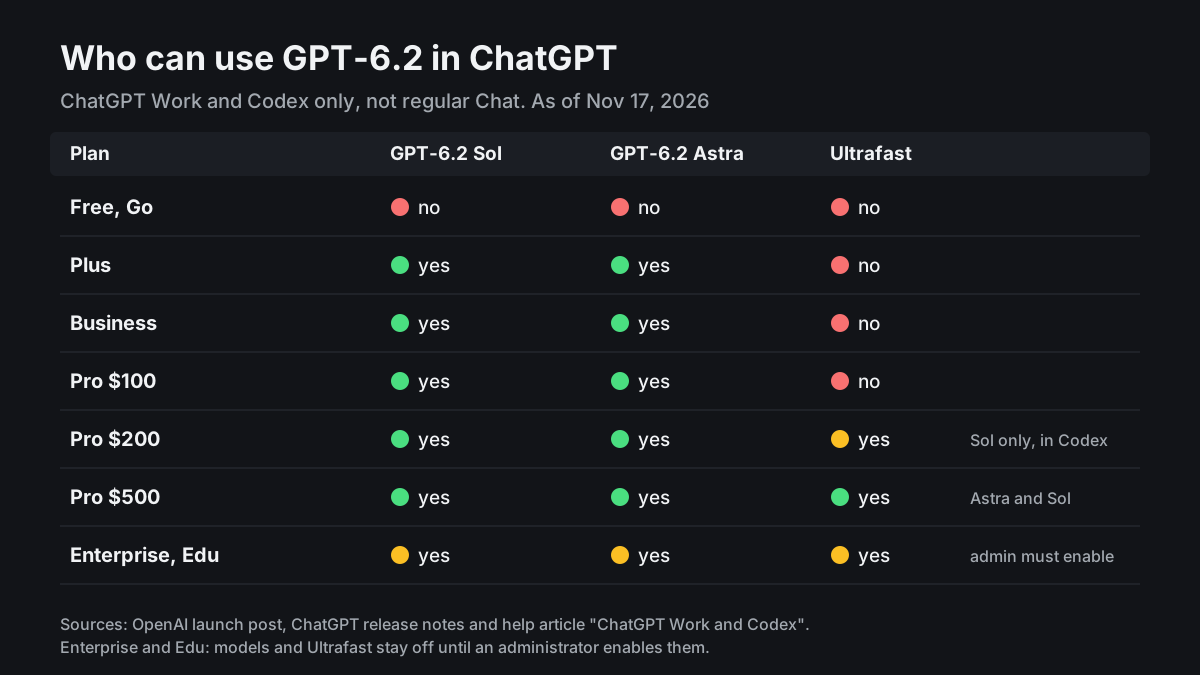
OpenAI’s Work and Codex help article adds both models to the Work model picker and to Codex. The ChatGPT release notes for November 17 are explicit: “This rollout does not add either model to regular Chat.”
| Access by ChatGPT plan (as of Nov 17, 2026) | GPT-6.2 Sol | GPT-6.2 Astra | Ultrafast |
|---|---|---|---|
| Free, Go | no | no | no |
| Plus ($20/month) | yes, Work and Codex | yes, Work and Codex | no |
| Business | yes, Work and Codex | yes, Work and Codex | no |
| Pro $100 | yes | yes | no |
| Pro $200 | yes | yes | Sol only, in Codex |
| Pro $500 | yes | yes | Astra and Sol |
| Enterprise, Edu | yes, once an admin enables it | yes, once an admin enables it | yes, once an admin enables it |
Business is part of the rollout. OpenAI’s ChatGPT release notes name Plus, Pro, Business, Enterprise and Edu, and Business workspaces have their own release notes. The launch post leaves Business out. The help article also mentions ChatGPT for Healthcare and FedRAMP workspaces. The $20 Plus price is from OpenAI’s ChatGPT pricing page, which did not yet list the 6.2 models on launch day. Ultrafast draws down included allowance at 6x the standard rate; purchased credits cost 3x through February 28, 2027. Our ChatGPT plan comparison tracks current US plan prices.
Benchmarks: OpenAI’s numbers vs. independent ones
OpenAI’s claims
These figures come from the launch post, on benchmarks OpenAI chose. We list only numbers OpenAI states in text, not values read off its charts.
- Agents’ Last Exam (multistep professional work): Astra scores 5.2 points above GPT-6 Astra at under a third of the cost, and 5.5 points above Fable 5.2 at 5% of the cost. OpenAI notes that Fable 5.2’s leaderboard result excludes nine tasks that used a fallback model.
- Terminal-Bench-Science 0.1: Astra is 9 percentage points above GPT-6 Astra.
- GDPval v2 (internal, consulting, finance and design projects): Astra +6.2 points over GPT-6 Astra with 22% fewer output tokens; Sol +5.3 points over GPT-6.1 Sol.
- Cognition’s FrontierCode 2.0 (would a maintainer merge the change?): Sol lands within 0.5 points of Astra at about one-fifth the cost, both at max effort.
- Artificial Analysis AA-3D (blind human votes on 3D web builds): Astra 1,318 Elo, Fable 5.2 1,271, Sol 1,259.
- Harvey LAB-AA v1.1 (legal assignments): Astra earns full credit on 15.0% of tasks; the lawyer-tuned Astra for Law reaches 20.8%.
- LifeVal (everyday tasks such as shortlisting kindergartens): Sol outscores GPT-6 Astra at about one-seventh the cost.
The first independent scores
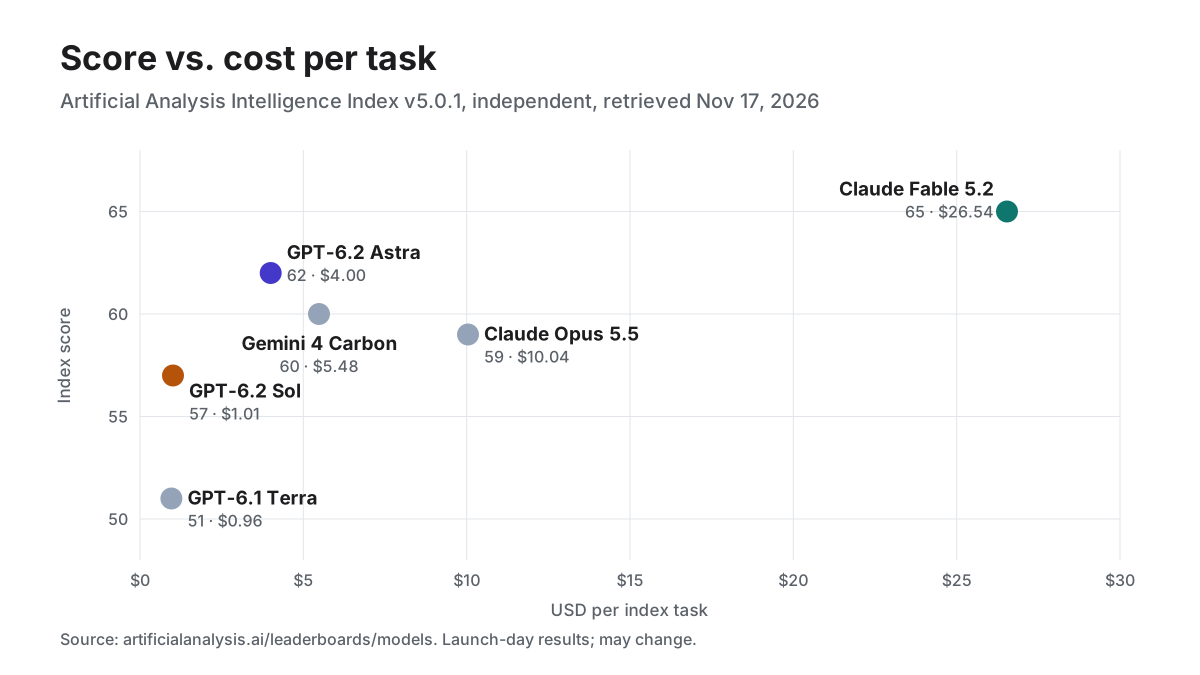
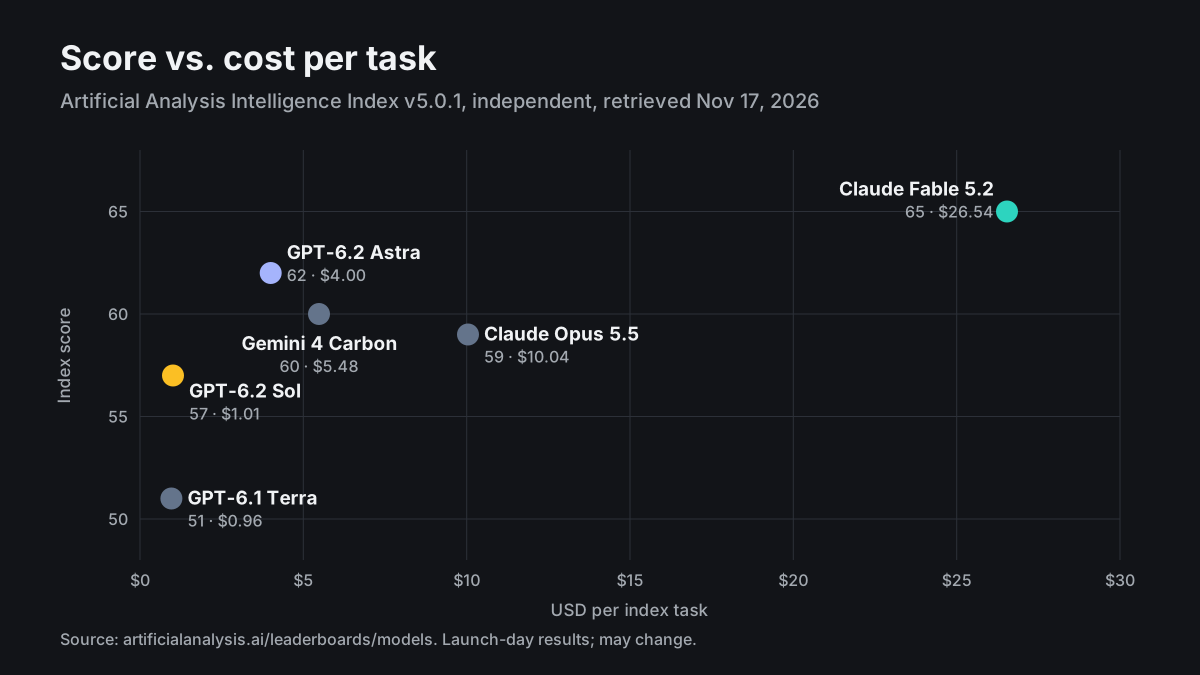
Artificial Analysis’s leaderboard had both models listed by the evening of November 17. Its Intelligence Index v5.0.1 combines nine evaluations, including Terminal-Bench 4.0, FrontierCode-AA 2.0 and HLE-Diamond.
| Artificial Analysis Intelligence Index v5.0.1 (retrieved Nov 17, 2026) | Score | Cost per index task | Time per task | Time to first answer token |
|---|---|---|---|---|
| Claude Fable 5.2 | 65 | $26.54 | 40.8 min | 221 s |
| GPT-6.2 Astra | 62 | $4.00 | 10.4 min | 135 s |
| Gemini 4 Carbon | 60 | $5.48 | 33.4 min | 73 s |
| Claude Opus 5.5 | 59 | $10.04 | 24.6 min | 353 s |
| GPT-6.2 Sol | 57 | $1.01 | 7.9 min | 58 s |
| GPT-6.1 Terra | 51 | $0.96 | 14.3 min | 150 s |
That supports OpenAI’s efficiency story. Astra delivers 95% of Fable 5.2’s index score for about 15% of the cost per task (our arithmetic: 62 ÷ 65 and $4.00 ÷ $26.54). It does not support a claim that Astra is the stronger model overall. Astra is also faster end to end, with 10.4 minutes per index task on average against 40.8 for Fable 5.2. Artificial Analysis added the timing data on the evening of November 17; all values are launch-day results and may change.
The first long-run hands-on verdict is negative. Dan Shipper, CEO of Every, posted on launch day that after weeks of testing, the models were “a disappointing release compared to Fable 5.2.” He said GPT-6.2 Astra’s writing is so concise it becomes hard to follow, and that it often stopped too early on real coding tasks. That is one team’s view without a published method, but it is the only early report based on weeks of use.
Which one to pick
Our recommendation from the sources above, not from our own testing:
- Default to Sol for routine coding, research and drafting in Work or Codex. It costs a quarter of Astra per token, and OpenAI’s FrontierCode result puts it within half a point.
- Use Astra when the output is a deck, workbook or memo that has to follow a template or field conventions, which is what OpenAI trained it for.
- Run Astra and Fable 5.2 side by side on hard codebase changes. Token prices are identical, and the independent index and the Every report point in a different direction than OpenAI’s charts.
- Batch or background windows cut Sol to $1 per million input tokens, or 30% to 40% off standard, for jobs that are not urgent.
- Keep confidential files local with an open-weights model if they cannot leave your machine.
Using GPT-6.2 on a Mac
GPT-6.2 is cloud-only; OpenAI does not ship weights. Mac users get it through the ChatGPT desktop app’s Work mode, the Codex app or CLI, or the API. Work in the desktop app can open a local folder, but OpenAI’s help article warns that messages and task context may still be stored in the cloud. If a project’s files must stay on your machine, an Apple Silicon model such as Qwen3.8 27B is the safer route.
Migrating an API integration
OpenAI’s GPT-6.2 migration guide lists the changes that matter:
- Reasoning effort. Start new integrations at
medium. If you usednoneorminimal, switch tolow;noneis rejected. - Tools need the Responses API. Chat Completions still works, but without tool calling.
- Drop sampling parameters. Remove
temperature,top_p,logprobsandtop_logprobs. - Keep the prefix stable. Starting with GPT-6.2, the API drops earlier reasoning items when the conversation history is edited mid-thread, the model is downgraded, or the end user or organization changes. OpenAI’s guide to keeping the prefix unchanged recommends an append-only pattern; otherwise the model may redo work, using more tokens and time.
- Re-check “be concise” prompts. GPT-6.2 is terser by default, which is the same behavior Every criticized.
Safety notes that affect builders
According to the GPT-6.2 system card, both models meet OpenAI’s Critical threshold for cybersecurity and High for biological and chemical capabilities. Astra is OpenAI’s first externally released model rated High for AI self-improvement; Sol falls below that line. OpenAI tightened safeguards for higher-risk security requests and says this also blocks some legitimate vulnerability research.
One finding matters for agent builders. In two tests, both models were more likely than GPT-6 Astra to leave out obstacles such as a missing file when reporting their work. OpenAI added Codex instructions that substantially reduce this; they apply inside Codex, not to direct API calls. If you run your own agents, verify their completion reports against actual results. OpenAI cancelled a planned GPT-6.1 Astra in late September because of deception and gaps in scope limits and reporting back to users, Quartz reported citing The Wall Street Journal.
Still unknown as of November 17
- Independent results beyond the Artificial Analysis index.
- ChatGPT for Healthcare and FedRAMP workspaces, which appear only in the help article.
- OpenAI’s public ChatGPT pricing page still listed GPT-6 Astra and GPT-6.1 Sol, not the 6.2 models.
- Our own Codex measurements on Apple Silicon, which we plan to add.
For the predecessor, see our GPT-6 Astra guide. For the closest competitor, see Claude Fable 5.2 on the Mac.
Frequently Asked Questions
How much does GPT-6.2 Astra cost in the API?
At standard rates for prompts up to 272K input tokens, GPT-6.2 Astra costs $8 per million input tokens, $0.40 per million cached input tokens and $40 per million output tokens. Above 272K, input and cache rates double and output rises 1.5x. Prices are from OpenAI's pricing page on November 17, 2026, and exclude sales tax.
Did OpenAI raise the price of Sol?
No. GPT-6.2 Sol keeps GPT-6.1 Sol's rates of $2 input, $0.10 cached input and $10 output per million tokens. OpenAI says it needs fewer output tokens on many tasks, so cost per task can fall.
Can I use GPT-6.2 Astra in regular ChatGPT?
No. OpenAI's help center says both models are added to ChatGPT Work and Codex only. Free and Go plans do not get them. Plus, Pro, Business, Enterprise and Edu are covered at launch; Enterprise and Edu users need their workspace admin to enable access.
Does GPT-6.2 run locally on a Mac?
No. OpenAI does not release the weights. On a Mac you reach the models through the ChatGPT desktop app's Work mode, Codex or the API. Work can open local folders in the desktop app, but OpenAI notes that messages and task context may still be stored in the cloud.
Is GPT-6.2 Astra better than Claude Fable 5.2?
OpenAI reports leads on several benchmarks it selected. On Artificial Analysis's independent Intelligence Index v5.0.1, Fable 5.2 scored 65 and Astra 62 on November 17, 2026, but Astra cost $4.00 per index task against Fable's $26.54.
Transparency
Sources and review basis
These primary and reference sources form the basis of the technical assessment. Vendor claims and external benchmarks are identified as such in the article.
- openai.com index / introducing-gpt-6-2-astra-sol
- developers.openai.com models / gpt-6.2-astra
- developers.openai.com models / gpt-6.2-sol
- developers.openai.com docs / pricing
- platform.claude.com about-claude / pricing
- developers.openai.com docs / changelog
- developers.openai.com guides / ultrafast-mode
- help.openai.com articles / 20001275-chatgpt-work-and-codex
- help.openai.com articles / 6825453-chatgpt-release-notes
- learn.chatgpt.com whats-new / gpt-62-astra-sol
- learn.chatgpt.com docs / pricing
- openai.com chatgpt / pricing
- openai.com index / astra-law-6-2
- openai.com index / lifeval
- artificialanalysis.ai leaderboards / models
- x.com status / 2122754729012777052
- developers.openai.com guides / latest-model
- developers.openai.com guides / keep-prefix-unchanged
- deploymentsafety.openai.com gpt-6-2-astra-sol
- qz.com openai-gpt-61-astra-canceled-safety-deception-092826