Researched and edited with AI assistance. Editorial responsibility: Julian Dominic Altmann. Facts checked November 17, 2026. Source analysis, no first-hand model benchmark.
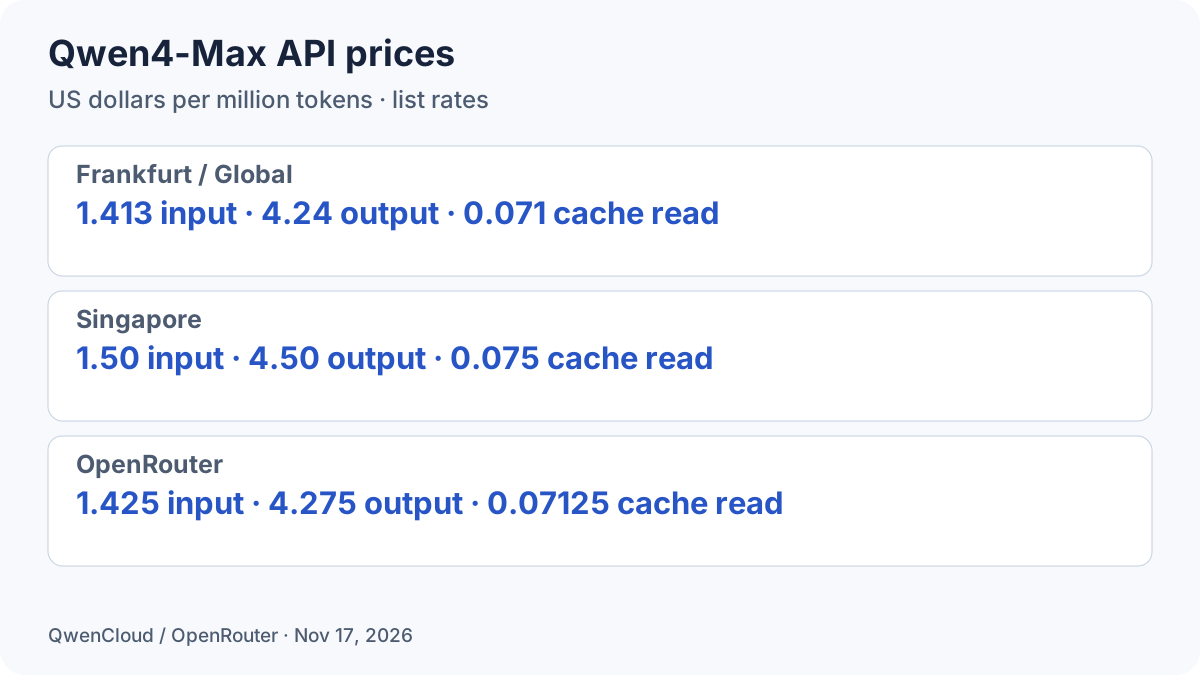
Qwen4-Max is Alibaba’s new cloud flagship, generally released on November 16, 2026. It combines vision inputs, long-context reasoning, and tool use with a sparse architecture that Alibaba describes as having 2.4 trillion parameters and 71 billion active per token. The standard QwenCloud Singapore API charges $1.50 per million input tokens and $4.50 per million output tokens. Other global deployment regions, including US Virginia and Frankfurt, have a lower listed rate of $1.413 and $4.24. Launch announcement · Official pricing.
For developers the interesting number is the cost of a completed coding or research task, not the price of individual tokens. A Mac can call the API, but it cannot run the full model locally.
Model specifications and release status
| Specification | Direct QwenCloud API |
|---|---|
| Production model ID | qwen4-max |
| Router model ID | qwen/qwen4-max |
| Release | November 16, 2026 |
| Architecture | Sparse mixture of experts; 2.4T total, 71B active (vendor) |
| Inputs | Text, images, video |
| Output | Text |
| Advertised context | 1,000,000 tokens |
| Max input, thinking on / off | 983,616 / 991,808 tokens |
| Max output, thinking off | 131,072 tokens |
| Combined thinking and answer ceiling | 262,144 tokens |
| Reasoning effort | Low, high (default), xhigh |
| Custom functions, JSON schema | Supported |
| Fine-tuning, batch inference, model deployment | Batch only in the Beijing region; fine-tuning and model deployment not supported |
Source: model reference and integration guide. Request limits may also depend on the total context and serving provider; advertised maximum input and output are not a promise that both can be used at once.
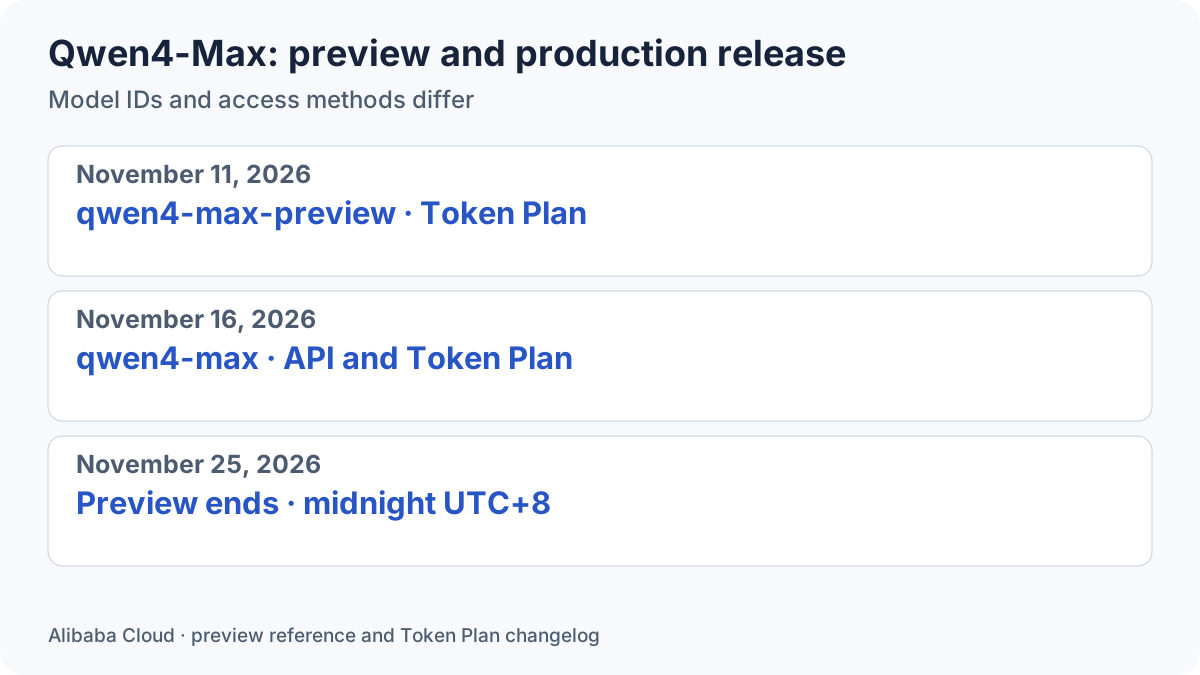
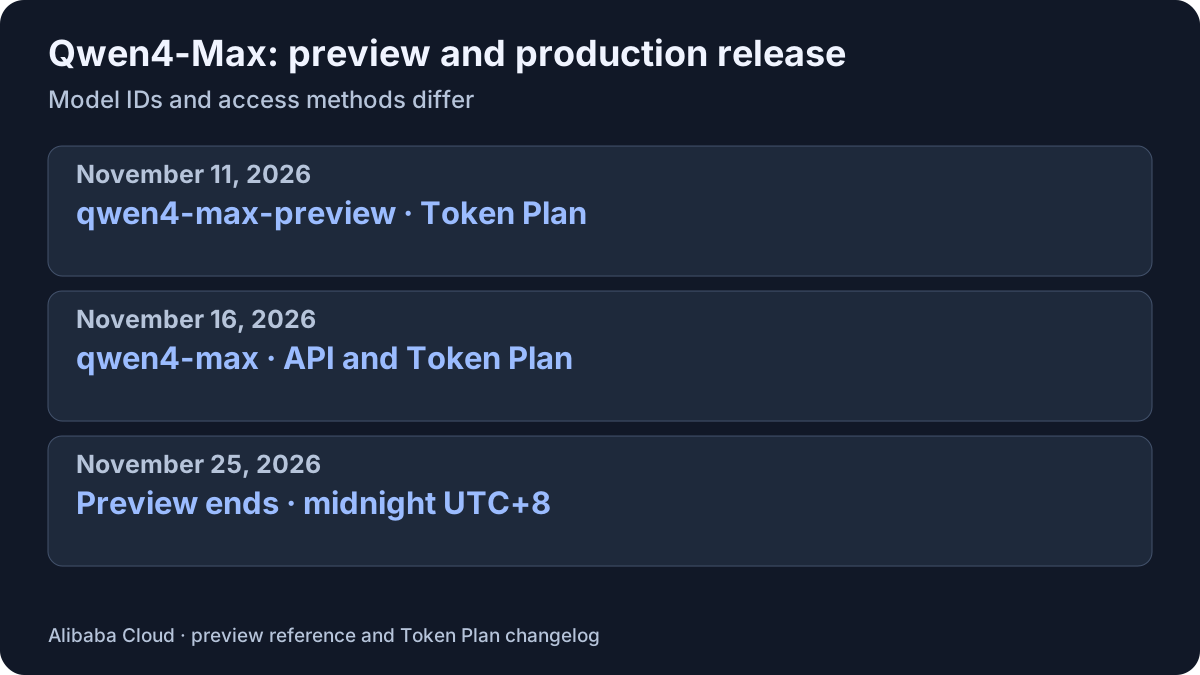
The November 11 preview was a separate ID, qwen4-max-preview, restricted to the Token Plan. The production model is now available on pay-as-you-go and the Token Plan. The old preview is scheduled to retire after November 25 at 24:00 UTC+8. Preview reference · Token Plan updates · Release log.
The economics of repeated context
For teams running many API calls, the cache rate matters more than the headline input price. A tool schema or repository prefix can be sent repeatedly across a coding session, while the assistant’s reasoning and generated patches continue to incur the output rate.
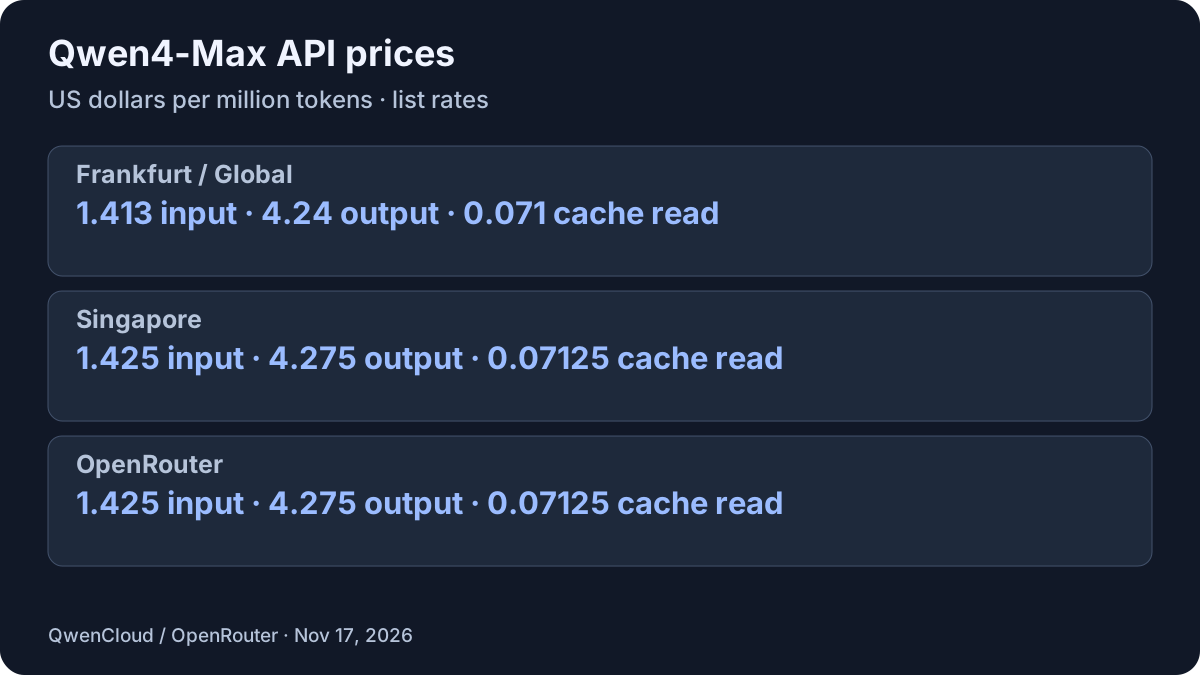
| Billing component (USD per million tokens) | QwenCloud Global / Beijing | Singapore International | OpenRouter listed rate |
|---|---|---|---|
| Uncached input | $1.413 | $1.50 | $1.425 |
| Output, including thinking | $4.24 | $4.50 | $4.275 |
| Cache read | $0.071 | $0.075 | $0.07125 |
| 5-minute cache write | $1.767 | $1.875 | $1.78125 |
| 1-hour cache write | $2.827 | $3.00 | not listed |
Rates checked November 17, 2026. Sources: QwenCloud pricing and OpenRouter listing. OpenRouter lists one cache write price of $1.78125 per million tokens and no separate rate for the one-hour lifetime. Taxes, account-specific rates, routing or payment fees and external services are excluded. The router may expose more than one provider and its pricing can change.
Monthly usage examples for US developers
Suppose a US Virginia Global workspace bills at the official Global rates. Let I be input tokens in millions, O be all billable output tokens in millions, and h be the fraction of input billed as cache reads. Ignoring explicit cache writes and external service charges:
Cost = I × ((1 − h) × 1.413 + h × 0.071) + O × 4.24
| Monthly input / output | No cache reads | 90% cache reads |
|---|---|---|
| 1M / 0.2M | $2.26 | $1.05 |
| 20M / 4M | $45.22 | $21.06 |
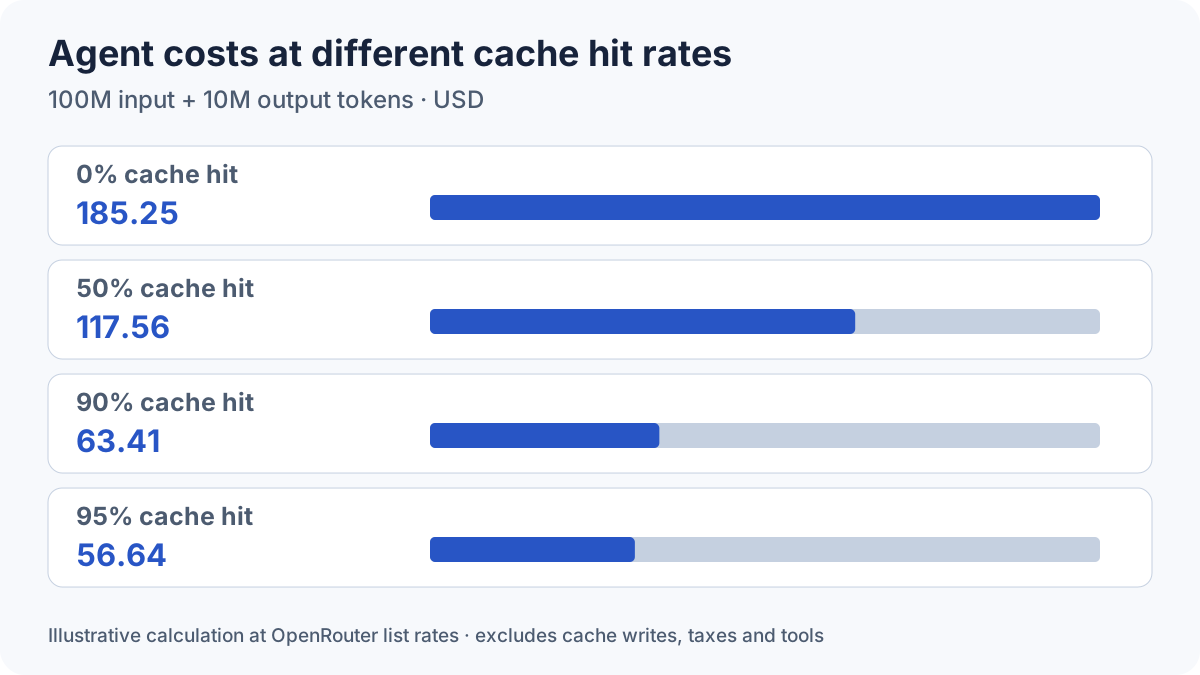
| 100M / 10M | $183.70 | $62.92 |
Original scenario calculation. Results are rounded to cents; 90% is a hypothetical cache-hit share, not a measured result. Output includes billed reasoning tokens. The high-volume example spends $42.40 on output alone, even with a perfect cache for the input.
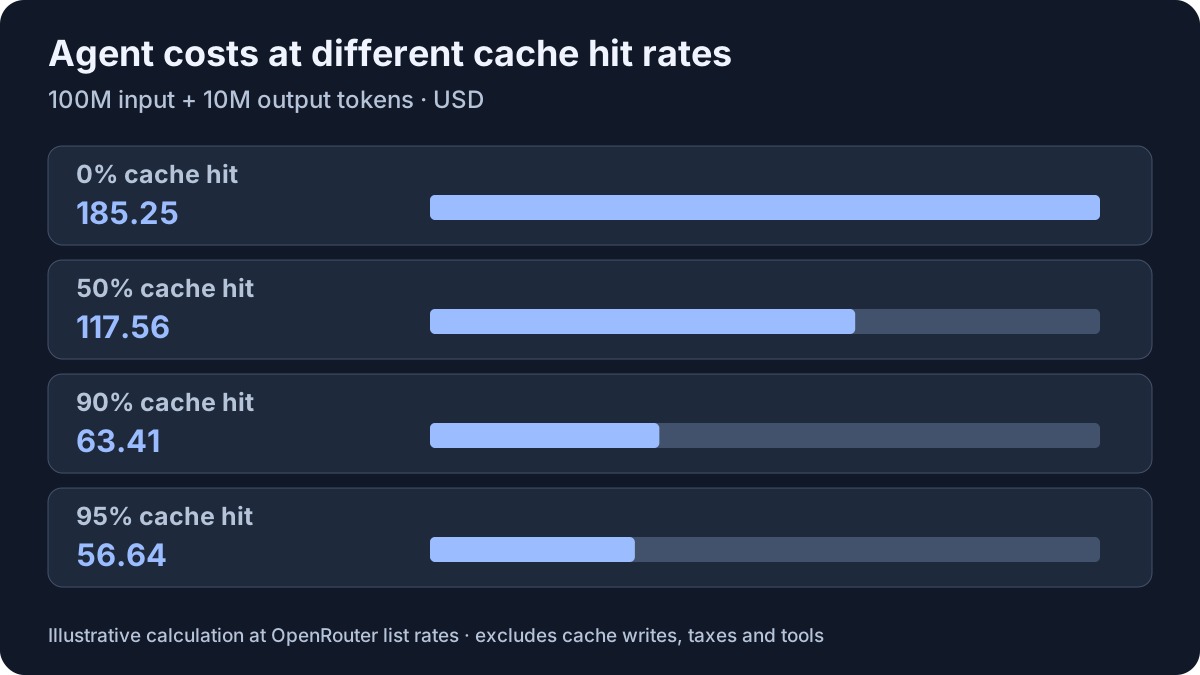
Using the OpenRouter headline rate instead, the last scenario costs $185.25 with no cache and $63.41 at a 90% hit share. This is why a cached-token discount of about 95% does not mean a 95% reduction in your total invoice.
Explicit caching allows five-minute and one-hour lifetimes. A cache write has its own price. At the listed Global rate, writing a one-million-token prefix with a five-minute lifetime and reading it once costs $1.838 rather than $2.826 for two regular inputs. A one-hour write plus one read costs $2.898, above two uncached calls; additional hits improve that comparison. These examples exclude new suffix tokens and output. Explicit cache guide.
What the benchmarks do and do not establish
Alibaba positions Qwen4-Max as a more efficient successor to Qwen3.8-Max. Its launch materials report sixth place in Code Arena, 35% fewer tokens on its internal Work360 evaluation at high effort, and about 60% lower average task cost. These are reported vendor results, not measurements of an arbitrary coding harness. Alibaba launch announcement.
An independent Artificial Analysis snapshot reports an Intelligence Index v5.0.1 score of 43 and a weighted cost of $3.27 per evaluation task. That index uses a different mix of evaluations than Work360, so its score and dollar figures should not be compared as if the two benchmarks used the same tasks. Artificial Analysis model results.
A practical warning comes from Kingy AI’s three-task pilot: a Qwen-first escalation workflow and Opus alone each passed two tasks, while the routed workflow cost more overall. The sample is far too small for a universal conclusion, but it illustrates why retries and escalation costs matter. Pilot report. Spring Prompt ran five business benchmarks on November 16. Its slide deck rating of 1,585 ranked first of 32 models, but none of the six decks it tested was presentable as returned. On product listings, 39.3% of listings were publish-ready in all three runs with a factual brief (19th of 32) and 8.9% with a sales brief (21st of 32). Independent practice report.
Measure your own agent on a fixed set of tasks with identical tools, repository states, time limits and success criteria. Record pass rate, total bill, billed reasoning, retries, wall-clock time and intervention count. A cheap failed attempt is not necessarily cheaper than a more expensive successful one.
How to access Qwen4-Max from a coding application
QwenCloud documents OpenAI Chat Completions, Responses, Anthropic Messages and DashScope compatibility. This is API-protocol compatibility rather than guaranteed drop-in equivalence to every feature of another vendor’s product. Chat API · Responses API · Messages API.
For a US Virginia Global workspace, use its own API key and regional endpoint. The example uses the OpenAI Python SDK and the officially documented regional endpoint pattern:
import os
from openai import OpenAI

client = OpenAI(
    api_key=os.environ["DASHSCOPE_API_KEY"],
    base_url="https://us-east-1.maas.qwencloudapi.com/compatible-mode/v1",
)

result = client.chat.completions.create(
    model="qwen4-max",
    messages=[{"role": "user", "content": "Suggest tests for a small Python parser."}],
    extra_body={"reasoning_effort": "low"},
    max_tokens=1024,
)
print(result.choices[0].message.content)
print(result.usage)
This is a documentation-based example, not a live-tested request. Use a secret manager or environment variable rather than hard-coding a key. The low effort setting is a starting point for a smoke test, not a universal optimum. QwenCloud quickstart · Regional endpoints.
Before migrating a Hermes or other agent configuration, test function call arguments, streamed responses, long tool-output histories, structured output and provider-specific reasoning fields. Structured outputs · Function calling. QwenCloud also supports reasoning summaries and encrypted reasoning state on supported APIs. Follow the documented state-handling rules if you use that option. Reasoning summary guide.
A regional endpoint is not a residency guarantee
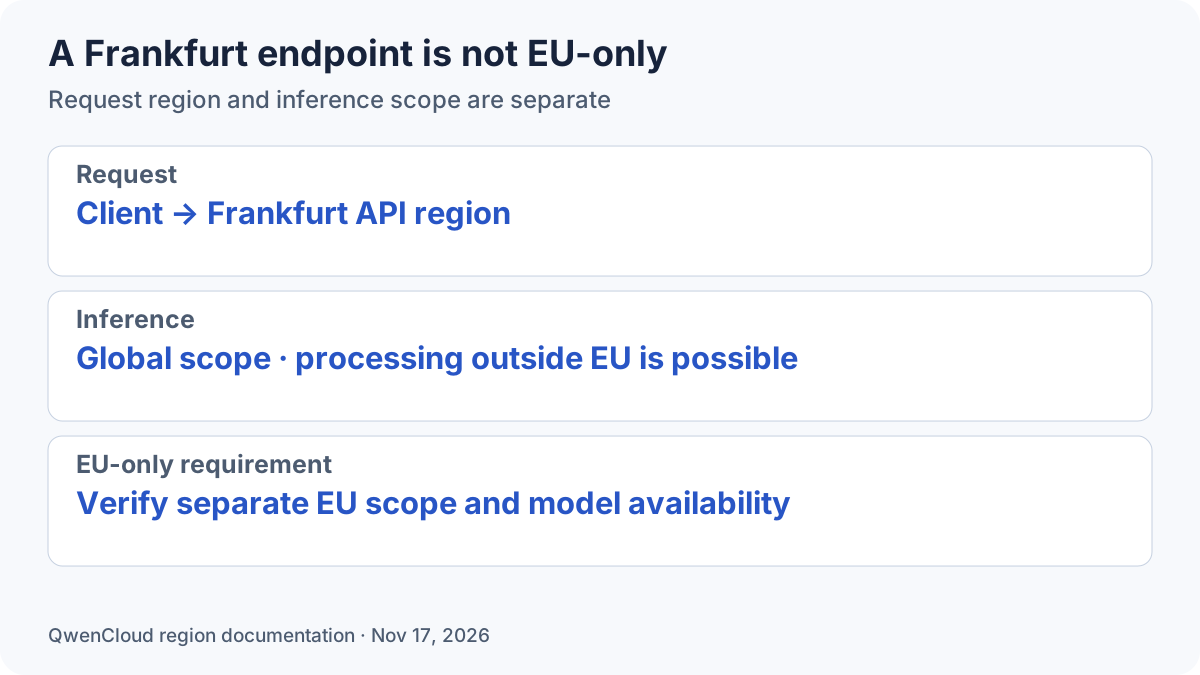
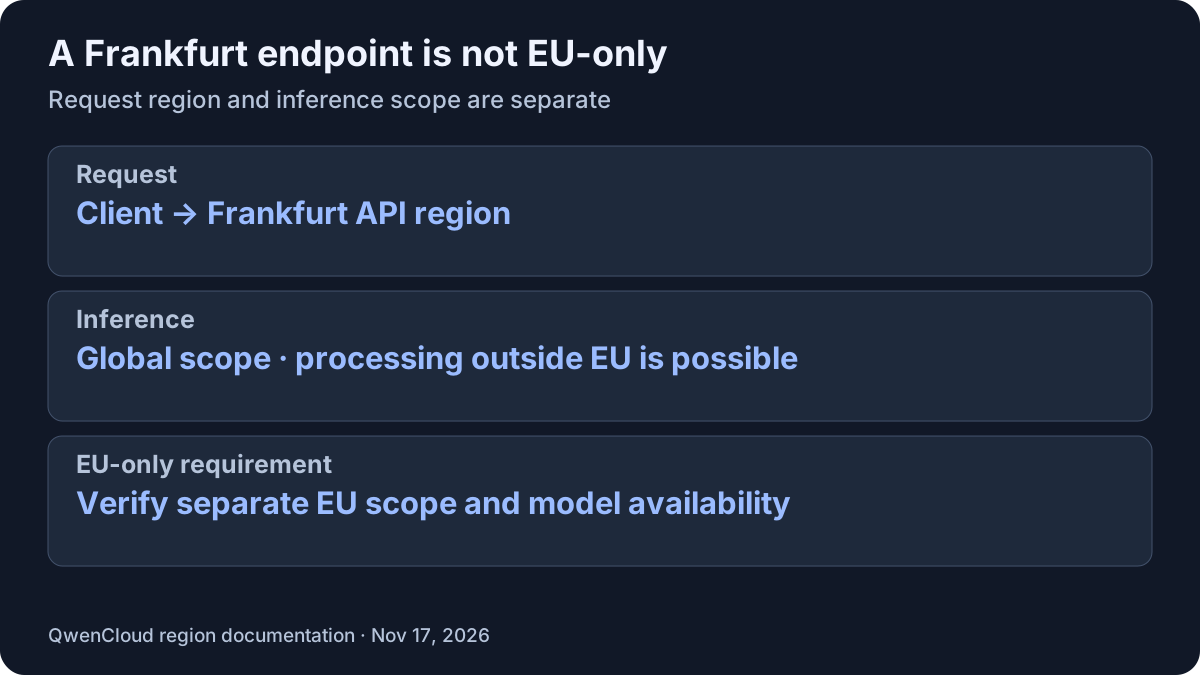
QwenCloud separates the location that receives and stores requests from the deployment scope that determines where inference runs. Virginia and Frankfurt list Qwen4-Max under Global scope. The provider documents Global inference as potentially running on nodes in different jurisdictions, including mainland China. A US-only or EU-only workspace is a separate scope, and model availability differs. Region and scope documentation.
OpenRouter currently indicates that EU in-region routing is unavailable for Qwen4-Max. Model listing. A regulated workload should not be sent to a Global deployment solely because the base URL contains a familiar region code. Check applicable contractual and organizational requirements, retention, tool endpoints and processing scope before sending confidential information.
Can Qwen4-Max run on Apple Silicon?
Not as a local checkpoint yet. Alibaba has announced plans to release smaller Qwen4 models with open weights, but the Max model itself is proprietary and no official public checkpoint was published. See Qwen’s Hugging Face organization and GitHub repositories.
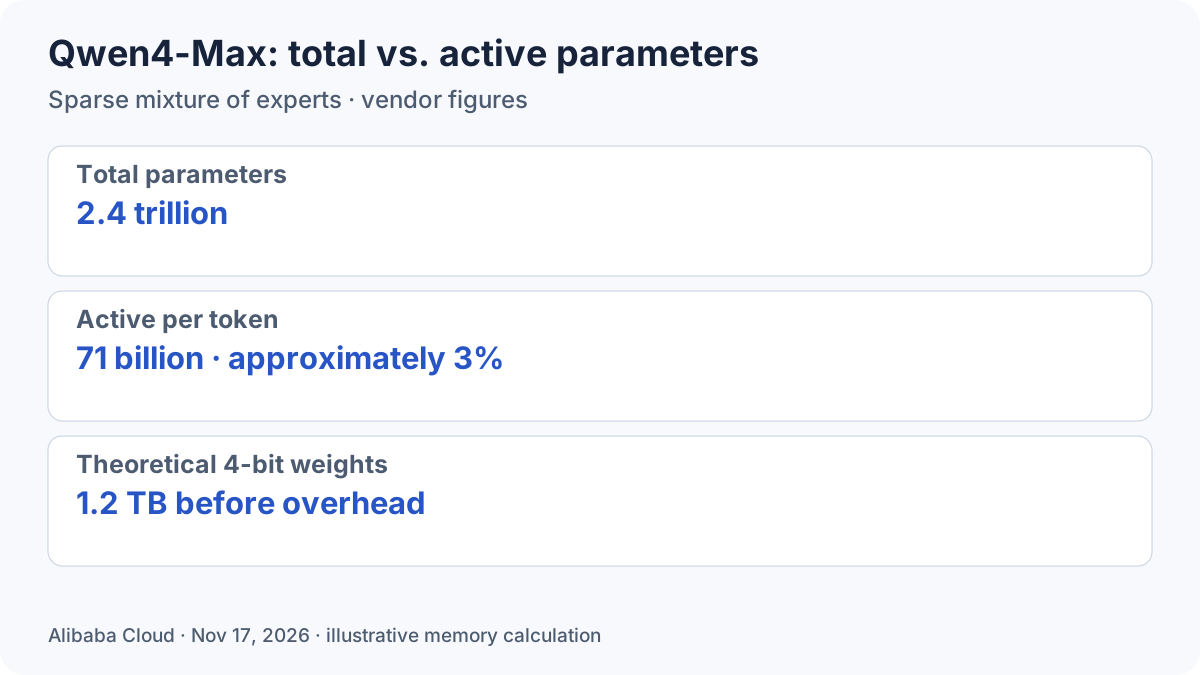
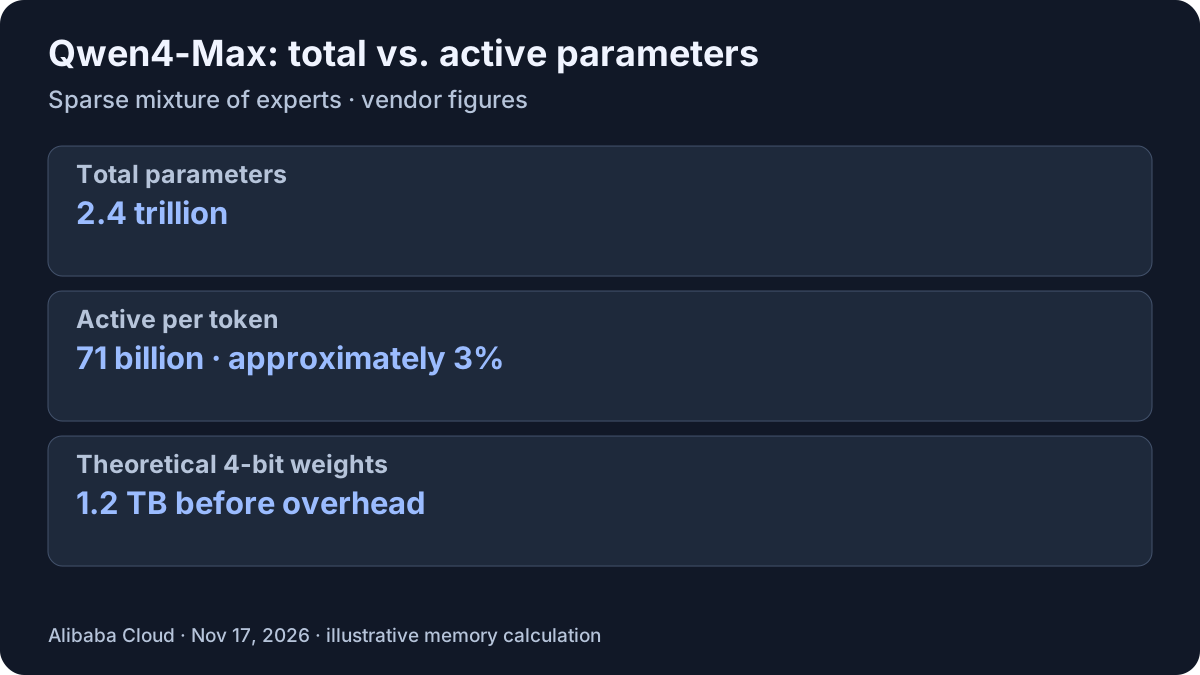
There is a second limitation even if the weights become available. A theoretical 4-bit representation of 2.4 trillion parameters would occupy about 1.2 TB in decimal units, before quantization overhead, context caches, additional components or runtime memory. At eight bits the corresponding arithmetic gives 2.4 TB. This is an illustrative calculation, not a released file size or a hardware benchmark.
The 71B active-parameter figure is a measure of sparse computation, not an indication that a 71B-sized Mac checkpoint exists. For a local workflow, an already released smaller model such as Qwen3.8-27B is a more realistic candidate. Check the machine’s memory capacity, quantization format and context requirements before choosing a model.
Mac LLM memory calculator (German) · English article directory
Frequently asked questions
Is Qwen4-Max open source? The flagship is not released as public weights. Smaller open-weight Qwen4 models are planned; a release date was not confirmed in the launch announcement.
Is there a free API tier? QwenCloud lists a one-million-token free quota for eligible Singapore pay-as-you-go accounts. Token Plan credits and free quota are separate. Free quota terms.
Can it generate videos? It accepts video as an input and returns text. Native video output is not listed in the model reference.
Is it better than Claude Opus for agents? Available launch-day data do not justify a universal ranking. Compare cost per accepted result on your own benchmark.
Where Qwen4-Max fits
For an API-based agent with repeated, non-sensitive context, Qwen4-Max is worth testing. For workloads with strict geographic inference restrictions, verify that the requested model is supported in the required scope first. For offline development, select a genuinely downloadable model instead.
Explore the AI on Mac article directory for local model and hardware guides.
Methodology: source review on November 17, 2026. Prices are dated list rates; scenario calculations are original and are not observed bills. No first-hand API test was performed.
Qwen3.8-Max pricing and benchmarks · Qwen3.8-27B for local workflows