Researched and edited with AI assistance. Editorial responsibility: Julian Dominic Altmann. Facts checked November 6, 2026. Source analysis only; no independent model generations or benchmarks.
Verified November 6, 2026. Google’s Gemini Omni 1.2 Flash, launched November 5, is a cloud-hosted video generation and editing model that can produce clips of up to 15 seconds with synchronized audio. Its published 720p video-output rate works out to $0.069504 per generated second. That is a meaningful decrease from the 1.1 model—but it is not an all-in price, and the model isn’t a downloadable option for local Apple Silicon inference. Google announcement · Google Cloud pricing
One distinction matters before building around it: the Google model ID is gemini-omni-1.2-flash. The google/ prefix in google/gemini-omni-1.2-flash belongs to OpenRouter and compatible third-party gateways. Video jobs require the appropriate video-generation or Interactions workflow, rather than treating this as a regular chat-completions model. Google Cloud model reference · OpenRouter listing
The confirmed differences from Omni 1.1
Google’s November 5 release adds longer native clips, tighter reference following, conversational revisions and a lower video-output tariff. The Cloud release notes mark the new model as generally available. The model handles text, image and video inputs and can return video with native audio and text. Google’s model card also describes audio inputs; particular audio-reference workflows can still require an allowlist or differ by client. Release notes · Model card
| Metric | Omni 1.1 Flash | Omni 1.2 Flash |
|---|---|---|
| Standard generation length | Up to 10 seconds | 3–15 seconds |
| Video output per million tokens | $17.50 | $12.00 |
| 720p video output per second | About $0.10136 | About $0.06950 |
| Input per million tokens | $1.50 | $1.50 |
| Text output per million tokens | $9.00 | $9.00 |
| Multi-turn editing | Supported | Supported with extended workflows |
Sources: Google’s Cloud rate card, release post and video API documentation. USD list prices; arithmetic is ours. The percentage reduction applies to video output, not the unchanged input or text-output tariff.
The updated model is marketed as more reliable at preserving faces, product packaging, scene geometry, references, and complex camera motion, with more natural dialogue. Those are Google’s qualitative claims, supported by selected demonstrations, not a published controlled evaluation of acceptance rates. Google itself highlights remaining challenges with fast sports motion, rapid script changes and complex physics. Google DeepMind launch
The resolution-based price calculation
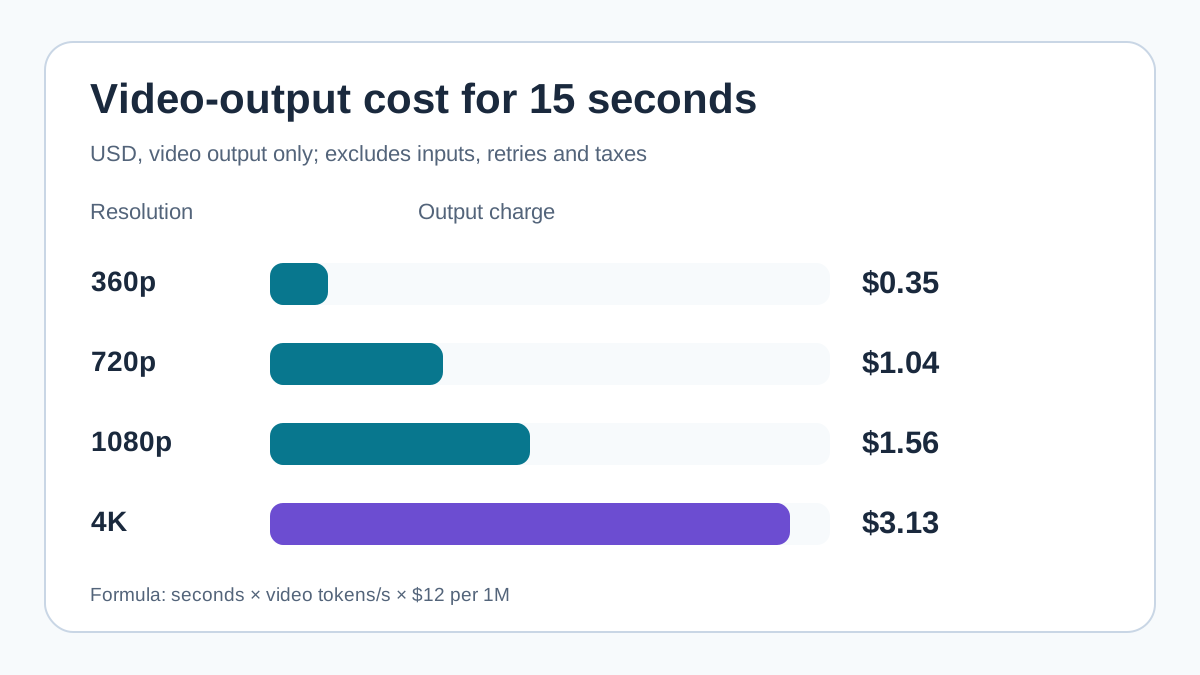
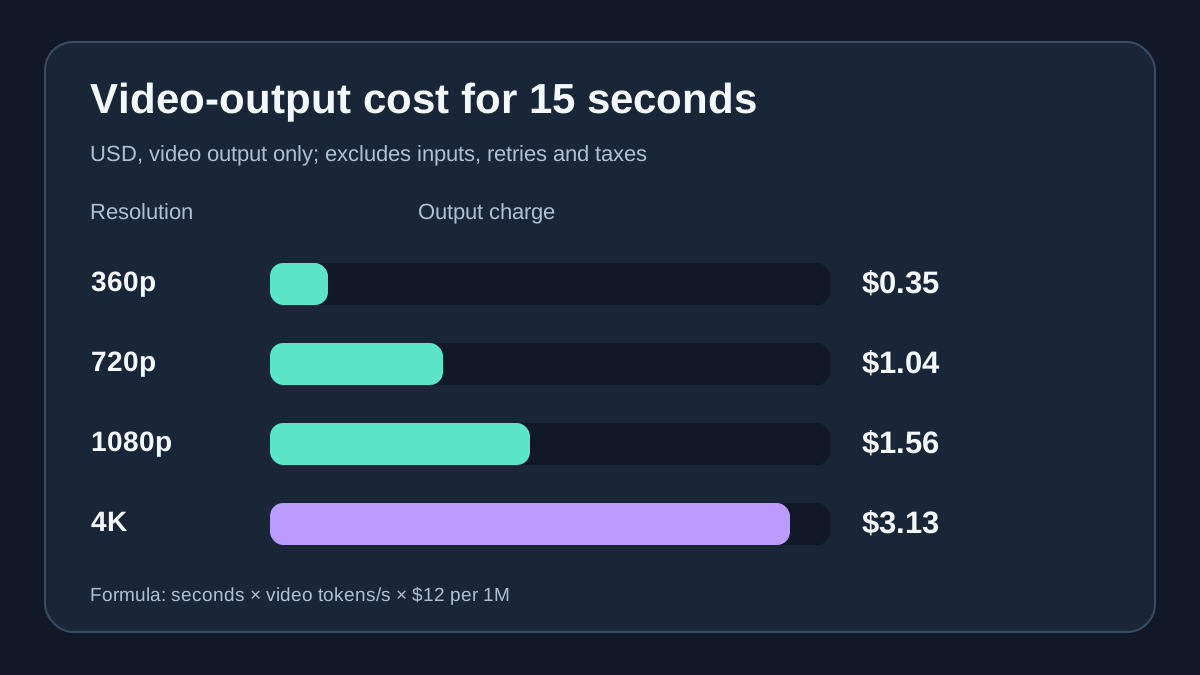
Google bills video output in tokens. For Omni 1.2 Flash, $12 per million video-output tokens is the relevant tariff. The published accounting factors are 1,931 tokens per second at 360p, 5,792 at 720p, 8,688 at 1080p and 17,376 at 4K. Google Cloud pricing
| Resolution | Output tokens / second | Output USD / second | Output USD / 15-second clip |
|---|---|---|---|
| 360p | 1,931 | $0.023172 | $0.347580 |
| 720p | 5,792 | $0.069504 | $1.042560 |
| 1080p | 8,688 | $0.104256 | $1.563840 |
| 4K | 17,376 | $0.208512 | $3.127680 |
The calculation is seconds × tokens_per_second × $12 / 1,000,000. A 15-second 720p output is therefore 15 × 5,792 × 12 / 1,000,000 = $1.04256. These numbers exclude input tokens, any additional text output, retries, follow-up edits, separate operations and taxes. Higher resolutions may be produced by upscaling, which has task-specific token accounting. Google upscaling documentation
A quick budget comparison at 720p shows why the number of attempts matters:
| Production pattern | Generated 720p footage | Video-output charge only |
|---|---|---|
| Trial | 10 × 10-second clips | $6.95 |
| Small production | 50 × 15-second clips | $52.13 |
| Heavy production | 500 × 15-second clips | $521.28 |
A creative team that needs three candidates for each accepted 15-second clip consumes about $3.13 in video output for one usable result, before the rest of the pipeline. Real cost per approved clip—not price per raw second—is the more useful operational metric.
What developers can actually build
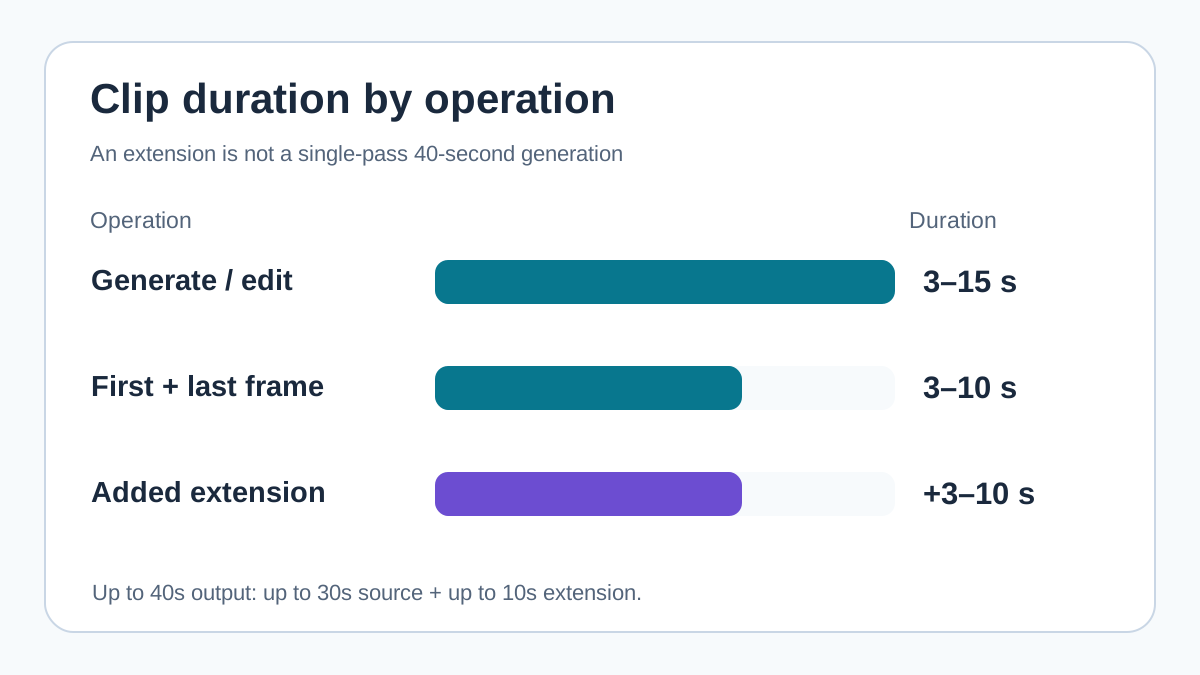
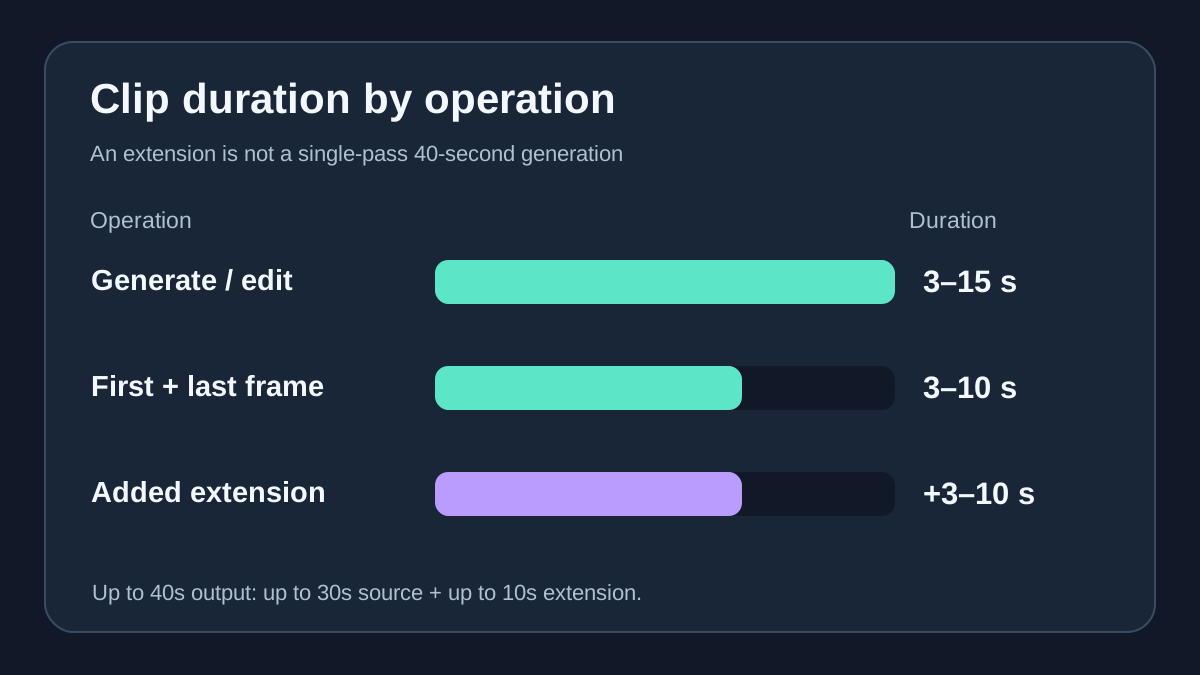
The supported tasks include text-to-video, image-to-video, video from reference images, first-and-last-frame interpolation, editing, extending and standalone upscaling. Google Cloud exposes them through the Interactions API, including stateful workflows that refer to prior interactions. The Cloud documentation also describes optional seeds and billing labels for repeatable evaluations and cost allocation. Video generation overview · Text-to-video guide
Keep the durations straight. Three to fifteen seconds applies to regular generation and editing. First/last-frame interpolation is limited to three to ten seconds. Extending a clip adds three to ten seconds; Google documents up to 40 seconds total output: up to 30 seconds retained from the source video plus as many as 10 newly generated seconds. This is not single-pass generation of a 40-second video. Model limits · Extend-video documentation
Reference counts also differ by access path. The Google Cloud model page lists up to 10 images per prompt, whereas Vercel’s AI Gateway announcement describes up to six reference images for its integration. This is not sufficient evidence to treat either gateway’s advertised limit as universal. The Google Cloud release also says audio references are allowlisted. For production applications, validate the exact input configuration against the selected endpoint. Google Cloud model details · Vercel launch · Cloud blog
Google API versus OpenRouter
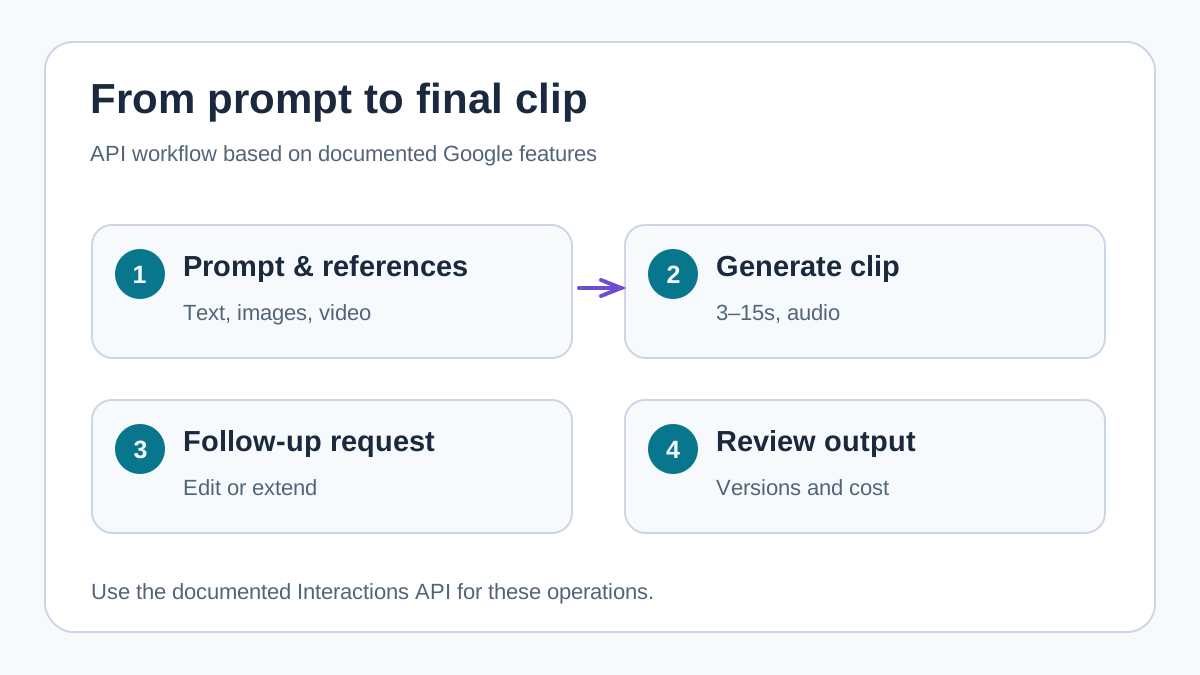
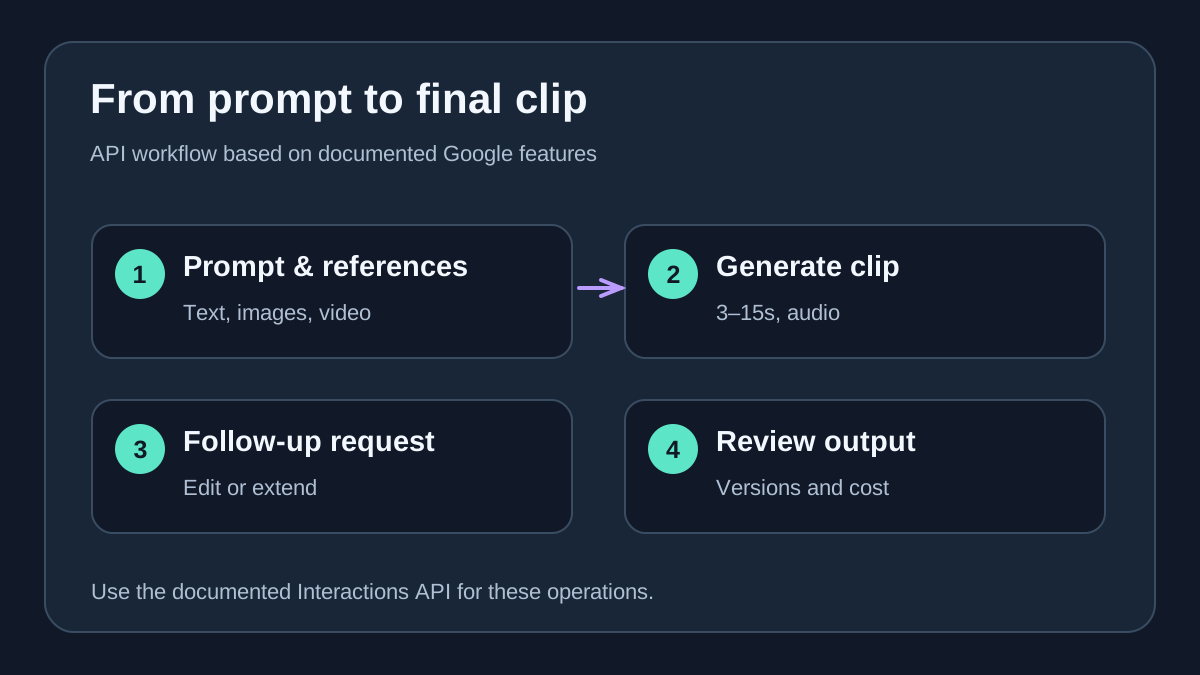
The Google Cloud model specification lists the Interactions API as supported, but not generateContent or Chat Completions for this model. OpenRouter exposes its own video job API (POST /api/v1/videos) and lists the model ID with a google/ prefix. Its prominent $1.50 / $9 per 1M pair refers to input and text output. Video has separate rates; blindly using that display for a video cost estimate understates the bill. Google model reference · OpenRouter video documentation · OpenRouter model page
Vercel AI Gateway separately announced support on November 5, including a video-generation example using the same prefixed identifier. Integration details and quotas should be checked against each gateway, not assumed to match the Google API. Vercel changelog
Access, regional processing and the Mac question
Google also distributes Omni through consumer and workplace experiences including the Gemini app, Flow and Vids. These offerings do not share one universal quota. The Gemini app help page distinguishes generally eligible subscriptions (up to 10 seconds) from Google AI Ultra access (up to 15 seconds), and notes region-specific exclusions for uploading videos for editing and avatar functions. An application subscription is separate from metered Developer API use. Gemini app help · Google launch
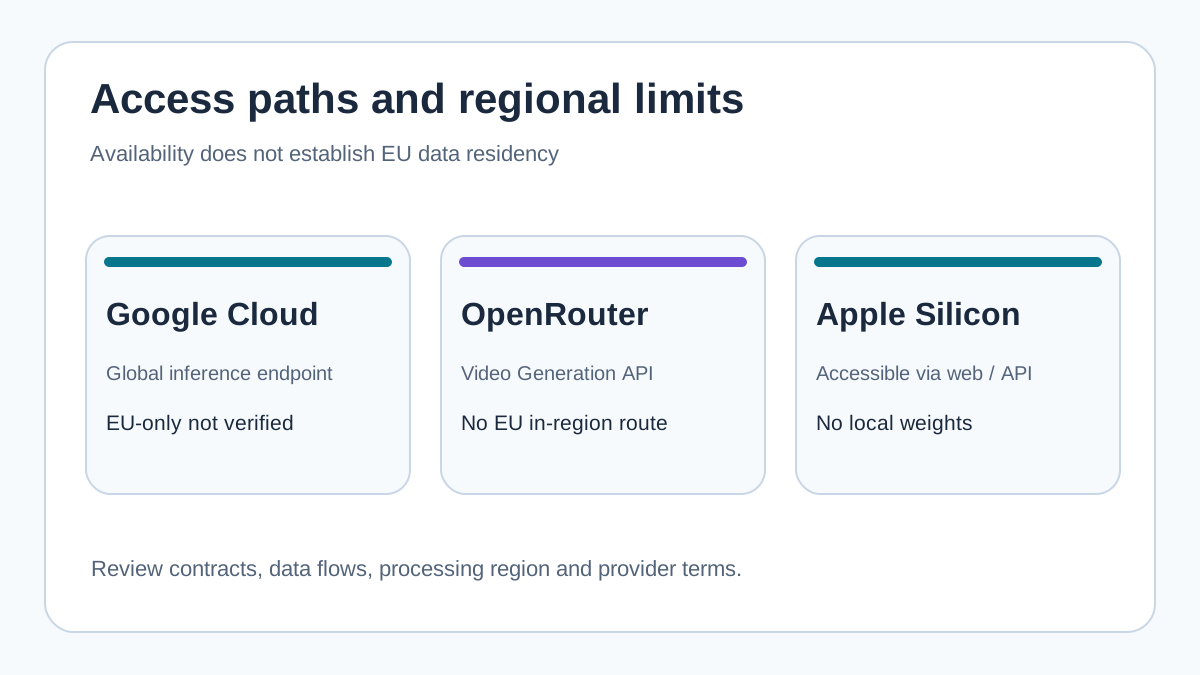
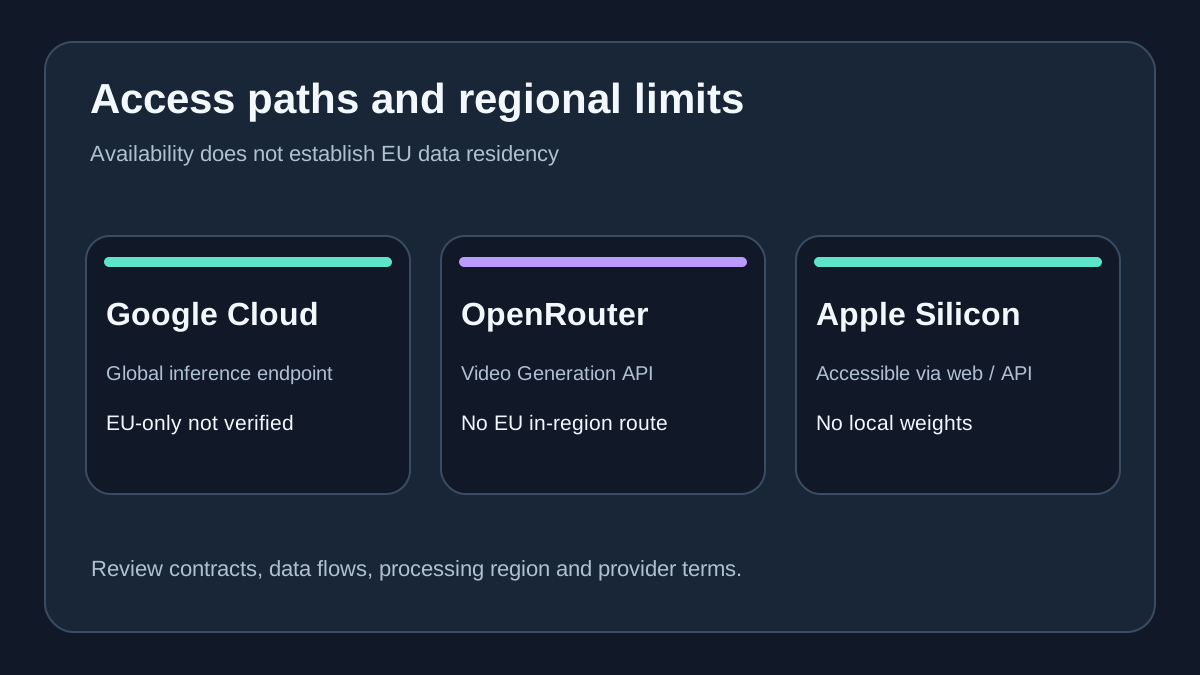
For readers subject to strict data-residency obligations, the cloud model reference lists global as its inference endpoint. OpenRouter labels the specific model unavailable for EU in-region routing. This does not, on its own, decide whether a particular legal use is GDPR-compliant. It means an EU-only hosting claim cannot be supported by those deployment pages. Review the applicable contract and transfer arrangements before uploading sensitive client footage. Google endpoint availability · OpenRouter region guide
On a Mac, the service can be used through the browser or an authenticated API client. It is not a locally downloadable model with public weights and does not become local simply because the browser or development tools run on Apple Silicon. The 131,072-token input limit described by Google Cloud and OpenRouter is an API context limit, not a RAM or GPU memory requirement for a Mac. Google Model Card · OpenRouter
Is it better than competing video models?
There is not yet a broad, independently reproduced benchmark proving a universal ranking for this specific November 5 release. Segmind reported 20 trials with call times ranging from 28 to 136 seconds, praising text-centric motion graphics while pointing out weaknesses in photorealistic human generation. CellCog published ten cross-model scenes plus one Omni-only editing test, with example prompts and generated clips. Both are commercial platforms with their own incentives; neither study establishes a general winner. Segmind hands-on test · CellCog comparative examples
The better evaluation strategy is workload-specific: retain a fixed prompt/reference dataset, compare instruction compliance, visual consistency, sound alignment, latency, failure rate and cost per approved deliverable, and collect more than one generation per case.
Verdict
Gemini Omni 1.2 Flash’s verifiable advantage is the combination of 15-second native generation, conversational editing and a reduced 720p output tariff. It looks most practical for repeatable branded variations, reference-guided shorts and explainers. It is a poor fit for someone seeking an offline Apple Silicon workflow or a verified EU-only inference location.
For related spending context, see the site’s US Gemini plan and API pricing guide and its Apple Silicon unified-memory guide. Consumer subscriptions, developer billing and local compute are three different cost models; compare them separately.
Sources, method and update policy
Primary sources: Google announcement, DeepMind model card, Google Cloud model reference, official price list, release notes. Further checks: OpenRouter, Segmind, CellCog. We did not run independent generations or latency measurements for this article. Last reviewed November 6, 2026. Recheck after pricing, availability or API contract changes.