Research and editorial drafting were AI-assisted. Editorial responsibility: Julian Dominic Altmann. Vendor claims, independent measurements, and original calculations are distinguished below.
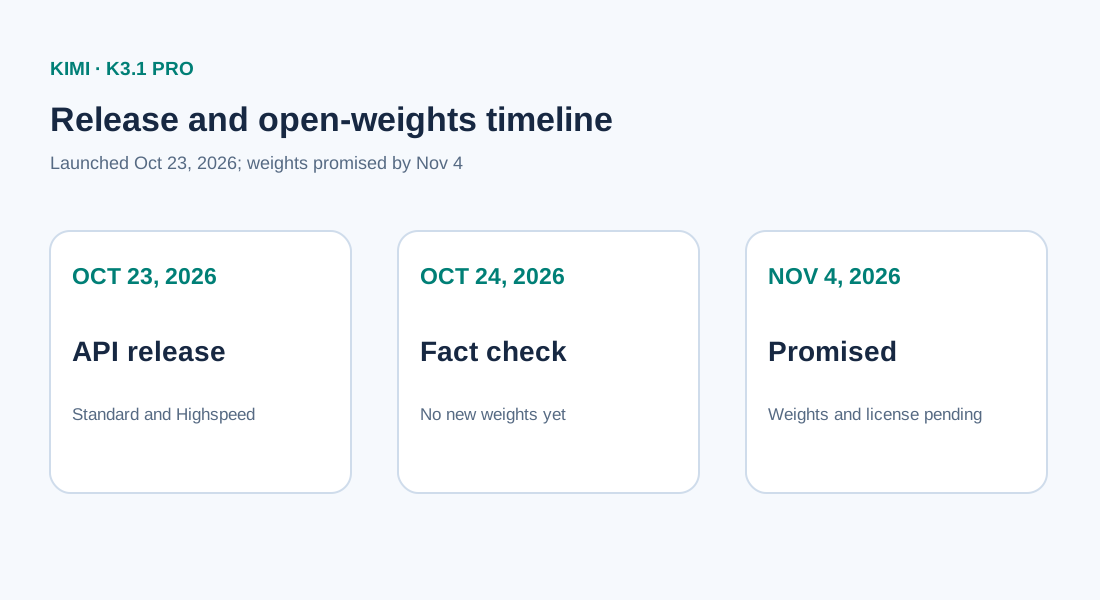
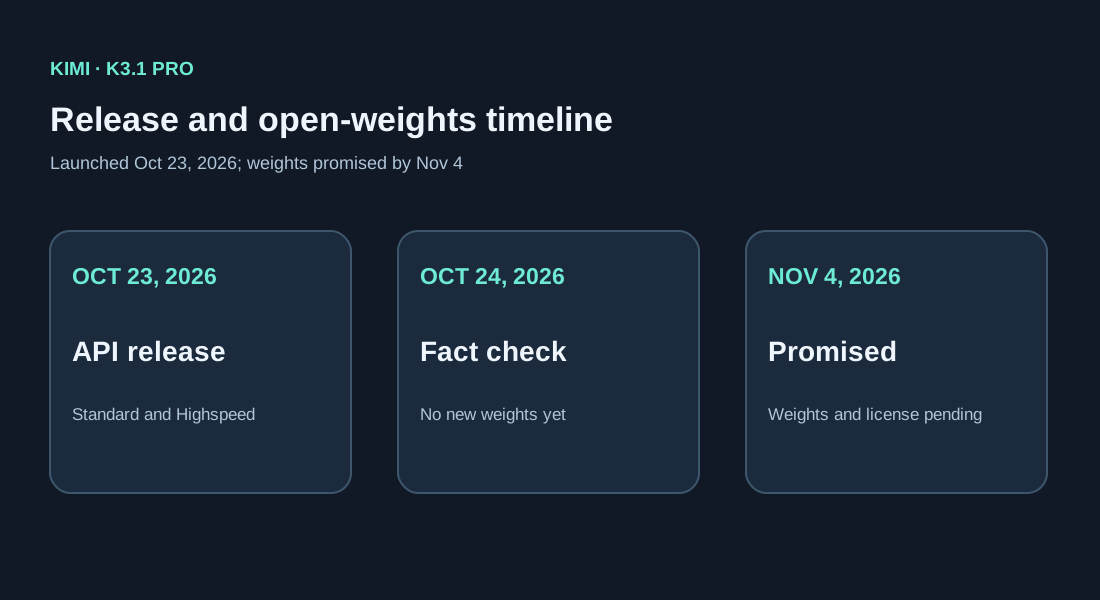
Verified October 24, 2026. Moonshot AI launched Kimi K3.1 Pro on October 23, positioning it as a flagship reasoning model for coding agents, 3D creation and document-heavy knowledge work. The standard API lists $2 per million input tokens and $10 per million output tokens, alongside a 1,048,576-token context window. A separate Highspeed endpoint is advertised at two to three times the output speed, but at twice the standard uncached input and output token price. 123
The distinction that matters today: the hosted model is available; its new weights are not. Moonshot promises to publish full K3.1 Pro weights by November 4, 2026. Until then, claims about actually running this version locally, its final downloadable size or its eventual license go beyond the verified release. This guide uses primary documentation, third-party measurements and transparent token-cost examples rather than inventing a hands-on test. 1
At a glance
| Question | Verified answer |
|---|---|
| What launched? | Kimi K3.1 Pro, October 23, 2026 |
| Direct Kimi API model | kimi-k3.1-pro |
| Highspeed API model | kimi-k3.1-pro-highspeed |
| OpenRouter model | moonshotai/kimi-k3.1-pro |
| Kimi Code membership model | k3.1-pro |
| Context | 1,048,576 tokens on the direct API; plan-dependent on Kimi Code |
| Reasoning | Always on; low, high, max (max default) |
| API rates | $2 input, $10 output, $0.20 cache hits / million tokens |
| Highspeed rates | $4 input, $20 output; cache hits $0.20 / million |
| Open-weight availability | Not published as of October 24; promised by November 4 |
| Typical Mac usage | Remote API or coding client rather than full local inference |
Sources: Kimi API platform, official technical announcement, developer docs and model-routing listings 123456789.
What’s changed since Kimi K3?
Moonshot calls K3.1 Pro a post-trained successor to Kimi K3, using a substantially larger reinforcement-learning effort across agentic work. Its most compelling use cases are difficult multi-step software tasks, programmatic 3D construction and document-grounded financial analysis. K3 is a 2.8-trillion-parameter mixture-of-experts model, but it would be premature to treat K3’s exact architectural figures as a fully validated K3.1 Pro specification before the new model card is released. 11011
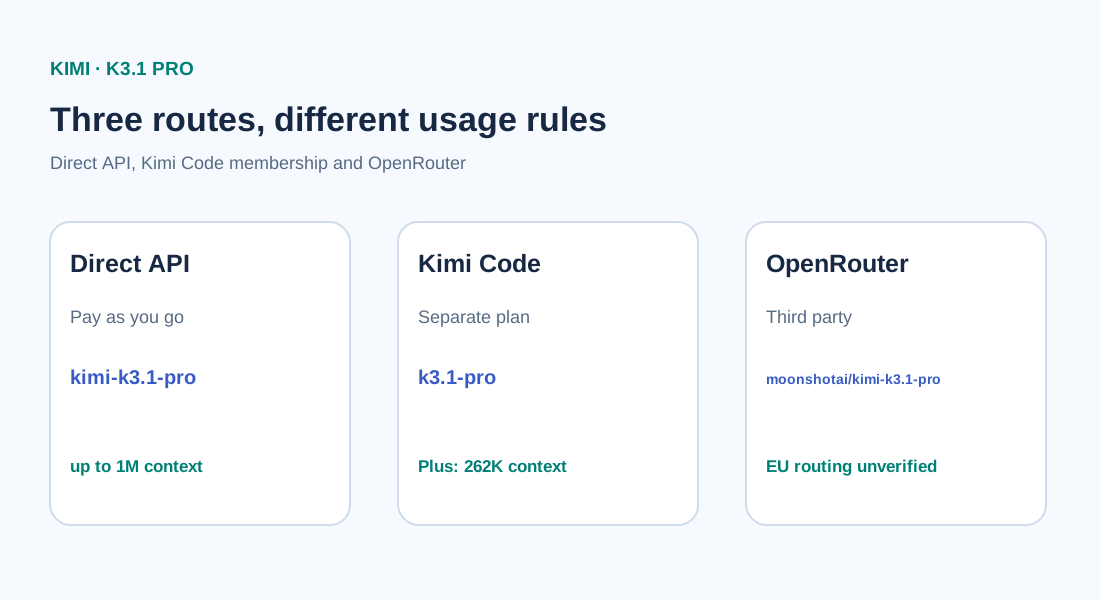
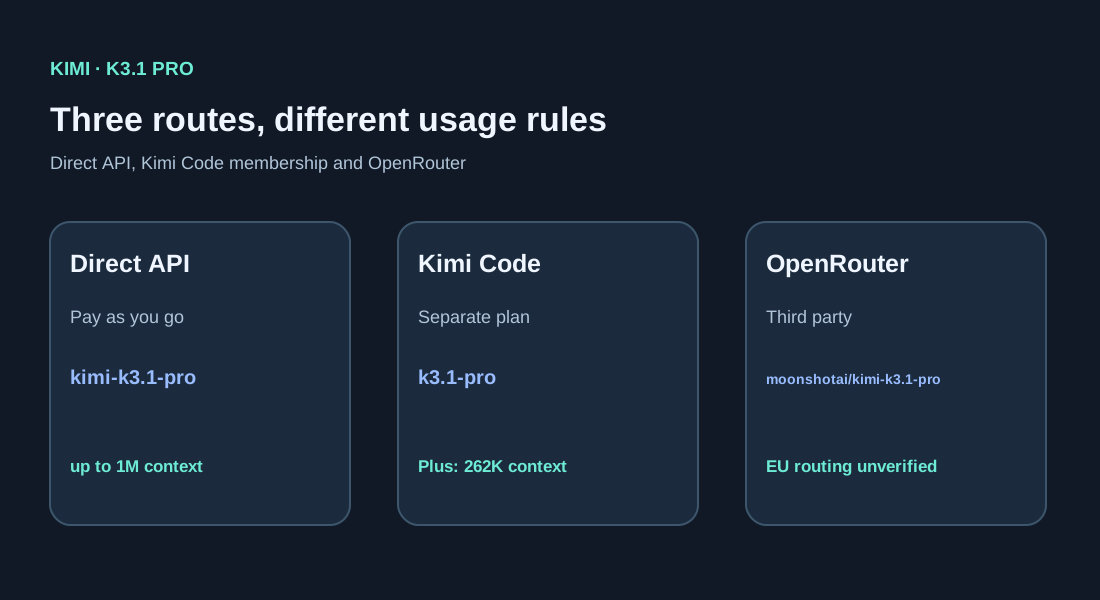
The naming can be confusing. kimi-k3.1-pro is the production ID for the pay-as-you-go API. k3.1-pro is a separate ID in the Kimi Code membership interface, with plan-specific quotas and context limits. A model’s marketing claim of 1M context does not imply that every subscriber can submit a million-token request. 478
What do the early benchmarks show?
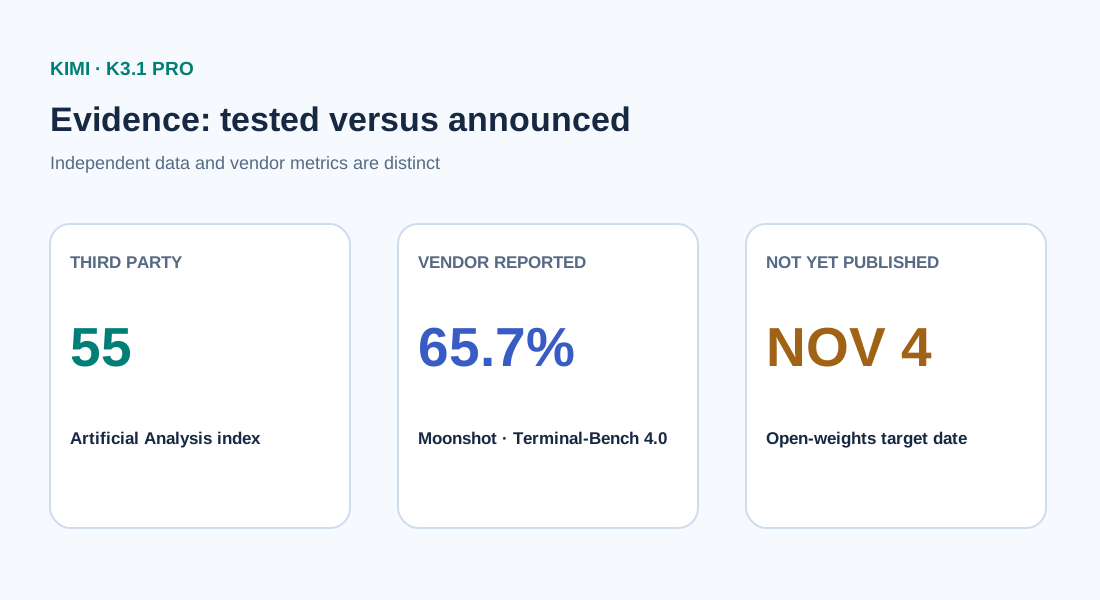
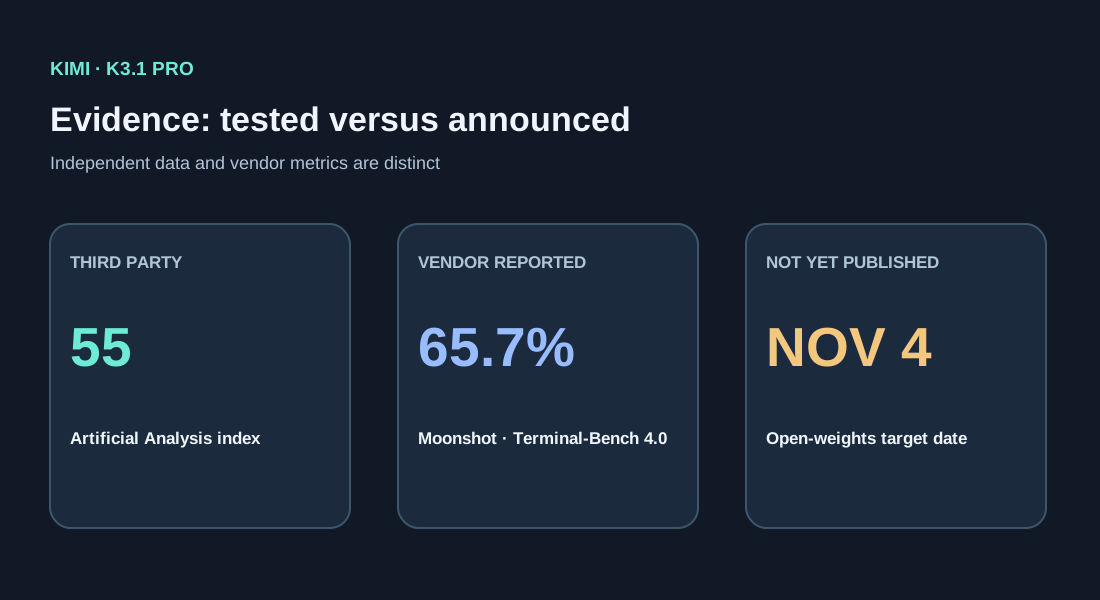
Artificial Analysis independently reports an Intelligence Index of 55 and approximately 73.5 output tokens per second on its model page, putting K3.1 Pro in a high-performing group while noting unusually verbose outputs. That combination matters financially: reasoning-heavy generation can make output tokens a substantial share of your bill, and output is priced at five times the ordinary input rate. An aggregate index should not be confused with an end-to-end coding-agent acceptance test. 12
Moonshot’s own evaluations report 65.7% on Terminal-Bench 4.0, 61.2% on its internal Kimi Code Bench 3.0 Long-horizon, 92.7% on tool-assisted BenchCAD, and 64.4 on OfficeQA Pro v2. These are attributable manufacturer results, not independent in-house tests by AI on Mac. A third-party display of 67.2% on Terminal-Bench 4.0 is not the same measurement as Moonshot’s 65.7%; the sources do not fully resolve the methodological difference. 1121314159
A repeatable comparison should pin the task set, tool permissions, harness, model ID, reasoning level, time limits and scoring rules. Run a minimum of three independent attempts per task and record full billed input, cached input, output, elapsed time, tool errors, user interventions and successful completion. The operational metric that best answers the purchase question is dollars per successfully completed task, not an isolated benchmark percentage.
Official API pricing, including cache writes
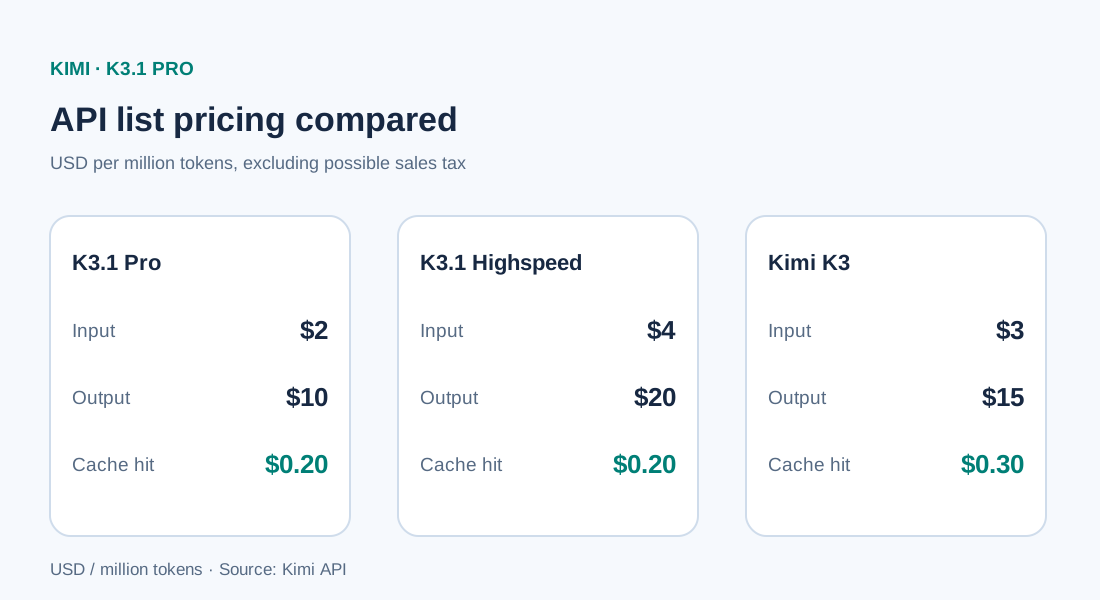
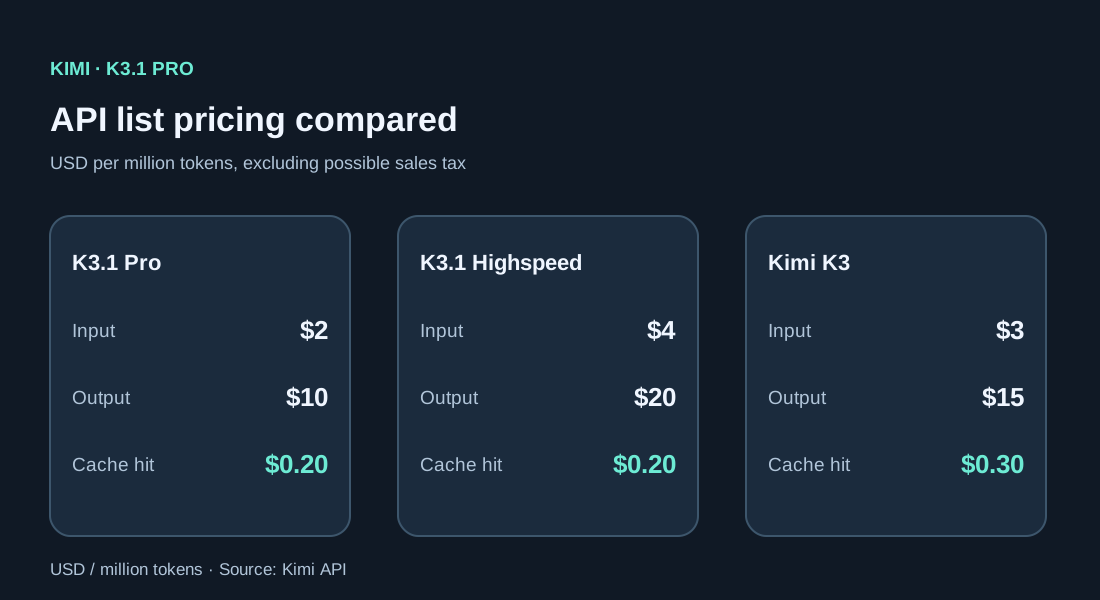
The figures below come from Moonshot’s published USD rates and exclude applicable taxes. Kimi Code subscription charges are a different product. 236
| USD / 1M tokens | K3.1 Pro | K3.1 Pro Highspeed | Kimi K3 |
|---|---|---|---|
| New input | $2.00 | $4.00 | $3.00 |
| Generated output, including reasoning | $10.00 | $20.00 | $15.00 |
| Cache read | $0.20 | $0.20 | $0.30 |
| Cache write, 5-minute TTL | $2.00 | $4.00 | $3.00 |
| Cache write, 1-hour TTL | $4.00 | $8.00 | $6.00 |
Relative to K3, regular K3.1 Pro lowers the standard input and output prices by one third. Highspeed doubles ordinary input and output rates but leaves cache-hit pricing unchanged. The speed uplift is Moonshot’s claim; your own network latency, reasoning-token volume and agent tool wait times can change the actual wall-clock benefit. 123
Three workload estimates
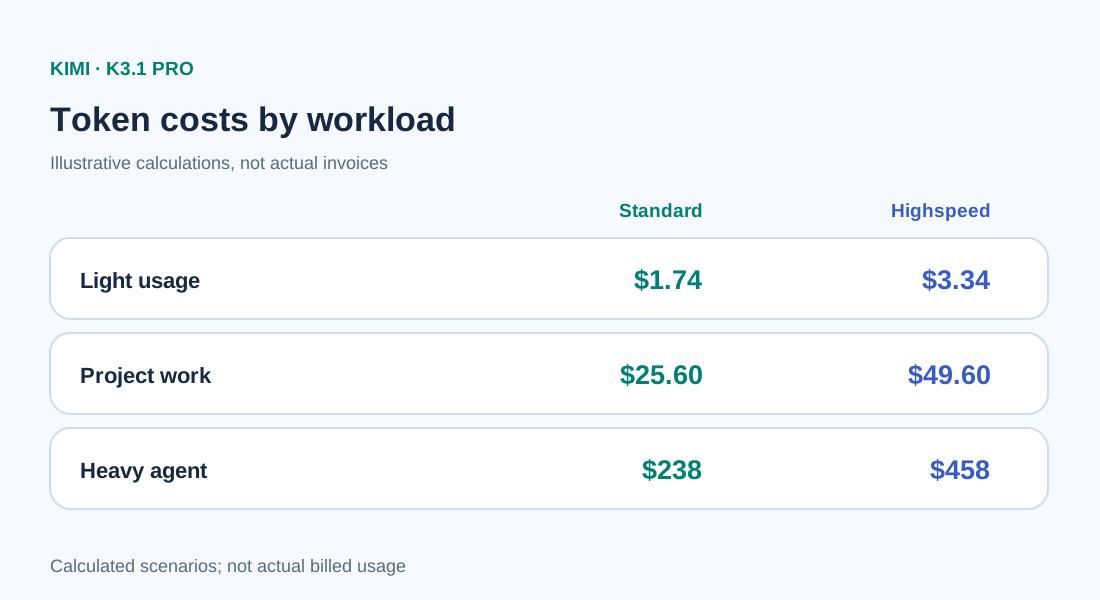
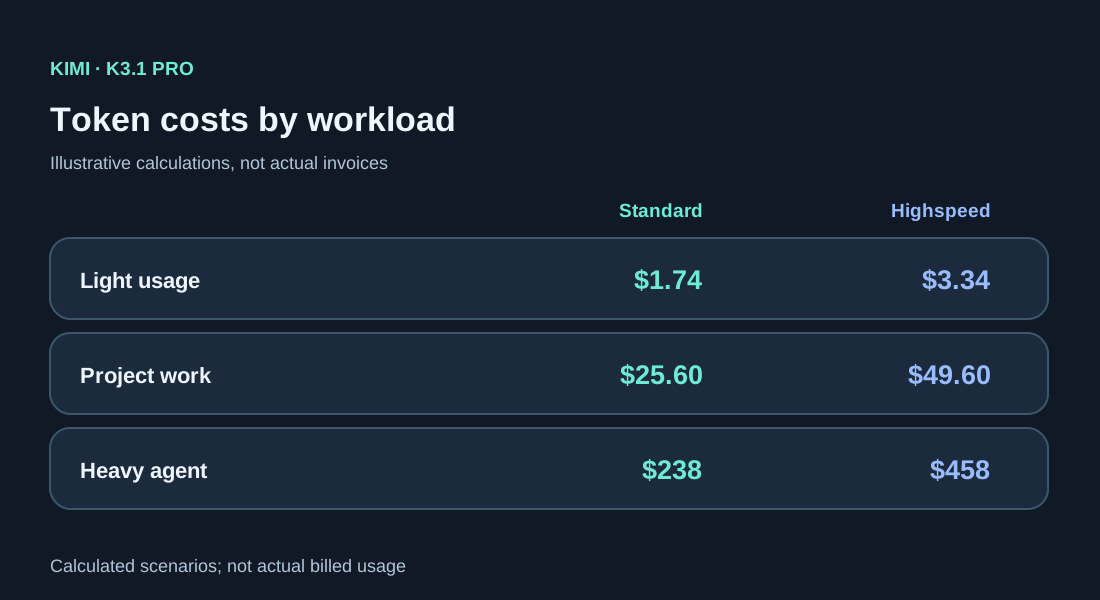
These are our calculations, not observed invoices. Assumptions: exact displayed token mix, successful cache hits, default five-minute write TTL, no non-model tools, retries, image-token charges or tax; output includes reasoning tokens.
| Workload | New input | Cache-hit input | Output | Regular | Highspeed |
|---|---|---|---|---|---|
| Light | 0.3M | 0.7M | 0.1M | $1.74 | $3.34 |
| Development project | 2M | 8M | 2M | $25.60 | $49.60 |
| Heavy agent | 10M | 90M | 20M | $238.00 | $458.00 |
Formula: new_input_M × new_input_rate + cache_hit_M × cache_read_rate + output_M × output_rate. For the development workload, the regular model costs 2×2 + 8×0.20 + 2×10 = $25.60. With no successful cache hits, that same 10M input plus 2M output would cost $40.00, excluding extras.
Moonshot documents automatic prefix caching with a five-minute default TTL and a pricier one-hour cache-write tier. Actual savings depend on stable request prefixes and timely reuse. Log real cache usage from provider usage fields rather than applying a guessed hit rate to your invoice. 6
Using Kimi K3.1 Pro with Hermes on a Mac
Unlike many new-model articles, there is a practical and official Hermes Agent integration guide from Kimi. It specifically distinguishes the Kimi Coding Plan endpoint from the standard token-metered API. 8
For direct API usage, the documented OpenAI-compatible URL is https://api.moonshot.ai/v1 and the model is kimi-k3.1-pro. For a Kimi Code subscription, the documented base URL is https://api.kimi.ai/coding/v1, the model becomes k3.1-pro, and a membership API key is required. 478
The core YAML below follows Moonshot’s Kimi Code recipe for a Plus / Moderato member with 256K context. Merge settings with your existing Hermes config; don’t delete unrelated custom providers:
custom_providers:
  - name: kimi-coding-plan
    base_url: https://api.kimi.ai/coding/v1
    key_env: KIMI_API_KEY
    api_mode: chat_completions
    model: k3.1-pro
    extra_body:
      reasoning_effort: max
    models:
      k3.1-pro:
        context_length: 262144
        supports_vision: true
model:
  provider: custom:kimi-coding-plan
  default: k3.1-pro
  context_length: 262144
  supports_vision: true
agent:
  reasoning_effort: max
Use hermes config edit to edit the file, then start a new session. On Pro / Allegretto or higher, the official guide allows setting the two context-length values to 1048576 and using k3.1-pro-highspeed. On Plus / Moderato, keep K3.1 Pro at 262,144. If reasoning is disabled, the API returns an error. For vision, optional video support, membership-specific 403 errors and the complete auxiliary block, follow the official Hermes setup guide. 816
When integrating tool calling yourself, preserve full assistant messages, including tool calls and reasoning-related fields as the API requires. Starting a new session after switching models prevents mixing old-model cached prefixes and incompatible history representations. Do not use a coding-subscription API key as though it were an unrestricted commercial application endpoint. 478
Subscriptions, speed and usage limits
Kimi’s current new memberships separate a Go tier without Kimi Code from Plus, which unlocks K3.1 Pro with a 256K context cap, and Pro and higher, which unlock the 1M context and Highspeed. New memberships no longer have the old weekly Kimi Code window; a rolling five-hour limit and shared monthly credit pool still apply. Existing legacy subscribers keep distinct quota rules. 717
Moonshot’s regional documentation lists Chinese monthly-billing prices of ¥99 for Plus and ¥199 for Pro as of October 19, 2026. These are explicitly China pricing figures, not verified US dollar or European checkout prices. Avoid promising a universal subscription price unless you can validate a local purchase screen. 18
A practical pricing decision: use the pay-as-you-go API when precise metering and a controlled research experiment matter. Consider the coding subscription for normal terminal and IDE work if its rolling-window quota matches your workload. If throughput is the bottleneck, test Highspeed on the same prompt and agent harness; don’t assume its claimed two-to-three-times model output speed makes an entire multi-tool workflow two-to-three times faster.
Can you self-host K3.1 Pro on Apple silicon?
Not as a complete model on a typical Mac today. The new weights were not available at the October 24 research cutoff. K3, the earlier open-weight checkpoint, contains 2.8 trillion parameters; a purely illustrative four-bit calculation for that amount is approximately 1.4 TB of raw weight bits converted to bytes before runtime, cache, scales and metadata. This is not an actual measured K3.1 Pro download or VRAM requirement. 11011
A Mac remains a capable development client for the cloud model through the Kimi app, Kimi Code CLI, an OpenAI-compatible API, or Hermes. The model runs remotely. For full local processing, use smaller, appropriately licensed weights and independently verify your Mac’s memory requirements. See our existing Kimi K3 on Mac analysis for the predecessor’s hardware context.
Data privacy and EU deployment
Moonshot advertises Zero Data Retention availability for API customers, but ZDR concerns retention policy, not necessarily geographic processing location. At the October 24 check, OpenRouter explicitly marks Kimi K3.1 Pro as unavailable on its EU in-region routing service. A provider may offer general privacy protections without guaranteeing EU-only processing. 191920
Before sending confidential source code, employee records or customer information through a coding agent, confirm the applicable contract, DPA, hosting region, onward transfers, subprocessors, access controls and retention settings for the exact route being used. No blanket GDPR guarantee follows simply from the model’s name or the presence of a ZDR setting. Conversely, this is not evidence that every use of Kimi is unlawful; it is a deployment-specific diligence requirement.
Should you switch to K3.1 Pro?
Worth benchmarking: a large codebase, many interdependent tool calls, document-grounded analysis or 3D code generation, provided the data policy permits the API. Don’t switch on benchmark headlines alone: verbose reasoning can raise output cost, the high-speed endpoint changes economics, and provider integration matters. If you primarily need low-cost automation, compare task-success economics against MiniMax M3.1 Flash, not only headline intelligence scores.
Wait before self-hosting: K3.1 Pro’s promised open-weight artifact, license and deployment recommendations have not yet been published. The next decisive editorial check is November 4, 2026.
FAQ
Is Kimi K3.1 Pro open source today? No downloadable K3.1 Pro weights were verified on October 24. An open-weight release is planned for November 4; licensing requires inspection after release. 1
Does the $2/$10 rate include my Kimi Code subscription? No. It applies to the pay-as-you-go Kimi API. Kimi Code is subscription-based and uses separate model identifiers, credits and limits. 27
Can the API process a million tokens? Yes, the published native API context is 1,048,576 tokens; a coding-membership Plus tier is more limited. 38
Does Highspeed improve reasoning quality? Moonshot describes equivalent model capability with faster generation. That is a provider claim, not proof of equal pass rates in every harness or use case. 17
Is Kimi K3.1 Pro an EU-hosted model? An EU-only endpoint has not been verified for this model, and OpenRouter’s EU in-region option did not list it at the research cutoff. 919
Sources and editorial disclosure
Research completed October 24, 2026. The numeric references link to the audit trail in redaktion/quellen-und-evidenz.md. The cited benchmark numbers are identified as either Moonshot reports or third-party measurements; examples and deployment judgments are labeled as calculations or editorial inferences. No proprietary benchmark, API-call test, local download or hands-on hardware run was conducted for this article.
Footnotes
-
https://www.kimi.com/en/blog/kimi-k3-1-pro ↩ ↩2 ↩3 ↩4 ↩5 ↩6 ↩7 ↩8 ↩9 ↩10
-
https://platform.kimi.ai/docs/guide/kimi-k3-1-pro-quickstart ↩ ↩2 ↩3 ↩4
-
https://www.kimi.com/code/docs/en/third-party-tools/hermes.html ↩ ↩2 ↩3 ↩4 ↩5 ↩6 ↩7
-
https://www.kimi.com/code/docs/en/kimi-code/whats-new.html ↩
-
https://www.kimi.com/code/docs/en/kimi-code/membership.html ↩
-
https://www.kimi.com/en/help/membership/membership-pricing ↩
-
https://www.kimi.com/user/agreement/userPrivacy?lang=en-US&version=v2 ↩
Frequently Asked Questions
Are Kimi K3.1 Pro weights available?
No new K3.1 Pro checkpoint was downloadable as of October 24, 2026. Moonshot promised weights by November 4; review the specific license after release.
What does the direct Kimi API cost?
Kimi K3.1 Pro costs $2 per million new input tokens, $10 per million output tokens and $0.20 per million cached input tokens, plus any applicable tax.
Can Kimi Code Plus accept a million tokens?
No. The Plus membership limits this model to 262,144 tokens, while higher tiers support up to 1,048,576 tokens.
Can it run fully offline on an ordinary Mac?
A full local deployment is not practical on an ordinary Mac; the K3.1 Pro weights were not yet publicly released by October 24.