Reviewed October 8, 2026. Claude Opus 4.8 remains available through the Claude API and OpenRouter, but Anthropic now marks it active (legacy). For a new U.S. coding integration, start by comparing Opus 5.5. Anthropic charges 20% less per standard input or output token for 5.5. These are cloud models, not downloads for Apple Silicon. Opus 4.8 specifications · Opus 5.5 specifications.
Model status, capabilities and API list rates
| Item | Opus 4.8 | Opus 5.5 |
|---|---|---|
| Status | Active (legacy) | Current Opus |
| Direct Claude API ID | claude-opus-4-8 | claude-opus-5-5 |
| Context window | 1M tokens | 1M tokens |
| Standard maximum output | 128K tokens | 128K tokens |
| Input per million tokens | $5.00 | $4.00 |
| Output per million tokens | $25.00 | $20.00 |
| Cache read | $0.50 | $0.20 |
| 5-minute cache write | $6.25 | $5.00 |
| 1-hour cache write | $10.00 | $8.00 |
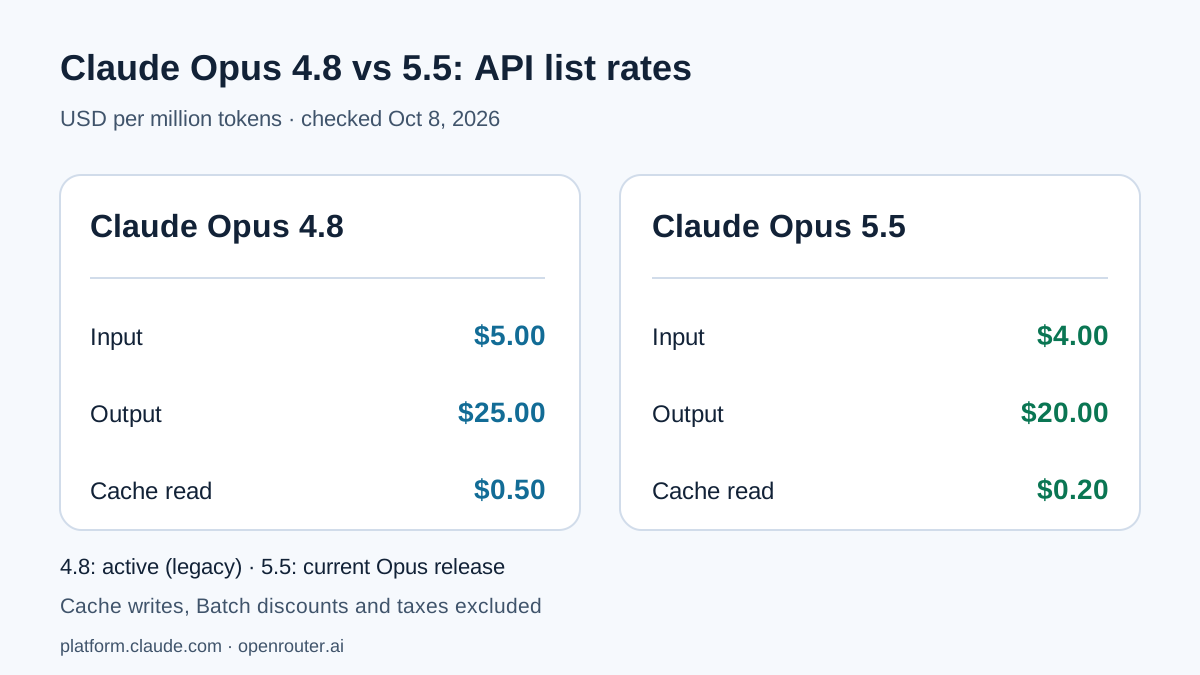
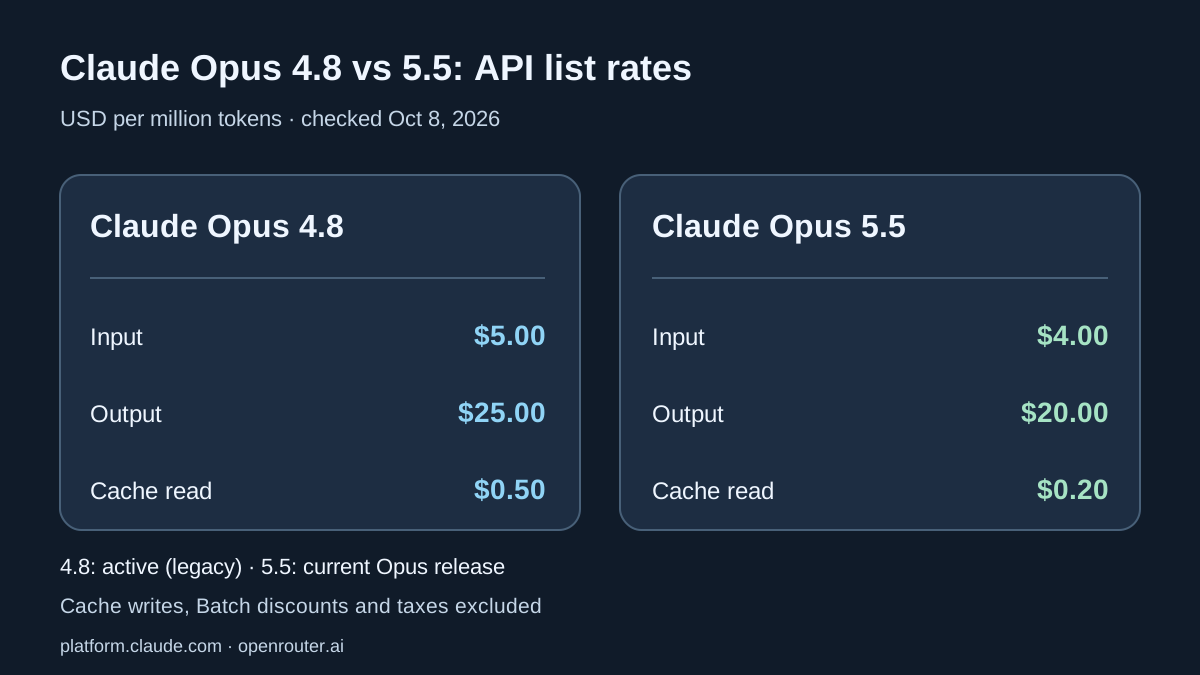
These are U.S.-dollar API rates, not Claude subscription prices. Applicable sales tax or other taxes can be additional depending on billing arrangements. Anthropic’s price list provides Batch API discounts on standard input and output; those direct API discounts should not be assumed for every OpenRouter route.
Does legacy mean it is shutting down?
Not today. Anthropic lists Opus 4.8 as „Active (legacy)“ with retirement no sooner than May 28, 2027. That phrase is a minimum date, not a scheduled shutdown. Existing production apps can continue using 4.8 while running migration tests.
What actually happens on a Mac
Your Mac runs the editor, agent shell, tests and related tools. It does not hold Opus 4.8’s model weights or perform its inference. Requests go to an external inference provider. Mac RAM affects your local applications, not the size of the remotely hosted model.
This distinction matters for privacy as much as hardware planning. When a client includes proprietary code, documents or logs in an API prompt, that content leaves the Mac. Terminal access does not make a cloud agent offline. Restrict tool permissions and send only the files required for the task.
OpenRouter access: check the provider
OpenRouter’s ID is anthropic/claude-opus-4.8, not the direct Claude API’s claude-opus-4-8. The OpenRouter listing displays a 1M-token context window and a $5/$25 input/output rate per million tokens.
OpenRouter may route across several upstream providers. A U.S. account does not establish U.S.-only data processing; the selected provider, its processing terms and the contract determine those details. Check tool support, caching, context, data retention and billing before letting an agent send a private repository. Keep gateway keys in server-side secrets rather than a browser bundle or a Git commit.
How much does a single task cost?
Assume 100,000 ordinary input tokens and 10,000 output tokens, without caching, tools, Batch discounts or retries:
| Model | Input | Output | Base token bill |
|---|---|---|---|
| Opus 4.8 | $0.50 | $0.25 | $0.75 |
| Opus 5.5 | $0.40 | $0.20 | $0.60 |
This illustrates pricing, not relative quality or throughput. Long-running coding agents can issue many more requests and repeatedly send the same files. Cache-write and cache-read charges are different; it is incorrect to treat every prompt token as a discounted cache hit.
Migration needs API compatibility testing
Changing only the ID can break a client. Anthropic documents important Opus 5.5 behavior around always-on adaptive thinking, forced tool calls and older computer-use tools. Some combinations accepted by earlier models may now return errors. Anthropic’s Opus 5.5 documentation is the first place to check before deploying the switch.
Build a representative set of real repository tasks, use fixed permissions and require passing unit or integration tests. Record completion rate, cost, latency, tool calls and manual fixes. This article includes no independent benchmark showing that one model writes better code on a Mac.
What should U.S. developers choose?
For an existing validated workflow, it is reasonable to retain 4.8 while testing a migration. For a new project, Opus 5.5’s lower API prices and current support make it the default comparison. If code must remain offline, choose a local open-weight model; no hosted Opus API is equivalent to local inference.
Sources checked October 8, 2026: Anthropic Opus 4.8, Opus 5.5, API pricing, OpenRouter.
Frequently Asked Questions
Is Opus 4.8 retired?
No. As of October 8, 2026, Anthropic lists it as Active (legacy) and says retirement will not be before May 28, 2027. That is not a confirmed shutdown date.
Can I run Opus 4.8 locally on Apple Silicon?
No. Your Mac operates the editor and tools, but inference takes place at a remote provider.
What is the US API price compared with Opus 5.5?
Anthropic lists $5 input/$25 output per million tokens for 4.8, versus $4/$20 for 5.5. Cache writes and other charges have separate rates.
What is the OpenRouter ID?
Use anthropic/claude-opus-4.8 on OpenRouter and claude-opus-4-8 with the direct Anthropic API.