Short answer
For local AI, choose RAM and chip bin first, display second: M5 Pro with 48 or 64 GB is the balanced range, M5 Max with 128 GB is for large local models, and the 32 GB M6 only for smaller models. OLED alone adds no LLM performance.
- Availability
- November 6, 2026, both lines
- Maximum unified memory
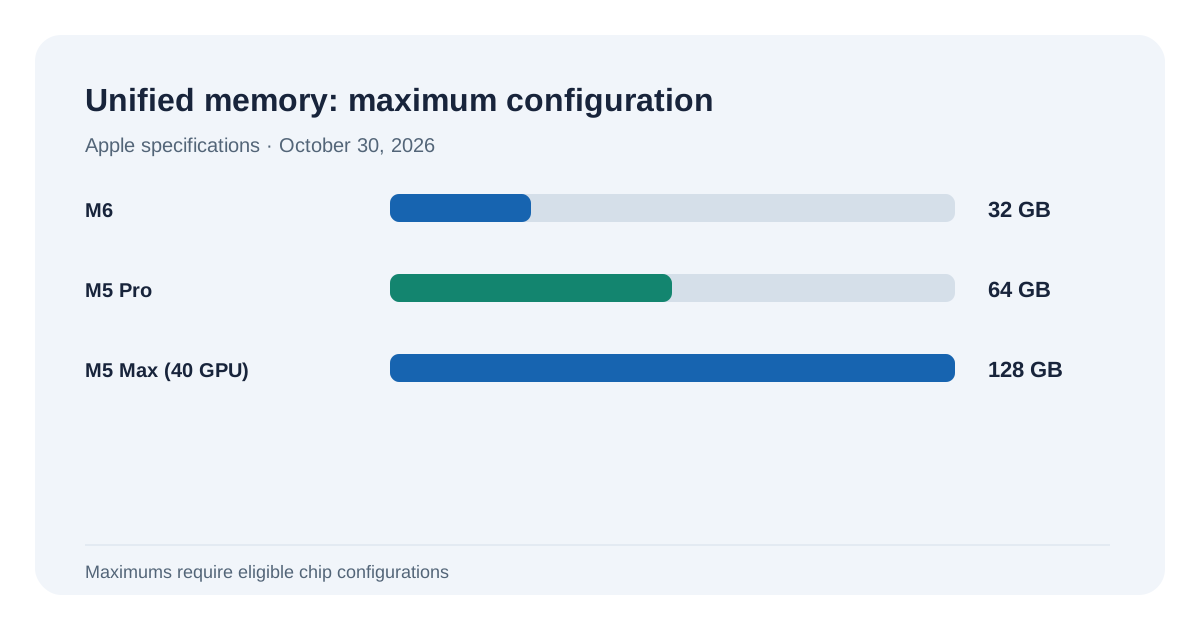
- M6 32 GB, M5 Pro 64 GB, M5 Max 128 GB
- US OLED premium
- 14-inch M5 Pro from $900 over the M6 base model
- No own test
- No measured benchmarks, only vendor and hands-on data
Last reviewed: October 30, 2026
Fact-checked October 30, 2026. Apple’s October MacBook launches are easy to misunderstand. On October 27, 2026, Apple introduced a base 14-inch MacBook Pro with M6. The next day, it unveiled a separate, premium MacBook Pro with PROLED XDR Display, pairing a touchscreen tandem-OLED panel with the existing M5 Pro or M5 Max chips. Both lines are scheduled for November 6, 2026 availability. These are confirmed announcements—not product reviews. Sources: M6 announcement, PROLED announcement. Fact-checked October 30, 2026.
For local AI development, the meaningful split is in memory capacity and bandwidth, not simply whether the chip name ends in 6. The base M6 machine tops out at 32GB unified memory. The M5 Pro supports up to 64GB and selected M5 Max configurations reach 128GB. The OLED panel does not, by itself, increase the number of model parameters you can keep in memory.
US starting prices and the three product paths
| MacBook Pro configuration | Panel | Unified-memory ceiling | US starting price | US education starting price |
|---|---|---|---|---|
| 14-inch M6 | Mini-LED Liquid Retina XDR, non-touch | 32GB | $1,999 | $1,899 |
| 14-inch PROLED, M5 Pro | Tandem OLED + touch | 64GB | $2,899 | $2,749 |
| 16-inch PROLED, M5 Pro | Tandem OLED + touch | 64GB | $3,399 | $3,199 |
| 14-inch PROLED, M5 Max | Tandem OLED + touch | 128GB | $4,499 | $4,199 |
| 16-inch PROLED, M5 Max | Tandem OLED + touch | 128GB | $4,799 | $4,499 |
US starting prices are taken from Apple’s October 28 news release. Tax treatment depends on location; these are not final checkout totals. Education eligibility applies. The M6 price is separately documented in Apple’s October 27 US release. The RAM ceiling requires eligible chip bins.
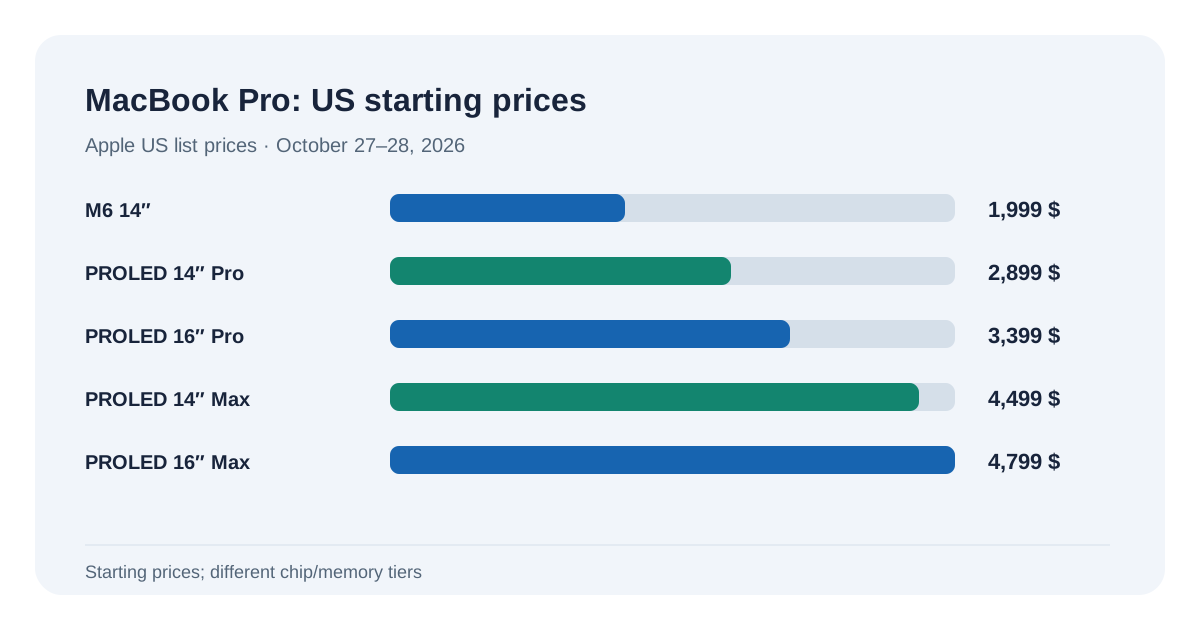
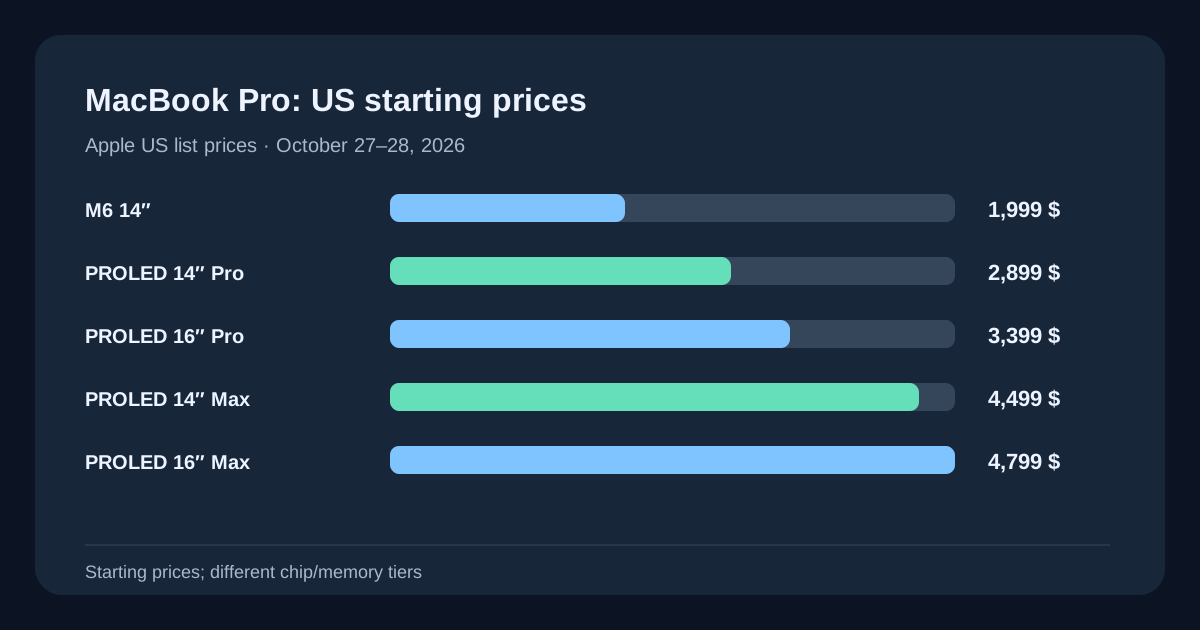
A third path matters: the March 2026 mini-LED M5 Pro and M5 Max MacBook Pros remain in the lineup. They use the same chip families as the premium OLED machines, making the screen and design premium a more important comparison than a simplistic “new versus old processor” story. Apple’s March announcement; MacRumors side-by-side buyer’s guide.
OLED is the real hardware change
The PROLED XDR MacBook Pro has a touch-enabled tandem-OLED panel, a Dynamic Island, thinner bezels and a lighter chassis. Apple specifies 14.2-inch and 16.3-inch panel sizes, up to 2,000 nits peak brightness under stated HDR and outdoor SDR conditions, up to 1,000 nits sustained full-screen brightness, 10–120Hz adaptive refresh, and P3 plus Adobe RGB color coverage. Apple detailed specifications.
The first independent show-floor impressions are favorable toward the display, but they are not full reviews. Ars Technica emphasized the visibly reduced weight and striking OLED picture; The Verge examined the practical trade-offs of touch interaction, including small legacy controls and screen movement when tapped. Neither proves long-term burn-in behavior or sustained local-inference performance. Apple says it uses display management and thermal design to reduce OLED-aging issues, but independent long-duration data are not yet established. Reuters report.
Touch may matter for color grading, direct manipulation, music software and creative apps. For programming, running an LLM server or remote development, it is not an obvious productivity upgrade. Treat it as an optional interaction feature, not a performance specification.
Which chip matters for on-device AI?
| Configuration | Maximum unified memory | Published memory bandwidth | Practical distinction |
|---|---|---|---|
| M6 base | 32GB | up to 170GB/s | smaller local checkpoints and cloud-first workflows |
| M5 Pro | 64GB | 307GB/s | headroom for mid-sized quantized models and development tools |
| M5 Max, 32 GPU cores | 36GB for this listed tier | 460GB/s | faster memory interface, but limited RAM on this exact tier |
| M5 Max, 40 GPU cores | 128GB | 614GB/s | strongest capacity for very large on-device checkpoints |
Sources: Apple M6 release; Apple M5 Pro/Max specs. Bandwidth and RAM are vendor specifications, not tokens-per-second benchmarks. The 128GB option is not available with every M5 Max bin.
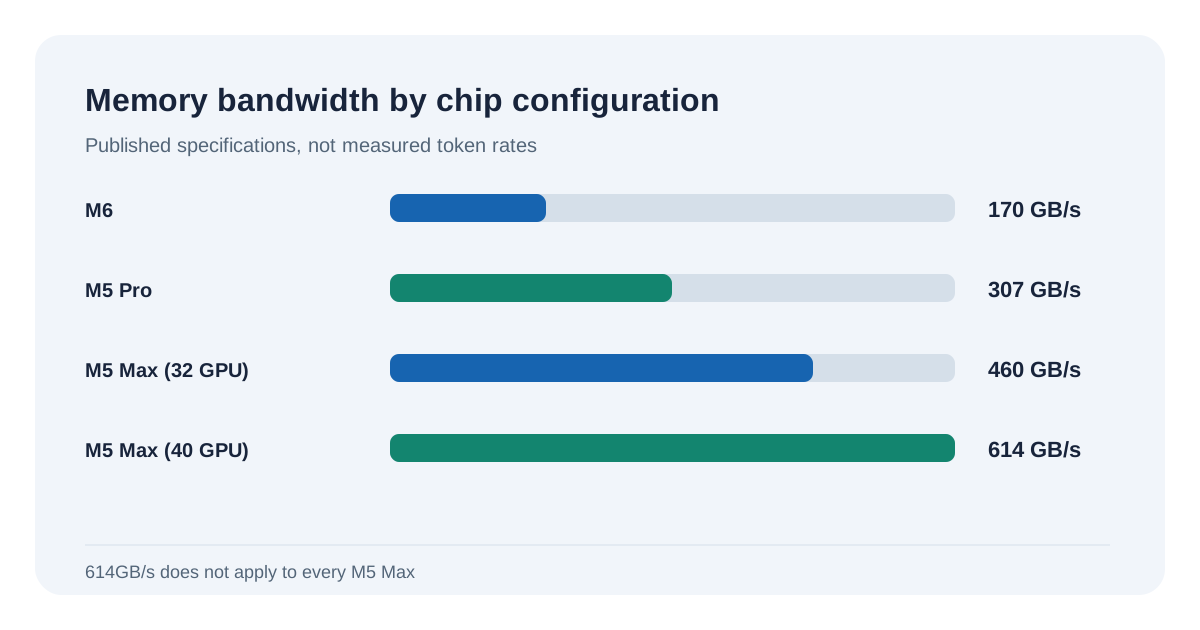
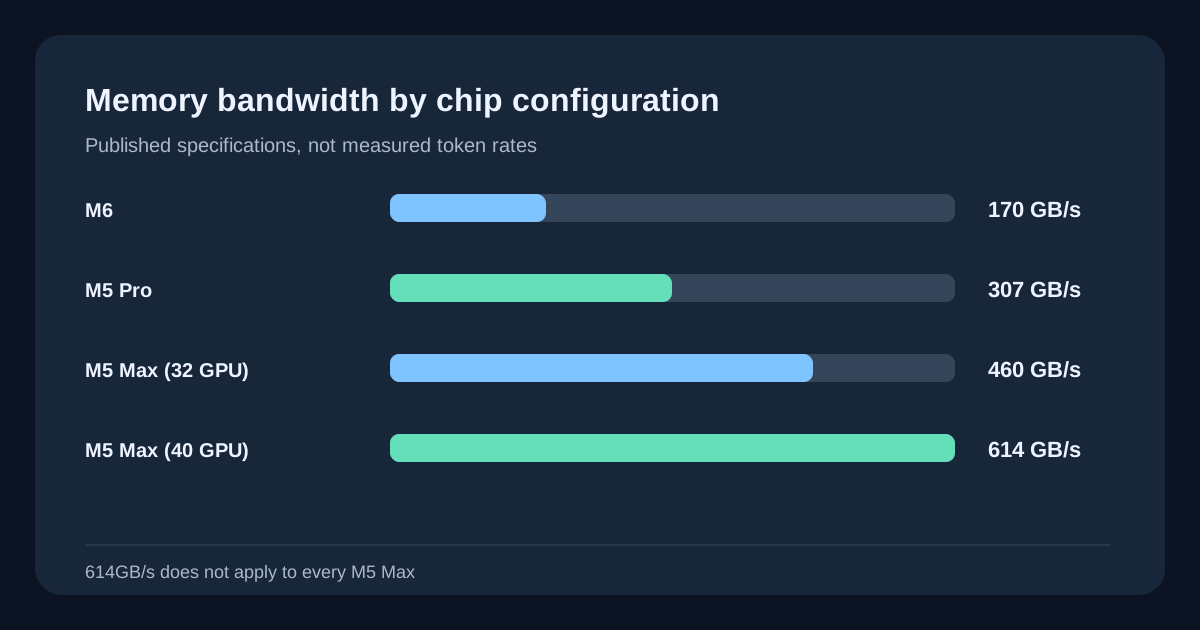
Apple says M6 delivers up to 25% faster performance in selected AI workloads than base M5, along with up to 30% faster graphics. These are Apple-reported comparisons to M5, not evidence that an M6 beats M5 Pro or Max on the same large language model. No independent, normalized M6-versus-M5-Max LLM benchmark is included in this analysis. Apple M6 launch.
Model size: why memory wins over marketing
A 4-bit dense model has a mathematical weight-only lower bound of roughly 0.5 decimal GB per billion parameters. For example, 8B is 4GB, 32B is 16GB, 70B is 35GB and 120B is 60GB of theoretical raw weights. These are our calculations, not actual quantized file sizes and not runtime-memory guarantees. Real deployments also require quantization metadata, KV cache, temporary buffers, macOS and concurrent IDE or browser use.
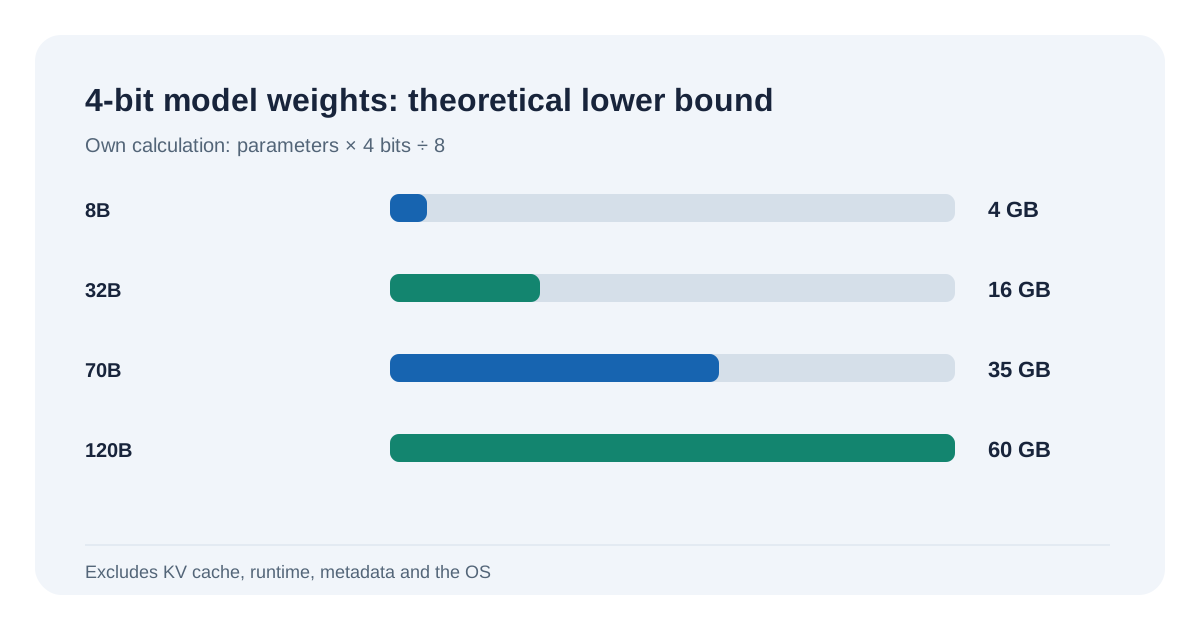
This changes the buying order. A 32GB MacBook may be entirely reasonable for a quantized small model plus coding tools, but a 70B-class model is not a sensible default target. A 48–64GB M5 Pro creates substantially more options, while 128GB with M5 Max is the more practical route for genuinely large models. Whether a particular checkpoint runs, and at what speed, still depends on its architecture, quantization, context length and runtime. Try the site’s memory estimator rather than assuming a parameter label guarantees compatibility.
Apple’s unified-memory architecture lets its CPU and GPU work with a shared memory pool, as described by the MLX documentation. The tooling landscape includes MLX-LM, llama.cpp with Metal, Ollama on macOS, and LM Studio. Current runtime versions need to be tested before making M6-specific acceleration claims.
Should you pay for PROLED?
If your job is color-critical media production and you can use touch interactions, the premium OLED computer has clear new capabilities. If your primary objective is local AI inference, compare like-for-like M5 Pro or M5 Max chip bins and unified-memory configurations against the mini-LED models first. The cost of an OLED screen does not automatically buy more inference throughput. Apple introduced the mini-LED M5 Pro in March and OLED M5 Pro in October; MacRumors reports a $400 starting-price increase across like-sized base-tier comparisons in the US. Final configured prices can differ.
For API-heavy coding, editing and university work, a lighter or less expensive MacBook can make more sense than buying an OLED Pro. For MLX research, retrieval-augmented generation, parallel local agents or large quantized checkpoints, pay for enough RAM and verify the exact processor bin before evaluating display extras. Our existing MacBook local AI buyer’s guide goes deeper into the memory decision.
What we cannot verify yet
At the October 30 research cutoff, these Macs have not been tested by this publication. We do not claim measured decoding tokens/second, prompt-prefill rates, battery life under inference load, thermal throttling, or OLED longevity. The November 6 retail launch should enable longer independent reviews and apples-to-apples MLX/Ollama comparisons. Apple’s advertised “up to 24 hours” battery figure is not an all-day large-LLM-inference guarantee.
Next update planned after November 6: verify shipping configurations and retailer/Apple checkout totals; add independent benchmarks using identical model checkpoints, quantizations, runtime versions and context sizes; update the decision matrix. We will label original tests only when measurement hardware and methods are available.
Methodology: Primary Apple specifications and launch releases plus independent first looks and open-source runtime documentation. The simple weight calculations are editorial estimates. No devices were physically reviewed here, and no affiliate links are included in this draft.
Frequently Asked Questions
Does the OLED MacBook Pro have an M6 chip?
No. The PROLED models use M5 Pro or M5 Max. The M6 is only in the 14-inch base model, which has no OLED display.
What is the maximum unified memory?
M6 up to 32 GB, M5 Pro up to 64 GB and M5 Max up to 128 GB – each only with an eligible chip configuration.
Is this article a review?
No. It is a specification- and source-based buying analysis without measured benchmarks. Retail availability starts November 6, 2026.